
by Michael Hollister
Published at apolut media on April 06, 2026
3.328 words * 18 minutes readingtime
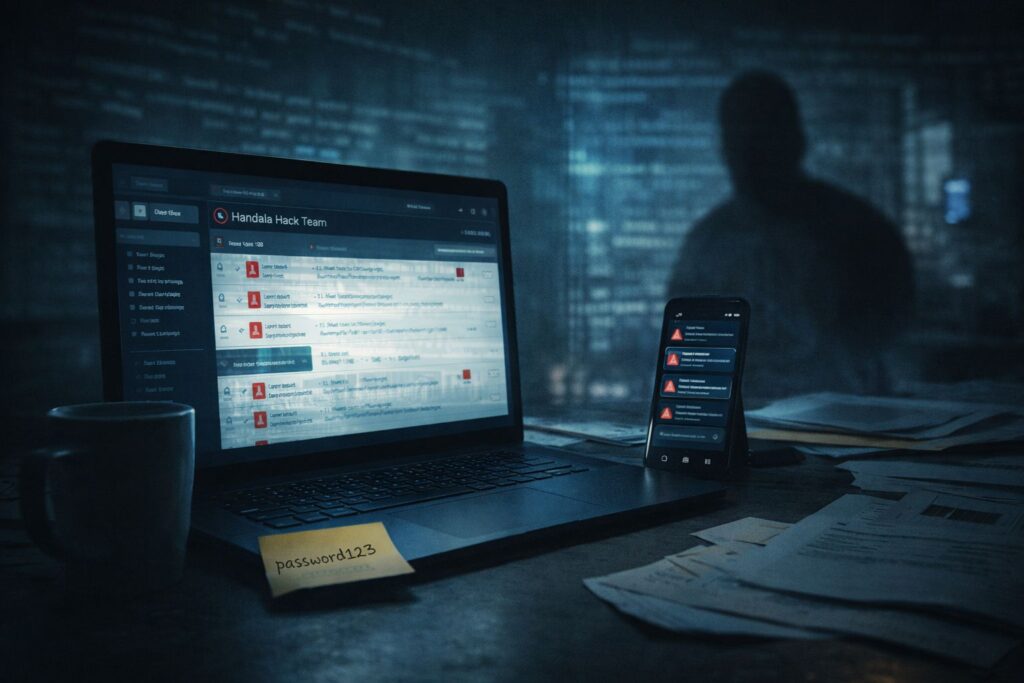


Iran’s Cyber War Hits Stryker, Lockheed Martin, and the FBI Director Personally
On March 27, 2026, an Iranian hacker group published photographs of the Director of the Federal Bureau of Investigation of the United States. Kash Patel, head of the world’s most powerful law enforcement agency, responsible for the internal security of a superpower – photographed with a cigar, next to a classic car with Cuban license plates, taking a selfie with a large bottle of rum. Along with that: 300 emails from his personal Gmail account. Travel records, tax documents, family correspondence, apartment leases spanning a decade.
The FBI confirmed the hack without equivocation. “The affected information is historical in nature and does not contain government information,” the agency stated. Technically accurate. Analytically devastating.
This is not the story of a sophisticated state-level hack that would have been nearly impossible to prevent even with a superpower’s resources. It is the story of systematic digital failure at the highest level – and what that says about the actual state of American cybersecurity. Because the Stryker attack, the Lockheed Martin leak, and the FBI director’s Gmail hack all follow the same logic: an Iranian intelligence operation that succeeded not because of its technical superiority, but because of the alarming negligence of its targets.
The camel – to stay with the cliché – hacks back. And it is finding open doors.
March 11, 2026, 4 a.m. GMT: Stryker Is Asleep
It begins in the early hours of March 11, 2026, just after 4 a.m. GMT. In the data centers of Stryker Corporation – Michigan, Portage, headquarters of one of the world’s largest medical device manufacturers – thousands of devices begin behaving as though they had never been used. Laptops. Phones. Servers. Workstations. All simultaneously. All reset to factory settings.
Stryker serves 150 million patients worldwide. 56,000 employees, offices in 79 countries, products that literally save lives: defibrillators, surgical instruments, orthopedic implants, emergency equipment. The company also supplies the US military. And on this night, none of its employees can boot their computers.
What happened technically can be reconstructed. The attackers had by this point already had access to the network for months – not through a spectacular zero-day exploit, but through stolen administrator credentials. What they then deployed was not a secret state tool. It was Microsoft Intune – a legitimate, commercially available IT management system that companies use to manage their device fleets. Whoever controls the Intune console controls every endpoint in the network. Whoever controls every endpoint can wipe every endpoint.
And that is what they did. Remotely, in a coordinated fashion, thoroughly. (CNN, “Pro-Iran hackers claim cyberattack on major US medical device maker,” Sean Lyngaas, March 11, 2026, https://www.cnn.com/2026/03/11/politics/pro-iran-hackers-cyberattack-medical-device-maker)
Stryker’s Lifenet system went down – the electronic EKG transmission system that first responders use to relay cardiac patient data to emergency rooms in advance. Maryland’s Institute for Emergency Medical Services immediately sent alerts to all hospitals in the state: Lifenet was “not functional in most parts of the state.” Paramedics were to switch to radio communication. Procedures were postponed. The company reported the attack to the SEC as a material incident – operational disruptions in order processing, production, and logistics. (HIPAA Journal, Iran-Linked Hacking Group Wipes Data of US Medical Device Manufacturer, updates March 15 and 26, 2026, https://www.hipaajournal.com/stryker-cyberattack-iran/)
The hacker group claiming responsibility appeared shortly afterward on Telegram and X. “Our great cyber operation was executed with complete success,” read the statement from the Handala Hack Team. They claimed: more than 200,000 systems wiped, 50 terabytes of critical data exfiltrated, Stryker paralyzed across 79 countries. As justification, they cited a US missile strike on an elementary school in Minab, Iran – which according to Iranian state media killed at least 168 children. The Pentagon stated it was investigating the incident.
Stryker reported having largely restored operations by March 26. No ransomware, no malware in the classical sense – but that is the wrong question. Wiper attacks do not need ransomware. Their goal is not money. Their goal is destruction.
Handala: Not a Teenager in a Basement
Who or what is Handala?
The name derives from Handala, the cartoon child created by Palestinian artist Naji al-Ali – a symbol of Palestinian identity and resistance since 1969, recognizable by its back turned toward the viewer. The group first appeared in December 2023, weeks after the Hamas attack on Israel of October 7. It initially presented itself as a Hamas supporter, then as a broader pro-Palestinian movement. On Telegram and X it spread propaganda, threats, and stolen data.
That is the image it projects publicly. The image that the US Department of Justice has established in court looks different.
According to the assessment of Western authorities and cybersecurity firms, Handala is a front for Iran’s Ministry of Intelligence and Security – the MOIS, the intelligence ministry of the Islamic Republic. The FBI describes Handala as a “fictitious identity” used by the MOIS to conceal its own role in “influence operations and psychological disinformation campaigns.” Check Point Research tracks the same group under the name “Void Manticore” – and documents close connections to additional Iranian cyber personas: Homeland Justice, Karma Below, Banished Kitten, also known as Storm-0842 and Dune. (Check Point Research, “Handala Hack – Unveiling Group’s Modus Operandi,” https://research.checkpoint.com/2026/handala-hack-unveiling-groups-modus-operandi/) (US Department of Justice, “Justice Department Disrupts Iranian Cyber-Enabled Psychological Operations,” https://www.justice.gov/opa/pr/justice-department-disrupts-iranian-cyber-enabled-psychological-operations)
The pattern is the same one Russia established with groups like Fancy Bear or Sandworm: state objectives, private group identity, plausible deniability. Iran has adopted and refined this model.
Technically, Handala is not a high-performance actor. Check Point writes in its current analysis that the group relies “primarily on manual, hands-on operations, commodity wipers, and publicly available deletion and encryption tools.” No zero-days, no national-level exploits. But: patience. Pre-positioning. Months of access to networks before the actual attack is triggered. “Initial access is believed to have been established well before the destructive phase,” Check Point writes about the Stryker attack.
That is not a technical weakness. It is a strategic strength. Those who get in early and wait can choose the optimal moment.
Handala had already tested this tactic extensively before the Stryker attack – initially against Israeli targets: wiper attacks against at least 60 Israeli companies, stolen data from Israeli healthcare provider Clalit Health Services containing 10,000 patient records, threats against Israeli intelligence officers including publication of their home addresses on a platform offering bounties for their “liquidation.” In cooperation with the Mexican Jalisco New Generation Cartel (CJNG), as documented in the FBI affidavit in the DOJ court filing of March 19, 2026.
Since the start of Operation Epic Fury on February 28, 2026, the target spectrum has expanded to American targets. Stryker was the first major strike. And then came Kash Patel.
On March 26, 2026 – one week after the Stryker attack and hours after the DOJ domain seizures – the next blow followed: Handala published personal data of 28 Lockheed Martin engineers working in Israel on defense projects – including passports, ID numbers, home addresses, and deployment locations. According to the group, those targeted were involved in the maintenance of F-35 and F-22 fighter jets and the THAAD missile defense system. Cybersecurity researchers at Cybernews assessed the documents as authentic; the names on the passport pages matched LinkedIn profiles of active employees. Handala also claimed to have made telephone contact with several of the engineers – with information about their children, weekend habits, and the home locations of their families in the United States. The company stated it was aware of the reports and trusted the integrity of its security systems. Lockheed Martin did not officially confirm the authenticity of the leaked data. The timing is no coincidence: the publication came at precisely the moment the DOJ seizure was making international headlines – a deliberate signal that the infrastructure can be taken away, but the operational capability cannot. (Cybernews, “Handala group doxxes Lockheed Martin staff in Israel,” March 27, 2026, https://cybernews.com/security/lockheed-martin-israel-breach-handala/)
Gmail, Rum, and Gross Negligence
I spent fourteen years working in IT security. As an ISO 27001/3 and BSI Grundschutz auditor, as an IT security consultant, as someone who explained to corporate leadership why digital negligence can become personally expensive. There is one sentence I said repeatedly during those years: “Security does not have to be expensive. But it requires attention. And attention costs time.”
The Kash Patel case is a textbook example of exactly what I argued against back then – multiplied by the factor FBI Director.

On March 27, 2026 – five days after the Stryker attack – Handala published the hack of Patel’s personal Gmail account. 300 emails, personal photographs, a decade’s worth of travel records. The photos show Patel in private moments: smoking, next to classic cars with Cuban license plates, taking a mirror selfie with a large bottle of rum. Emails from 2010 to 2022 – tax forms, apartment leases, family correspondence, travel bookings, a 2014 email in which he forwarded from his DOJ address to his then-FBI account and his personal Gmail. (CNN, “Iran-linked hackers have breached FBI Director Kash Patel’s personal emails,” March 27, 2026, https://www.cnn.com/2026/03/27/politics/iran-linked-hackers-fbi-director-patel) (NBC News, “Iranian hackers publish emails allegedly stolen from Kash Patel,” March 27, 2026, https://www.nbcnews.com/tech/security/iranian-hackers-publish-emails-allegedly-stolen-kash-patel-rcna265490)
Reuters, CNN, and NBC independently confirmed the authenticity of the documents. The FBI confirmed the attack. “The information is historical in nature and does not contain government information,” the agency stated.
But here lies the actual problem – and it is not one that can be defined away by pointing to “historical information.”
At the end of 2024, weeks before Patel was confirmed as FBI Director, he was officially informed: Iranian hackers had compromised his personal account. It was part of a broader campaign against Trump transition officials – alongside Patel, later Deputy Attorney General Todd Blanche and Donald Trump Jr. were also affected. The information came from the FBI itself. Patel knew. He was warned.
He changed nothing.
What does that mean technically? According to experts, Handala used no sophisticated tools for the Patel hack. Alex Orleans, Head of Threat Intelligence at Sublime Security, describes it precisely to NBC News: “Looks like something they had sitting around.” The group likely accessed usernames and passwords from old, unrelated data breaches – publicly available in dark web databases. This is not a top-tier intelligence operation. This is password recycling. This is exploiting credentials someone has not rotated in years.
Cynthia Kaiser, until May 2025 Deputy Director of the FBI Cyber Division and now Senior VP at Halcyon, puts it plainly: “You’ve seen Handala do this a lot – it’s a mixture of lies and real attacks, making it hard to parse out what’s exactly happening.” And further: “But if the ultimate aim is showing you can retaliate – either for an internal Iranian audience or for those whose activity you’re trying to dissuade – going public is important.”
That is the core. This attack was not a covert operation. It was communication. A message to the American public, to the Iranian public, to every country watching: the Director of the FBI uses Gmail. His password came from an old data breach. We had it for months. We waited until it would hurt most.
As an IT security auditor, I know: gross negligence is not a question of budget. It is not about whether you can afford expensive security solutions. It is about basic principles that require no investment: strong, unique passwords; two-factor authentication; no official correspondence through personal accounts; rotating credentials immediately after a known compromise.
Kash Patel, the man responsible for the cybersecurity of the world’s most powerful nation, followed none of these basic principles. After being explicitly warned. That is not bad luck. That is negligence. And in any German GmbH, it would trigger the personal liability of the managing director.
The Response and Its Structural Limits
The US Department of Justice responded decisively. Four Handala domains were seized – handala-hack.to, handala-redwanted.to, and two further MOIS front domains. A $10 million reward for information on the operators. FBI Director Patel personally: “We’ve taken down four of their operational pillars and we’re not done.” (The National, “Iran-linked Handala hacker group responds with defiance after US seizure of websites,” March 20, 2026, https://www.thenationalnews.com/future/technology/2026/03/20/iran-hackers-handala-fbi-doj-seizure/)
Handala rebuilt the infrastructure within hours.
That is not a failure of American law enforcement – it is a structural problem. Domains can be registered in minutes. Bulletproof hosting services in countries without extradition agreements are cheap and efficient. The US Treasury has sanctioned some of these services, but not quickly enough, not comprehensively enough. Iran has been running this model for years – and it works.
Handala responded to the domain seizure with a statement on Telegram: “The seizure of our domains, propaganda bombardments, death threats, and even the looming shadow of airstrikes are nothing more than the latest desperate attempts to silence the voice of Handala.” And: “History has shown that neither bullets nor bombs nor assassinations have ever stopped the will of the peoples.”
Hours later: the hack of Kash Patel’s Gmail.
That also explains the timing. Handala had the Patel emails for months. They could have published them earlier. They waited for the right moment – the moment of maximum psychological impact. The moment after the FBI seizure had made international headlines. Then they responded not with another infrastructure attack, but with a photograph of the FBI director holding a bottle of rum. That is information operations design.
Palo Alto Networks Unit 42 reports in its current situation assessment on 60 active pro-Iranian hacker groups since the start of Operation Epic Fury – among them Handala, DieNet, Cotton Sandstorm, and dozens of others. A coordinated digital ecosystem that has documented attacks on airports in Bahrain and Saudi Arabia, banks in Jordan, defense contractors and healthcare providers worldwide. (Palo Alto Networks Unit 42, “Threat Brief – March 2026 Escalation of Cyber Risk Related to Iran,” updated March 26, 2026, https://unit42.paloaltonetworks.com/iranian-cyberattacks-2026/)
The pattern is clear: Iran uses cyber not as a substitute for kinetic warfare, but as a parallel instrument. Cheaper, harder to attribute, internationally less escalatory – but real in its consequences. “Cyber will keep going because it’s under the radar in many cases,” says David Carmiel, CEO of Israeli cybersecurity firm Kela. “The target universe for Iranian groups just became bigger.”
What the Camel Teaches Us
Let me return to the cliché. The image of the Iranian hacker on a camel somewhere in a Bedouin tent – it is absurd. But it is not only a cliché about Iran. It is a cliché about the West.
We systematically underestimate what we cannot see. Explosions we see. Images of destroyed buildings we see. The moment when 200,000 Stryker devices are reset to factory settings, we do not see – until the EKG transmission in Maryland goes down and hospitals have to switch to radio communication.
After Stuxnet – the US-Israeli sabotage attack on Iran’s uranium centrifuges in 2010 – Iran made a fundamental strategic decision: if the enemy deploys cyber warfare as a weapon, we develop cyber weapons. Since then, the country has systematically invested. Not in high-performance exploits for every situation, but in endurance, positioning, and psychological effect. Shamoon 2012 – 35,000 Saudi Aramco computers wiped, the world’s largest oil company paralyzed for weeks. Sands Casino 2014 – wiped because the owner Sheldon Adelson made a statement about Iran that displeased the regime. These are not isolated incidents. This is doctrine.
And the doctrine works – not because Iranian hackers are technically unbeatable, but because their targets are alarmingly unprepared. Stryker failed to notice Handala in its network for months. The FBI Director, after a confirmed compromise, did not change his password. Lockheed Martin employees in the Middle East had personal data in accessible systems.
These are not unavoidable catastrophes. These are fundamental failures.
For many years I told companies that cybersecurity is not a budget problem but a leadership problem. When the boss says “security is important” and then uses his Gmail address for sensitive correspondence, every employee knows what that actually means. When the FBI Director – the man responsible for the cybersecurity of the nation – draws no consequences after a confirmed Iranian compromise, that is not a personal failure. It is a cultural signal. And it sends that signal inward and outward.
Handala understood this. That is why they did not publish the 50 terabytes of Stryker data first – which almost nobody would read anyway. They published the photo of the FBI Director with the rum bottle. Because everyone understands that.
Conclusion: The Open Door
The ODNI Annual Threat Assessment 2026 explicitly classifies Handala as an instrument of Iranian intelligence operations – an indicator of the weight US intelligence services assign to this attack. Not a nuclear missile. Not a drone strike. A stolen administrator password, a legitimate IT management tool, and months of patience. (Annual Threat Assessment of the US Intelligence Community 2026, ODNI, March 18, 2026, pp. 16–17, https://www.dni.gov/files/ODNI/documents/assessments/ATA-2026-Unclassified-Report.pdf)
The hack of the FBI Director – not a sophisticated state-level hack. An old, compromised Gmail password that had been available in dark web databases for years. Known. Reported. Ignored.
The camel hacks back. Not because the camel is so dangerous. But because the door was left open.
And as long as those in leadership positions – whether in corporations or in government – treat cybersecurity as a technical problem for others to solve rather than a leadership responsibility that begins with them, more doors will stand open. The next hacker group only needs to walk through.
Part 2 of this series appears shortly: Iran’s Cyber Doctrine – From Stuxnet to Handala, how a middle power became a serious cyber threat.
Michael Hollister
is a geopolitical analyst and investigative journalist. He served six years in the German military, including peacekeeping deployments in the Balkans (SFOR, KFOR), followed by 14 years in IT security management. His analysis draws on primary sources to examine European militarization, Western intervention policy, and shifting power dynamics across Asia. A particular focus of his work lies in Southeast Asia, where he investigates strategic dependencies, spheres of influence, and security architectures. Hollister combines operational insider perspective with uncompromising systemic critique—beyond opinion journalism. His work appears on his bilingual website (German/English) www.michael-hollister.com, at Substack and in investigative outlets across the German-speaking world and the Anglosphere.
Sources
- CNN: “Pro-Iran hackers claim cyberattack on major US medical device maker,” Sean Lyngaas, March 11, 2026 https://www.cnn.com/2026/03/11/politics/pro-iran-hackers-cyberattack-medical-device-maker
- NBC News: “Iran appears to have conducted a significant cyberattack against a U.S. company,” Kevin Collier, March 11, 2026 https://www.nbcnews.com/world/iran/iran-appears-conducted-significant-cyberattack-us-company-first-war-st-rcna263084
- US Department of Justice: “Justice Department Disrupts Iranian Cyber-Enabled Psychological Operations” – primary source: DOJ press release with court documents https://www.justice.gov/opa/pr/justice-department-disrupts-iranian-cyber-enabled-psychological-operations
- Check Point Research: “Handala Hack – Unveiling Group’s Modus Operandi” – technical deep-dive analysis, TTP documentation https://research.checkpoint.com/2026/handala-hack-unveiling-groups-modus-operandi/
- Palo Alto Networks Unit 42: “Threat Brief – March 2026 Escalation of Cyber Risk Related to Iran” – situation assessment with 60 active pro-Iranian groups, updated March 26, 2026 https://unit42.paloaltonetworks.com/iranian-cyberattacks-2026/
- CNN: “Iran-linked hackers have breached FBI Director Kash Patel’s personal emails,” March 27, 2026 – confirmed by CNN and independent cybersecurity experts https://www.cnn.com/2026/03/27/politics/iran-linked-hackers-fbi-director-patel
- Al Jazeera: “FBI director Kash Patel’s emails, photos hacked by Iran-linked group,” March 27, 2026 https://www.aljazeera.com/news/2026/3/27/fbi-director-kash-patels-emails-photos-hacked-by-iran-linked-group
- PBS NewsHour: “Pro-Iranian group claims credit for hacking into FBI Director Patel’s personal account,” March 27, 2026 – with official FBI statement https://www.pbs.org/newshour/nation/pro-iranian-group-claims-credit-for-hacking-into-fbi-director-patels-personal-account
- NBC News: “Iranian hackers publish emails allegedly stolen from Kash Patel,” March 27, 2026 – with expert assessment from Alex Orleans (Sublime Security) https://www.nbcnews.com/tech/security/iranian-hackers-publish-emails-allegedly-stolen-kash-patel-rcna265490
- The National: “Iran-linked Handala hacker group responds with defiance after US seizure of websites,” March 20, 2026 – DOJ confirmation, Patel reaction, Handala statement https://www.thenationalnews.com/future/technology/2026/03/20/iran-hackers-handala-fbi-doj-seizure/
- HIPAA Journal: “Iran-Linked Hacking Group Wipes Data of U.S. Medical Device Manufacturer” – Stryker updates March 15 and 26, 2026 – coordination with FBI, CISA, DHS, HHS https://www.hipaajournal.com/stryker-cyberattack-iran/
- Annual Threat Assessment of the US Intelligence Community 2026, ODNI, March 18, 2026 – official reference to the Handala attack, pp. 16–17 https://www.dni.gov/files/ODNI/documents/assessments/ATA-2026-Unclassified-Report.pdf
- Cybernews: “Handala group doxxes Lockheed Martin staff in Israel,” March 27, 2026 https://cybernews.com/security/lockheed-martin-israel-breach-handala/
- Cybersecurity Dive: “Iran actors’ claims raise questions about larger cyber threat to US, allies,” April 1, 2026 https://www.cybersecuritydive.com/news/iran-actors-claims-cyber-threat-us-allies/816228/
© Michael Hollister – All rights reserved. Redistribution, publication or reuse of this text requires express written permission from the author. For licensing inquiries, please contact the author via www.michael-hollister.com.
Newsletter
🇩🇪 Deutsch: Verstehen Sie geopolitische Zusammenhänge durch Primärquellen, historische Parallelen und dokumentierte Machtstrukturen. Monatlich, zweisprachig (DE/EN).
🇬🇧 English: Understand geopolitical contexts through primary sources, historical patterns, and documented power structures. Monthly, bilingual (DE/EN).