
by Michael Hollister
Exclusive published at Michael Hollister on March 29, 2026
2.462 words * 16 minutes readingtime
This analysis is made available for free – but high-quality research takes time, money, energy, and focus. If you’d like to support this work, you can do so here:

Alternatively, support my work with a Substack subscription – from as little as 5 USD/month or 40 USD/year!
Let’s build a counter-public together.
When the United States deploys 8,000 to 10,000 soldiers toward the Persian Gulf – Marines, paratroopers, amphibious assault ships – that is not a show of force.
Shows of force don’t cost money. This deployment costs hundreds of millions of dollars. You don’t send paratroopers and Marine Expeditionary Units into a war zone to guard embassies. You send them because you have something specific in mind.
That something has a name: Kharg Island.
The Island That Is Everything
Look up Kharg Island on a world map. You will barely find it. Five miles long, two and a half miles wide. A coral outcrop in the northern Persian Gulf, 15 miles off the Iranian coast. No city name anyone recognizes. No tourist destination. No strategic significance apparent to the eye.
And yet: 90 percent of all Iranian oil exports move through this island. 1.5 million barrels per day, almost exclusively to China. Loading capacity: up to 7 million barrels per day, ten supertankers simultaneously. Underwater pipelines from some of the country’s largest oil fields converge here. Kharg is not just any port. Kharg is the heartbeat of the Iranian economy.
Washington has known this for decades. Trump put it plainly in a 1988 interview with the Guardian: “One bullet shot at one of our men or ships, and I’d do a number on Kharg Island. I’d go in and take it.” He is now president. And the USS Tripoli, the USS Boxer as a second amphibious assault ship, and the 82nd Airborne are en route.
U.S. Central Command already conducted a preparatory strike on the island on March 13: over 90 targets hit – air defense systems, naval base, airport control tower, helicopter hangars, mine depots. The oil infrastructure was deliberately left untouched. Trump publicly attributed this to “decency.” The military logic is different: you don’t destroy what you intend to take.
Miad Maleki, former sanctions official at the U.S. Treasury and Senior Advisor at the Foundation for Defense of Democracies, told Time Magazine: a U.S. presence on Kharg would simultaneously guarantee freedom of navigation in the northern Persian Gulf, give Trump direct control over Iran’s oil sector – and create the physical precondition for redirecting Iranian oil from Chinese to Western markets.
That is the war aim behind the war aim. Not Iran. China.
How You Take an Island – and Why It Is Not Simple
Anyone who wants to understand what the combination of forces CENTCOM is currently positioning actually means should read an earlier piece: “When the Osprey and Marines Show Up, It’s Not About Bridges” – an analysis of the specific operational capabilities of the Marine Expeditionary Unit and the MV-22 Osprey, published March 22. The key takeaway: when the Osprey appears, the question is not whether. The question is when.
The operational logic for Kharg follows a clear sequence.
First, the preparatory bombardment. Before a single soldier lands, the shoreline must be neutralized. Iran has been reinforcing since March 13: additional MANPAD systems – shoulder-fired anti-aircraft missiles – positioned on the beaches, anti-personnel and anti-tank mines along the coastline, prepared fighting positions. CNN confirmed this from U.S. intelligence sources. These positions must be flattened first – with JDAM precision bombs and Tomahawks from safe altitude, before any helicopter or Osprey comes anywhere near.
Only then come the A-10 Warthog and Apache – both officially on station since March 19, confirmed by General Caine at the Pentagon briefing. But not before. The A-10 is ideal for low-altitude coastal operations. It is also the preferred target of a MANPAD operator waiting deep in cover. The sequence is not a tactic of caution. It is a survival requirement.
Second, the simultaneous landing. 82nd Airborne: night jump, low altitude, fast, shock assault. The paratroopers of the 82nd are not trained for security missions – they are the fastest assault force in the U.S. Army, specialized in insertion into hostile terrain without warning. Simultaneously, from the sea: Marine Expeditionary Unit with Ospreys from the amphibious assault ships. The MEU keeps the enemy suppressed so the Airborne doesn’t get shot out of the sky. The amphibious ships secure both flanks.
Third, the consolidation. Once the island is taken, the MANPAD problem is solved – because there are no more MANPAD operators on the island. Only now do the A-10 and Apache fly freely. Kharg has its own freshwater sources – the island can be held without resupply from the mainland. Air resupply is feasible.
That is the plan, as far as it can be reconstructed from available sources and military logic. It is well thought through. And it has one flaw.
The Scenario Nobody Is Saying Out Loud
Kharg has been militarily hardened since the 1980s. During the Iran-Iraq War, the island was repeatedly bombed by Iraqi aircraft – and Iran learned from that. Underground structures, tunnel networks, prepared demolition positions are the consequence of decades of experience in such situations. And Iran has had three weeks since March 13 to reinforce further, as the Jerusalem Post reported on March 26.
Here is the question no Western newspaper is asking: what happens if Iran has decided it would rather blow up Kharg than lose it?
Iran’s calculus would be as follows: if Kharg falls and the U.S. holds it, China permanently loses 20 percent of its Iranian oil supply. Iran loses its most important source of hard currency. The U.S. war aim is achieved. If Kharg is destroyed – by whoever – China still loses its Iranian oil, but the United States has gained nothing. Iran has denied Trump his victory.
Iran’s version: blow the island before it falls. With the American soldiers on it, if necessary.
And Trump’s version? He has no personal loss from destroying Kharg if he realizes he cannot hold it. China loses its oil access – that was always the actual objective. The Gulf states benefit from rising oil prices. Israel is satisfied. Iran is financially finished. The only political cost would be the loss of American soldiers on the island – but that is calculable if the strategic gain is large enough.
That sounds cold. It is cold. It is also the logic behind the buildup.
As for Larak and Abu Musa – the two other key islands for Hormuz control – the scenario is less dramatic. Less strategic for Iran, less tunnel infrastructure, more realistic to take and hold. Abu Musa, Greater Tunb, and Lesser Tunb also offer a diplomatic opportunity Trump cannot refuse: these islands have been claimed by the United Arab Emirates since 1971. Whoever takes them and hands them over buys the most important U.S. ally in the region – while simultaneously controlling three further outposts at the Hormuz chokepoint.
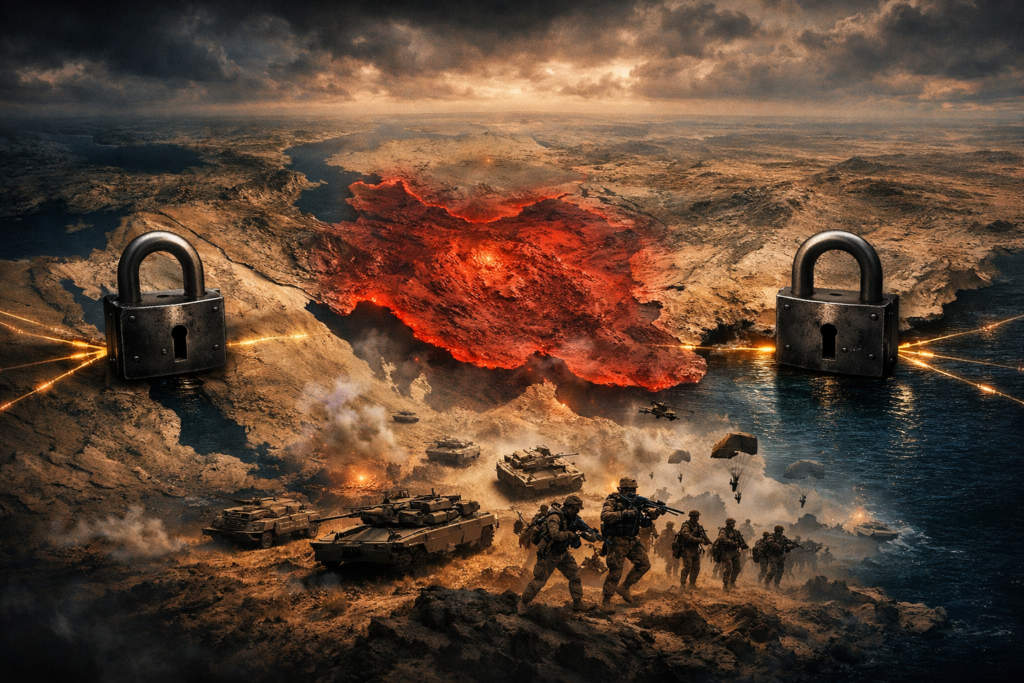
The Double Lock
So far we have been talking about Hormuz. The eastern lock.
There is a second one.
Bab al-Mandab – Arabic for “Gate of Grief” – lies 2,200 miles west of Hormuz. A 16-mile-wide passage between the Arabian Peninsula and the Horn of Africa, between Yemen on one side and Djibouti and Eritrea on the other. Whoever wants to transit Bab al-Mandab wants to transit the Red Sea – and through the Red Sea runs the route to the Suez Canal, the main corridor between Asia and Europe.
An anonymous Iranian source warned via state media: should the United States deploy ground troops in southern Iran, Tehran would open a new front at Bab al-Mandab. That is not an empty formula. It is the description of a mechanism Iran can already activate – through the Houthis in Yemen, who spent two years demonstrating that they can effectively turn the strait into a danger zone without physically closing it. It is enough that no insurer will cover ships.
The numbers: roughly 12 percent of global seaborne oil trade transits Bab al-Mandab. Roughly 30 percent of container traffic between Asia and Europe uses the Red Sea–Suez Canal corridor. A closure or serious threat to this route would force ships around the Cape of Good Hope – 10 to 15 additional days of transit, massively higher costs, at a moment when fuel for the ships themselves is becoming scarce because Hormuz is closed.
As The National put it on March 26, 2026: “Bab al-Mandab and Hormuz are sequential chokepoints on the same energy artery. If both are hit, the route collapses end to end.”
The Federal Reserve Bank of Dallas has calculated the numbers for Hormuz alone: net loss after all pipeline alternatives – 14.5 to 16.5 million barrels per day. That is three to five times larger than the worst oil shocks of the 1970s and 1990s. A CBS energy economist said it plainly: “The global economy cannot grow without 20 percent of its energy supply.”
Bab al-Mandab adds the rest of the route. Europe, which has no direct access to Hormuz oil in any case, loses the only fast sea route from Asia. Japan, South Korea, Taiwan – 90 to 95 percent dependent on Middle Eastern oil – face supply disruptions that no strategic reserve in the world can bridge in the short term.
What follows is what economists call recession. What actually follows is the collapse of a foundational assumption on which the entire global economy of the past 50 years has been built: that the oil flows from the Gulf. Always.
What the United States Knew – and Did Anyway
Here is the point that appears in no official statement.
Alongside the Bab al-Mandab threat, a further Iranian source warned via state media: in the event of a U.S. ground invasion, Iran would occupy coastal areas of the United Arab Emirates and Bahrain and “change the map.”
This statement has not been verified by Western wire services. It is also not without foundation. Iranian state media does not circulate uncontrolled individual opinions on war scenarios.
And if this warning left Iran – which it did – it also reached Washington. Through intelligence channels at the latest, if not earlier.
That means: if the United States invades anyway, it has priced in this warning. The question of what protection Washington can and will guarantee its allies in the UAE and Bahrain in an actual emergency has not been answered by any public statement.
What This Means
The troops are moving. The buildup is real. The decision has not yet been made – but the options are set, the capabilities are in place, and the clock is running.
What follows depends on variables neither Washington nor Tehran fully controls: whether negotiations can build a bridge both sides can cross. Whether Trump has enough domestic political room to sell a withdrawal as victory. Whether Iran assesses the costs of another month of war as higher than the costs of a deal it does not want.
And what the world knows – or does not know – until then makes the difference. Not between war and peace. But perhaps between what can still be explained afterward.
This analysis is made available for free – but high-quality research takes time, money, energy, and focus. If you’d like to support this work, you can do so here:
Alternatively, support my work with a Substack subscription – from as little as 5 USD/month or 40 USD/year!
Let’s build a counter-public together.
Michael Hollister is a geopolitical analyst and investigative journalist. He served six years in the German military, including peacekeeping deployments in the Balkans (SFOR, KFOR), followed by 14 years in IT security management. His analysis draws on primary sources to examine European militarization, Western intervention policy, and shifting power dynamics across Asia. A particular focus of his work lies in Southeast Asia, where he investigates strategic dependencies, spheres of influence, and security architectures. Hollister combines operational insider perspective with uncompromising systemic critique—beyond opinion journalism. His work appears on his bilingual website (German/English) www.michael-hollister.com, at Substack at https://michaelhollister.substack.com and in investigative outlets across the German-speaking world and the Anglosphere.
Sources
- Michael Hollister – When the Osprey and Marines Show Up, It’s Not About Bridges (March 22, 2026): When the Osprey and the Marines Show Up, It’s Not About Bridges
- CNN – Iran building up defenses of Kharg Island (March 25, 2026): https://www.cnn.com/2026/03/25/politics/iran-kharg-island-us-military-ground-troops
- CNN – How risky would a US assault on Kharg Island be (March 26, 2026): https://www.cnn.com/2026/03/26/middleeast/kharg-island-us-assault-risk-trump-intl
- Time Magazine – What to know about Kharg Island (March 14, 2026): https://time.com/article/2026/03/14/kharg-island-trump-oil/
- Al Jazeera – War on Iran: What troops is the US moving to the Gulf? (March 25, 2026): https://www.aljazeera.com/news/2026/3/25/war-on-iran-what-troops-is-the-us-moving-to-the-gulf
- Stars and Stripes – A-10 Warthog back in action in Iran war (March 20, 2026): https://www.stripes.com/branches/air_force/2026-03-20/a-10-warthog-back-in-action-in-iran-war-21129008.html
- Jerusalem Post – Tehran building up Kharg Island for potential US ground invasion (March 26, 2026): https://www.jpost.com/middle-east/iran-news/article-891224
- The National – Bab al-Mandab: How Iran could bend a second strait to its will (March 26, 2026): https://www.thenationalnews.com/news/mena/2026/03/26/bab-al-mandeb-how-iran-could-bend-a-second-strait-to-its-will/
- Federal Reserve Bank Dallas – What the closure of the Strait of Hormuz means for the global economy (March 20, 2026): https://www.dallasfed.org/research/economics/2026/0320
- Wikipedia – 2026 Kharg Island raid: https://en.wikipedia.org/wiki/2026_Kharg_Island_raid
- Jerusalem Post – Iran warns it’s ready to open new front in Yemen, close Bab al-Mandab Strait with Houthis (March 25, 2026): https://www.jpost.com/middle-east/iran-news/article-891193
- Tasnim News Agency – Opening Bab al-Mandab Front Possible in Case of Enemy Provocation (March 25, 2026): https://www.tasnimnews.ir/en/news/2026/03/25/3549108/opening-bab-almandeb-front-possible-in-case-of-enemy-provocation-in-southern-iran-source
- Times of Israel – Iran state media threatens seizure of UAE and Bahrain coastlines (March 25, 2026): https://www.timesofisrael.com/liveblog_entry/iran-state-media-threatens-seizure-of-uae-and-bahrain-coastlines/
- Al Jazeera – Tehran issues warning to regional neighbour if Iranian island occupied (March 26, 2026): https://www.aljazeera.com/news/2026/3/26/tehran-issues-warning-to-regional-neighbour-if-iranian-island-occupied
© Michael Hollister — All rights reserved. Redistribution, publication or reuse of this text requires express written permission from the author. For licensing inquiries, please contact the author via www.michael-hollister.com.
Newsletter
🇩🇪 Deutsch: Verstehen Sie geopolitische Zusammenhänge durch Primärquellen, historische Parallelen und dokumentierte Machtstrukturen. Monatlich, zweisprachig (DE/EN).
🇬🇧 English: Understand geopolitical contexts through primary sources, historical patterns, and documented power structures. Monthly, bilingual (DE/EN).