
by Michael Hollister
with contributions by Patrik Baab, investigative journalist and author
Exclusive published at Michael Hollister on March 22, 2026
5.189 words * 27 minutes readingtime
This analysis is made available for free – but high-quality research takes time, money, energy, and focus. If you’d like to support this work, you can do so here:

Alternatively, support my work with a Substack subscription – from as little as 5 USD/month or 40 USD/year!
Let’s build a counter-public together.
How Populations Are Conditioned for War – and Why the Pattern Is Recognizable
The Attack That Was No Accident
On February 28, 2026, the armed forces of the United States and Israel struck Iran. For most Europeans, it seemed to come out of nowhere. For anyone who had been tracking the developments of the preceding months – the sanctions campaign, the media casualty figures, the rhetoric from Washington – it was the opposite: a sequence that had announced itself like a summer thunderstorm. On February 1, 2026, the author of this piece had laid out the military logic pointing toward a U.S. strike in an analysis titled “Operation Pivot.” On February 27, one day before the strikes, “Calculus of Attack” appeared – a detailed case for why the moment was imminent.
These predictions were not clairvoyance. They were the result of pattern recognition.
No war begins as a surprise. It always begins with preparation – not military preparation, but mental preparation. Before the first bombs fall, populations must be conditioned for those bombs. They must want them, tolerate them, or at least lack the resolve to reject them. This article shows how that conditioning works, what psychological mechanisms are deployed, what the historical pattern looks like – and why it is once again recognizable in Germany and Europe today.
I. The Mechanics of Consent
Carl von Clausewitz, the Prussian military theorist and author of the foundational work On War (1832), described war as a phenomenon driven by three forces: the professional military, political leadership – and the people. His “trinity,” as it has been discussed in military science ever since, makes a decisive point: no war can be sustained over time without the will or at least the acquiescence of the population. Democratically constituted societies intensify this dependency further. Anyone who wants to lead people into war must first lead them into thinking about war.
Over the past several decades, psychology has produced precise instruments to describe how this works. One of the most powerful is the so-called Illusory Truth Effect. First systematically examined by Lynn Hasher, David Goldstein, and Thomas Toppino in 1977, confirmed and expanded in more recent studies by Lisa Fazio and colleagues in 2015: statements that are repeated come to feel truer – regardless of whether they are objectively correct. The mechanism is straightforward. Our brains confuse familiarity with truth. What is heard often feels true. Repetition creates the sensation of confirmation.
Morning newspaper: Russia is attacking. Midday radio: Russia threatens Europe. Evening news: Russia is rearming. None of these claims need to be substantiated anew. They only need to be repeated – and they begin to burn themselves into the consciousness of the audience as things that are simply true.
The principle works not only with obvious disinformation. It works just as well with selectively true statements. Russia genuinely has troops at the Ukrainian border. That is true. Russia genuinely has conducted cyberattacks. That is documented. But when these true facts are repeated daily – without context, without comparison, without framing – while American drone strikes across seven countries, NATO exercises directly on Russian borders, and EU intelligence operations do not exist in coverage, a distorted picture emerges not through lies but through selection. The Illusory Truth Effect does not need false information. It only needs repetition without context.
A second mechanism is linguistic framing. Daniel Kahneman and Amos Tversky demonstrated as early as 1981 in classic experiments that identical facts lead to completely different judgments depending on how they are phrased. “200 people will be saved” versus “400 people will die” – mathematically identical, emotionally worlds apart. Applied to political reporting: “democratically elected government” versus “regime.” “Security forces” versus “henchmen.” “Military operation” versus “invasion.” The facts remain the same. This linguistic work is not incidental. It is systematic. The British linguist and political scientist Norman Fairclough has shown in his analyses of political discourse how language does not merely describe power relations – it produces them. When a government is consistently called a “regime,” that is not a descriptive decision – it is a prescriptive one: it determines how the reader is to categorize the subject before encountering a single fact. In newsrooms this is treated as a matter of style. In its effect, it is politics. Emotional framing is not a side effect of language. It is its purpose.
Both mechanisms are compounded by deliberate emotionalization. Communication research confirms: the more strongly negative emotions – fear in particular – are activated, the less critically people evaluate information, and the more readily they accept simplified explanations and hard measures. Fear appeals work with particular effectiveness when paired with a clear course of action: Threat X – Solution Y. Rearmament as protection. War as defense. The enemy as cause, one’s own government as savior.
Add to this agenda-setting: whoever decides what is discussed every day decides what society regards as important. Reality does not determine what the public thinks about – the selection of what gets reported, at what frequency, and with what emphasis does. The hybrid Russian threat: daily. U.S. violations of international law in Venezuela and Iran: marginal or absent entirely.
These techniques are not insider knowledge. They are described in academic literature, taught at universities – and have been consciously deployed in political communication for at least a century.
II. The Pattern in History: America, 1917
In November 1916, Woodrow Wilson won the U.S. presidential election on a clear promise: “He kept us out of war.” A majority of the American public was opposed to entering the First World War. Europe was bleeding itself dry – that was Europe’s business. Less than five months later, in April 1917, the United States declared war on Germany.
What happened in those months?
The shift in public sentiment was neither accidental nor gradual. It was the result of a coordinated media campaign unmatched in pace and systematization. Between January and April 1917, the number of pro-interventionist articles in major American daily newspapers doubled. Coverage of German warfare grew increasingly emotional, the language more drastic, the imagery more brutal. At the same time, voices advocating neutrality or negotiation disappeared from front pages – not through censorship, but through displacement. What was printed determined what counted as discussable.
American newspapers carried rapid-fire accounts of German war atrocities – brutal soldiers, murdered civilians, the image of the “Hun” in pickelhaube threatening women and children. Cartoons depicted the German Empire as an animalistic menace. The Zimmermann Telegram – an intercepted German cable offering Mexico a military alliance against the United States – was prominently published across all major papers. Unrestricted submarine warfare had sunk American ships, triggering outrage.
In April 1917, immediately following the declaration of war, President Wilson established the Committee on Public Information – the first state propaganda agency in U.S. history. Led by George Creel, it later described its own work openly: in his 1920 book How We Advertised America, Creel laid out how systematically public opinion had been shaped – through newspaper advertisements, traveling speakers, film productions, posters, and schools. Some 75,000 so-called “Four-Minute Men” delivered brief propaganda speeches in cinemas, churches, and factory halls across the country. The message was invariably the same: Germany is a threat to civilization. America must intervene.
What Creel and his Committee accomplished was not an exception – it was a model. The techniques – repeating a core message across every available channel, emotionally charging the atmosphere through enemy images, socially stigmatizing dissenters, achieving conformity not through coercion but through the pressure of expectations – were documented, analyzed, and passed on. Edward Bernays, Sigmund Freud’s nephew and later the founder of the modern public relations industry, worked for the Committee on Public Information during the First World War. What he learned there he summarized in his 1928 book Propaganda: the conscious and intelligent manipulation of the organized habits and opinions of the masses, he argued, was an important element of democratic society. He did not write that as a warning. He wrote it as a handbook.
The craft was not new when Joseph Goebbels perfected it in the Third Reich – he had studied his predecessors.
What historical research documents for this episode is the pattern: a population that was majority anti-war was transformed, within a matter of months, into a war-ready population through targeted media work, emotional escalation, and repetition. The military events – the submarine war, the Zimmermann Telegram – provided the occasion. The media infrastructure supplied the meaning assigned to those events.
III. The Pattern Today: Iran, 2026
Anyone who followed the media buildup to the Iran strikes will recognize the pattern.
U.S. Treasury Secretary Scott Bessent never made the goal of American Iran policy a secret. In March 2025, he announced before the Economic Club of New York that the strategy of “maximum pressure” would drive the Iranian economy “to collapse.” In January 2026, he stated in a Fox News interview that this had been achieved: oil exports reduced to near zero, access to the international financial system severed, inflation driven up. Both statements were made publicly, before audiences, without apology. They are not leaked strategy papers or retroactively reconstructed intentions – they are the self-reports of a sitting Treasury Secretary that barely registered in German flagship media.
The World Bank data are unambiguous: Iranian inflation and waves of U.S. sanctions correlate directly and demonstrably. When Bush tightened sanctions in 2006, inflation rose to 25 percent. When Obama followed suit in 2010, it exceeded 36 percent. When Trump withdrew from the nuclear deal (JCPOA) in 2018, it approached 40 percent. When the agreement entered into force in 2015 and sanctions were lifted, inflation fell to a historic low of 7.2 percent. The UN Special Rapporteur on Unilateral Coercive Measures characterized this sanctions policy as a violation of human rights and international law.
In this economically battered population, protests emerged – or were at least amplified. Western media picked them up. Their primary source for casualty figures: Human Rights Activists in Iran (HRANA), an NGO headquartered in Fairfax, Virginia – a few miles from CIA headquarters in Langley. CNN, NBC, ABC, and the Wall Street Journal reported death tolls supplied by HRANA. What none of these reports mentioned: the National Endowment for Democracy (NED) – an organization that, according to its own co-founders, has taken over many activities previously conducted covertly by the CIA – funded HRANA with over $900,000 in 2024 alone. Documented through the publicly accessible Form 990, exposed by journalist Michael Tracey.
Not a single article citing HRANA figures mentioned this funding structure. Not one editor asked: whose interests does this organization serve? How verifiable are its numbers? The figures were passed along as facts. That is agenda-setting in its purest form: not invention, but selection and omission.
For comparison: when Russian state media published casualty figures from the Ukraine war, the first question from Western newsrooms was invariably: whose interests does this source serve? That question is legitimate. It is journalistically necessary. It should have been applied to HRANA with equal rigor. It was not. The disparity in source scrutiny is not methodologically grounded – it is political.
On February 28, 2026, the strikes followed. No UN mandate. Iran had attacked neither the United States nor Israel. Ongoing negotiations over Iran’s nuclear program, mediated by Oman, were terminated – by the strikes, not by Iranian refusal. UN Secretary-General António Guterres condemned the attacks as a violation of Article 2 of the UN Charter. Leading international legal scholars – including experts from Just Security, the Atlantic Council, and The Conversation – reached the same conclusion uniformly: the strikes met neither the conditions for self-defense under Article 51 nor was there a Security Council mandate or a credible, imminent threat.
German media coverage of the Iran strikes is instructive in this context. While Russian strikes on Ukrainian territory are routinely labeled “war crimes,” “barbarism,” or a “breach of civilization” – and rightly so when evidence supports it – coverage of Iran was dominated by more measured, detached language: “military strikes,” “targeted operations,” “a response to the nuclear program.” Guterres’ condemnation was mentioned, but not embedded in the same moral framework that self-evidently applies to Russian attacks. The same event, different language, different emotional temperature. The framing principle from Part I, applied in real time.
The pattern in this episode: economic pressure generates social distress. Social distress generates protests, or amplifies them. Funded NGOs supply the narratives and casualty figures. Media adopt them without source scrutiny. The enemy image is set. The attack follows.
IV. The Pattern at Our Door
Anyone who wants to understand how narratives are constructed need not look to history books. They need only have followed German news media over the past two years.
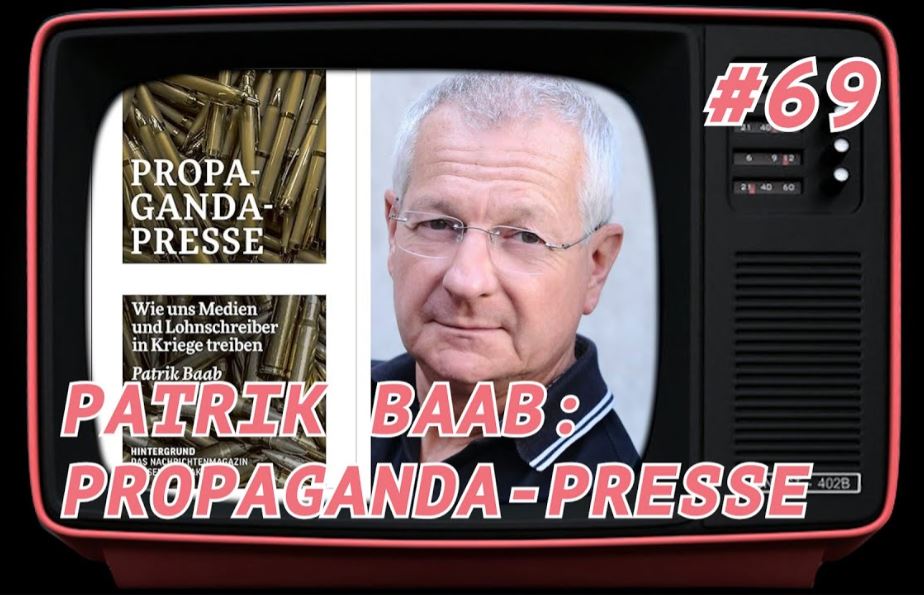
Patrik Baab is an investigative journalist and longtime editor at public broadcasting. In the fall of 2022, he traveled to the referendum territories in the Donbas as one of the few Western journalists to do so – not on behalf of a newsroom, but on his own initiative, because he held himself to the standard of forming his own picture. What he saw and reported there diverged significantly from what German media presented as established truth. The consequences were immediate: he lost his teaching positions at the state University of Kiel and at the private University of Media, Communication and Business in Berlin.
In a democracy, journalism is understood as a check on power. Baab lived up to that standard – and paid an institutional price for it. What he has to say about that belongs in this article.
Patrik Baab has traveled to Ukraine and the Donbas multiple times – not as a tourist, but as a journalist committed to seeing both sides. In conversation with the author, he describes an analytical framework he calls the 3-I concept: Incompetence, Ignorance, Ideology. These three factors, Baab argues, collectively define German coverage of the Ukraine war.
He describes the craft failures with clinical detachment: the basic journalistic five W’s – who, where, what, when, why, and the source of the report – are not fully answered. The opposing side is not incorporated. Judgments are rendered in what Baab calls the “comfort zone of editorial desks” – without a reality check, without local knowledge.
What weighs heaviest for him is causal blindness: this war, Baab emphasizes, did not begin with the Russian invasion in 2022. It began with the Western-backed change of power on the Maidan in 2014, which brought ultranationalist forces into the Ukrainian government, and with NATO’s eastward expansion in defiance of contrary assurances. Anyone who starts the war in 2022 explains it incorrectly – and draws wrong conclusions.
To this he adds what Baab calls apocalypse blindness – a term he borrows from the philosopher Günther Anders: the inability and unwillingness to concretely imagine the consequences of nuclear war. In a conflict where the use of nuclear weapons has already been threatened, where new U.S. intermediate-range missiles are to be stationed on German soil, this blindness is not an academic shortcoming – it is a public danger.
That such connections go unexamined in German flagship media has structural causes as well, in Baab’s assessment. He has experienced them firsthand. When he returned from Kosovo in 1999 with a report in which an OSCE representative questioned the legal basis of the KFOR deployment, the film was not broadcast. Chancellor Schröder had backed the operation, and the television director needed his contract renewed. The report disappeared into a drawer – not through formal censorship, but through preemptive compliance. “That’s how it’s done,” Baab notes dryly.
Baab’s case is not an isolated incident – it is symptomatic. In a functioning free press, the sanctioning of a journalist for his reporting is a scandal that triggers public debate. In Germany in 2022, it produced a brief news item. The journalism profession’s response – silence, isolated distancing, zero solidarity – says more about the condition of the German media system than any media study. Anyone who wants to understand where the limits of the sayable lie need only observe what happens to those who cross them.
Language as a Weapon
The first and most accessible level of the pattern is linguistic. German flagship media do not speak of the Russian government – they speak of the “Putin regime.” Not of the Russian president, but of “Putler” – a compound of Putin and Hitler that anticipates the entire moral verdict before a single fact is stated. Not of Moscow, but of “the Kremlin.” These terms are not neutral. They are frames – linguistic structures that carry an emotional attitude before the first sentence of the article has been read.
Anyone who doubts this makes a difference should conduct the Kahneman-Tversky experiment in their mind: read the same article once with “Moscow government” instead of “Putin regime” – and observe whether your emotional response to the text remains unchanged.
Framing is not confined to individual terms. It runs through entire sentence structures. “Russia attacks” is a different sentence from “Russia responds to NATO expansion” – even if both statements can be simultaneously true. “Putin orders strike” personalizes and moralizes differently than “Moscow government escalates conflict.” The choice of subject, verb, and contextual frame – all of it is editorial decision, one that presents itself as neutral craft while producing political effect. Media analyses of coverage in major German daily newspapers since February 2022 show a striking consistency in these linguistic choices – across newsrooms that consider themselves entirely independent of one another.
Drones Without Evidence, Headlines With Russia
On October 3 and 4, 2025, drones were sighted over Munich Airport. Airport operations were halted twice; roughly 6,500 passengers were stranded. That is documented and real. What is equally documented: the drones departed, according to the Federal Police, before they could be identified. The background – possible operators, possible motives – was, in the words of Federal Interior Minister Dobrindt, “still unclear.”
The media did not wait for clarity. Süddeutsche Zeitung asked: “Has Putin’s hybrid war reached Munich?” Chancellor Friedrich Merz “suspected Russia” behind the incidents – without citing any evidence. North Rhine-Westphalia Interior Minister Herbert Reul supplied the mood with a formulation that contained its own contradiction: “I am certain: not every drone is steered by the Kremlin – but every single one plays into Putin’s hands.” That is not news. That is framing: no matter who flew the drone, the narrative belongs to Russia.
A hobby pilot who ignored restricted airspace would have produced the same effect. We do not know. But the narrative already does.
The General and the Headline
In November 2025, Lieutenant General Alexander Sollfrank, commander of the Bundeswehr’s Joint Operations Command, gave an interview to Reuters. What he said was technically differentiated: Russia currently possesses the capacity to move against NATO territory “on a smaller scale.” Whether an attack would occur depends “very heavily on the behavior of the West.” With further rearmament, a large-scale attack by 2029 was “conceivable.”
What the media produced from this: “Bundeswehr General: Russia Could Attack Tomorrow” (Bild, n-tv). The qualifications – “smaller scale,” “depends on the behavior of the West,” time horizon 2029 – disappeared. A capability assessment became a threat announcement. A conditional military judgment became an alarming headline. The mechanism is precise: no one lied. The general said what he said. Only what generated maximum fear was selectively quoted – and the rest was cut.
The Asymmetry of Standards
On January 3, 2026, U.S. Special Operations Forces struck in the Venezuelan capital Caracas. Delta Force and the 160th Special Operations Aviation Regiment carried out Operation Absolute Resolve. According to Venezuelan and Cuban authorities, more than 80 people were killed – including 32 Cuban military personnel and at least 24 Venezuelan security forces. The Washington Post, citing U.S. government sources, put the death toll at approximately 75. Interior Minister Diosdado Cabello spoke of 100 dead on January 7. The independent British monitoring organization Airwars independently confirmed at least two civilian deaths with named identification. The sitting head of state, Nicolás Maduro, was abducted and transported to the United States. No UN mandate. No declaration of war. A sovereign state was attacked.
On February 28, 2026, U.S. and Israeli forces struck Iran. The UN Secretary-General condemned the attacks as a violation of Article 2 of the UN Charter. The strikes occurred during active diplomacy, without a mandate, and without Iran having carried out any armed attack on the United States or Israel.
Russia’s invasion of Ukraine is described in German media daily as a “brutal war of aggression in violation of international law.” Whether this legal characterization is conclusive is a matter of active debate among jurists across multiple countries – with divergent outcomes. That is not a fringe position but an open dispute that simply does not occur in German flagship media. The question that must be asked here is not a relativization of that verdict. It is a question of standards: why does the same measure, the same moral outrage, not apply equally to Venezuela and Iran? Why does the same public broadcaster report on the Russian attack with systematically different language and different weight than on American attacks against sovereign states?
That is not foreign policy. That is framing.
Those Who Don’t Fit the Narrative Are Removed
One distinctive feature of the current situation is how consistently dissenting voices are pushed out of public discourse – and how little attention that process attracts.
RT Deutsch and Sputnik were banned in March 2022 by decision of the EU Council. No court proceedings, no individual finding of journalistic misconduct, no due process – an administrative act. One can debate the editorial independence of these outlets and conclude that they report in proximity to the state. But in a democracy that defines press freedom as a fundamental right, the shutdown of media channels by executive decree is a precedent-setting act. The question that follows is not: were RT and Sputnik good journalists? The question is: who decides in the future which outlets are permitted to broadcast – and by what criteria?
Alina Lipp reported from the Donbas from the perspective of people affected by the conflict. Her German bank account was frozen; criminal proceedings were initiated. Thomas Röper, who on his blog Anti-Spiegel covers and comments on Russian positions regarding the Ukraine war, faced legal action as well. Neither is a neutral journalist – but neutrality was never a precondition for press freedom. Press freedom applies explicitly to uncomfortable, one-sided, and factually wrong journalists. Its limit is criminal law – not political alignment.
Jacques Baud is a different case deserving particular attention. The former Swiss intelligence officer and NATO advisor grounded his Ukraine analyses explicitly in Western and Ukrainian sources – not Russian ones. His conclusions nonetheless diverged sharply from the Western mainstream. He was sanctioned. Not for his methods. Not for any demonstrated errors. But because his findings did not fit the narrative. That is a quality of opinion suppression that is subtler, and in some ways more troubling, than open censorship: not the method is punished, but the result.
And Patrik Baab lost his teaching position – because he had done as a journalist what journalists are supposed to do: look, go, report.
On the chilling effect – the self-censorship that arises because others can see what happens to dissenting journalists – Baab confirms its impact from personal experience, without equivocation. The few colleagues from public broadcasting with whom he remains in contact, he reports, are people he now meets “in back rooms of bars, because they fear the consequences of being seen with me.” He adds: “That is how far public broadcasting has fallen.”
The mechanism behind his own case Baab describes precisely. The trigger was an article by the portal t-online – in Baab’s assessment, a propaganda outlet owned by the advertising conglomerate Ströer, whose largest client is the state. The portal falsely insinuated that Baab had appeared as an election observer for the Russian Federation at the Donbas referenda. In fact, he had been properly credentialed as a journalist – and appeared on no election observer list, something basic research would have confirmed. Shortly after the article was published, the universities made contact. The chancellor of the University of Media, Communication and Business in Berlin called while Baab was still in the war zone, having just escaped shelling. The Christian-Albrechts-Universität Kiel took the position that Baab was justifying Putin’s war of aggression – solely by virtue of his physical presence there. The Administrative Court of Schleswig-Holstein later clarified that Baab’s work was protected under Article 5 of the Basic Law and declared the dismissal unlawful. The university’s administration nonetheless continues to pressure students and staff not to travel to Russia.
Baab sees in these cases – RT Deutsch, Sputnik, Lipp, Röper, Baud, his own – no random pattern. He speaks of an entrenched censorship apparatus in Germany and the EU, documented in part in a report by the U.S. Congress. The criminal prosecution of political opponents, he notes, is a classic feature of authoritarian systems. His verdict on the EU in this context is unambiguous: not a democracy and peace project, but “an anti-democratic despotism.”
What these cases share is not the political orientation of those targeted. What they share is the effect: anyone who sees what happened to Baab, Lipp, Röper, and Baud thinks twice before publishing a dissenting analysis. That is the actual function of these measures – not the punishment of those targeted, but the disciplining of everyone else. In communication studies, this is called the chilling effect: the self-censorship that arises not because prohibitions are issued, but because the costs of deviation are made visible.
V. Pattern Recognition as Civic Competence
The title of this article comes from an observation older than the twentieth century: wars do not break out – they are prepared. The surprise populations feel when bombs fall is the product of a preparation they did not recognize as such.
What this article has sought to demonstrate is not cynicism and not fatalism. It is the opposite: the pattern is recognizable. It was recognizable with the U.S. entry into the war in 1917 – in hindsight. It was recognizable with Iran in 2026 – beforehand, because someone knew the pattern. It is recognizable in Germany today – for anyone willing to ask the right questions.
Those questions are not: Is Russia harmless? Is hybrid warfare an invention? Is every journalist who reports critically on Russia a propagandist? No. Hybrid warfare exists. Russia conducts it, as other states do. The United States does it. Germany does it. The EU does it.
The questions are: Where is the evidence for this specific claim? What information is being omitted? Whose interests does this framing serve? What is being presented as fact, and what is speculation? What voices have been removed from this discourse – and why?
That is not an abstract demand. It is a concrete exercise every reader can apply to every article. Take the next headline about the Russian threat. Ask: is evidence cited, or is a supposition presented as fact? Take the next quote from a general or politician about rearmament. Ask: what did they actually say – and what was cut? Take the next report from an NGO supplying casualty figures from a conflict zone. Ask: who funds this organization, and what interest might that funding generate?
These questions do not make anyone a conspiracy theorist. They make someone an informed reader – precisely what a functioning democracy demands of its citizens, and what schools and universities should be teaching as media literacy but are increasingly failing to do.
Asking these questions is not Russian propaganda. Asking these questions is practicing democracy.
In a society where public broadcasters – funded by mandatory contributions from all citizens and obligated by media law to political neutrality – repeat the same enemy image daily; where journalists experience house searches for dissenting coverage; where media channels are shut down by administrative decree and analysts are sanctioned because their conclusions do not fit the narrative – in such a society, critical media literacy is not an academic exercise. It is a necessity.
The First World War ended with 17 million dead. The populations that had made it possible had not wanted it – until they did. What had brought them to want it was not reason. It was repetition, fear, enemy images, and the silence of those who knew better or could have known better.
The pattern does not repeat because people are stupid. It repeats because it works – as long as it goes unrecognized.
Recognition is the first step. Everything else follows from it.
This analysis is made available for free – but high-quality research takes time, money, energy, and focus. If you’d like to support this work, you can do so here:
Alternatively, support my work with a Substack subscription – from as little as 5 USD/month or 40 USD/year!
Let’s build a counter-public together.
About the Authors
Patrik Baab is a German journalist and author. He has investigated intelligence services and political assassinations, the war in Ukraine, Russia, and geopolitical questions. He has worked in Eastern Europe and Russia, Scandinavia, Ukraine, the Balkans, and the United Kingdom. His work appears at www.patrikbaab.de, on Substack at patrikbaab.substack.com, and on Telegram at t.me/patrik_baab.
Michael Hollister is a geopolitical analyst and investigative journalist. He served six years in the German military, including peacekeeping deployments in the Balkans (SFOR, KFOR), followed by 14 years in IT security management. His analysis draws on primary sources to examine European militarization, Western intervention policy, and shifting power dynamics across Asia. A particular focus of his work lies in Southeast Asia, where he investigates strategic dependencies, spheres of influence, and security architectures. Hollister combines operational insider perspective with uncompromising systemic critique—beyond opinion journalism. His work appears on his bilingual website (German/English) www.michael-hollister.com, at Substack at https://michaelhollister.substack.com and in investigative outlets across the German-speaking world and the Anglosphere.
Sources
Academic Foundations
- Hasher, L., Goldstein, D. & Toppino, T. (1977): Frequency and the Conference of Referential Validity – ScienceDirect
- Fazio et al. (2015): Illusory Truth Effect – overview and meta-analysis – PMC / National Library of Medicine
Primary Historical Sources
- Carl von Clausewitz: On War (1832) – full text online – clausewitzstudies.org
- George Creel: How We Advertised America (1920) – full text via Library of Congress – loc.gov
- George Creel: How We Advertised America – reading excerpt MIT – web.mit.edu
- Edward Bernays: Propaganda (1928) – full text via Internet Archive – archive.org
Iran: Economic Warfare and Sanctions
- Scott Bessent, address to the Economic Club of New York (March 2025) + Fox News interview (January 2026) – documented via Geopolitical Economy Report – geopoliticaleconomy.com
- Scott Bessent, testimony before the Senate Banking Committee (February 5, 2026) – documented via PolitiFact – politifact.com
- Scott Bessent, statement on Iran sanctions – U.S. Treasury (official source) – home.treasury.gov
- NPR: Trump’s sanctions on Iran have dramatically affected its economy – npr.org
Iran: HRANA / NED Funding
- Alan MacLeod / MintPress News: The CIA-Linked NGOs Driving Iran Protest Coverage – mintpressnews.com
- National Endowment for Democracy – Form 990 / financial data – ProPublica Nonprofit Explorer
Patrik Baab
- Patrik Baab: Propaganda-Presse. Wie uns Medien und Lohnschreiber in Kriege treiben – patrikbaab.de
© Michael Hollister – All rights reserved. Redistribution, publication or reuse of this text requires express written permission from the author. For licensing inquiries, please contact the author via www.michael-hollister.com.
Newsletter
🇩🇪 Deutsch: Verstehen Sie geopolitische Zusammenhänge durch Primärquellen, historische Parallelen und dokumentierte Machtstrukturen. Monatlich, zweisprachig (DE/EN).
🇬🇧 English: Understand geopolitical contexts through primary sources, historical patterns, and documented power structures. Monthly, bilingual (DE/EN).