
by Michael Hollister
Exclusive published at Michael Hollister on March 15, 2026
4.098 words * 22 minutes readingtime
This analysis is made available for free – but high-quality research takes time, money, energy, and focus. If you’d like to support this work, you can do so here:

Alternatively, support my work with a Substack subscription – from as little as 5 USD/month or 40 USD/year!
Let’s build a counter-public together.
How Turkey could become the fuse of the next regional conflict – and why nobody wants to talk about it
March 4, 2026: One Missile, Three Interpretations
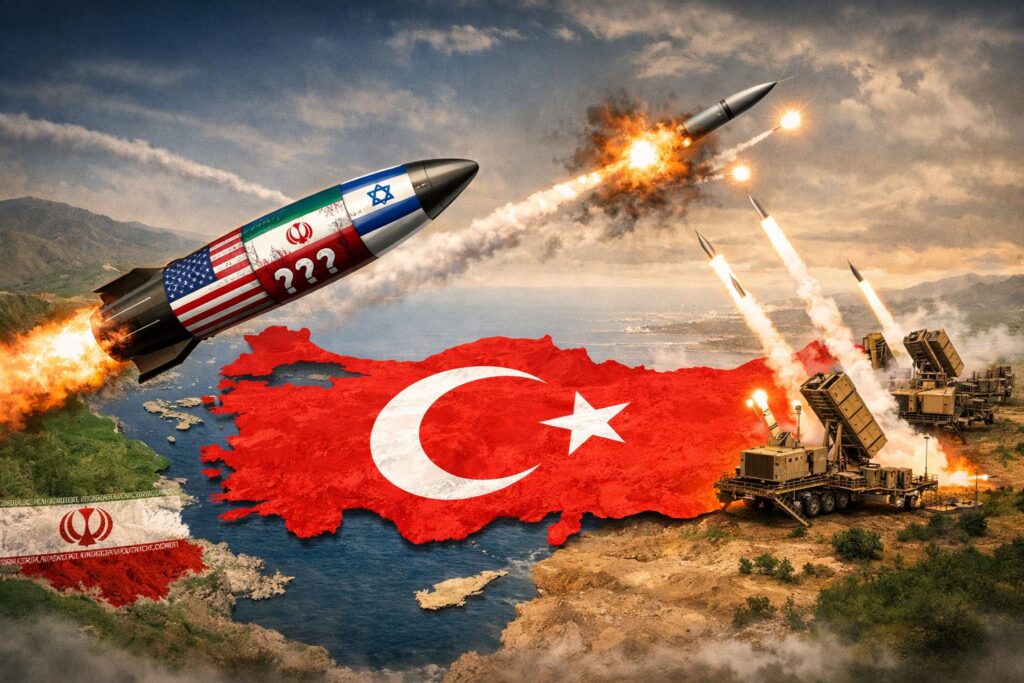
It is March 4, 2026, shortly after midnight local time. Somewhere over the eastern Mediterranean, a NATO air defense system intercepts a ballistic missile incoming from Iran. The debris falls in the southern Turkish province of Hatay. Nobody is injured. What follows is more remarkable in its political choreography than the missile itself.
First, the Turkish Foreign Ministry posts on X that a missile fired from Iran had entered Turkish airspace after crossing Iraq and Syria. Clear finding, Turkish framing. Then – anonymously, from Turkish government circles – an entirely different assessment surfaces: the missile had not been aimed at Turkey at all. It had apparently “gone off course.” The actual target: a British military base on Cyprus. Cyprus is not a NATO member.
NATO responds before the political dust has settled, with demonstrative solidarity rhetoric. Military headquarters in Mons announces that it considers the missile an intentional Iranian attack on alliance member Turkey. Three days later, on March 9, 2026, a second ballistic missile is intercepted over Turkish airspace. This time: no anonymous back-channel, no Cyprus explanation. Ankara officially declares that Iran attacked Turkey. The rhetoric has shifted fundamentally within 72 hours. (SRF News, March 4, 2026; Euronews, March 10, 2026)
The first analytical question every observer must ask is not: Did Iran attack Turkey? It is: Cui bono – who benefits from Turkey suddenly appearing as a target in the Middle East?
The Central Question: Who Is Constructing What – and Why?
While Western media focus on the spectacular images from Tehran and the daily updated casualty counts, a geopolitical realignment is taking place at the margins of the Iran war – one that could prove more consequential in the long run than the war itself: Turkey is being systematically reframed.
In Israeli security circles, Washington think tanks, and European foreign policy discussions, a sentence is surfacing that would have been unthinkable two years ago: “Turkey is the new Iran.” That sentence is not a strategic analysis. It is a political instrument – and it is worth examining precisely whose instrument it is, who it serves, and whether Turkey has itself provided grounds for it.
The overarching analytical question of this article: Is Turkey genuinely on a path from difficult NATO partner to the West’s next conflict zone – or is this narrative being strategically constructed, and if so, with what consequences?
The Underestimated Military Power: What Turkey Actually Is
To grasp the geopolitical stakes of current developments, one must first understand the scale of what Turkey has quietly built over the past two decades. Public debate in the German-speaking world tends to reduce Turkey to Erdoğan, refugee policy, and EU accession talks. That picture is dramatically incomplete.
The Turkish armed forces are NATO’s second-largest standing military after the United States, with approximately 480,000 active personnel, four field armies, and a reserve force of an additional 380,000. What distinguishes this army from most Western European militaries is not its size but its combat experience: Syria (Operations Euphrates Shield, Olive Branch, Peace Spring), northern Iraq, Libya, the Nagorno-Karabakh conflict as a drone exporter. This is an army that fights, not one that trains.
In parallel, Turkey has over the past decade built an indigenous defense ecosystem that commands serious international attention. Drone manufacturer Baykar sells its TB2 and Akıncı systems to more than 30 countries. Missile producer Roketsan supplies systems ranging from rocket artillery to the Tayfun family of tactical ballistic missiles with ranges exceeding 175 miles. Aselsan – Turkey’s equivalent of Thales or Elbit – produces radar, avionics, and electronic warfare systems across the full product range. The result: defense exports of $7.1 billion in 2024, growth of more than 250 percent since 2020, ranked 11th among global arms exporters. (NZZ, January 2025; SWP Berlin, February 2024)
Add to this two geographic assets that no other regional power possesses. First: control over the Bosphorus and Dardanelles under the 1936 Montreux Convention. During the Ukraine war, Ankara exercised this leverage against Russia – effectively locking Russian warships out of the Black Sea. A decision that prompted neither NATO nor Moscow to escalate, but placed both in a relationship of dependency with Ankara. Second: its function as an energy corridor. TurkStream carries Russian gas to southeastern Europe. The TANAP pipeline routes Azerbaijani gas toward the EU. The Russian-built Akkuyu nuclear power plant, scheduled to generate electricity for the first time in 2026, makes Turkey the hub of three energy systems simultaneously.
At the level of trade routes, Ankara is positioning itself as the Middle Corridor between China, Central Asia, the Caucasus, and Europe – an alternative to Russia’s northern Belt and Road route. China has taken notice: BYD is investing $1 billion in a plant in Manisa province; the Asian Infrastructure Investment Bank has committed $5 billion to Turkish development projects.
The table below sets out the conventional military capabilities of Turkey and Israel – the two powers that appear to be moving toward a confrontation that structurally neither can win:
| Category | Turkey | Israel |
| Active personnel | ~480,000 | ~170,000 |
| Reservists | ~380,000 | ~460,000 |
| Main battle tanks | 4,200+ (Leopard 2A4, M60, Altay) | Several thousand (Merkava 4, M60) |
| Air force | F-16 (modernized), KAAN in development | F-35I, F-15I, F-16I |
| Drones | TB2, Akıncı, Aksungur (exported to 30+ countries) | Heron TP, Hermes 900, tactical drones |
| Navy | 191 ships, 13 submarines, TCG Anadolu | Sa’ar corvettes, Dolphin submarines |
| Defense exports | $7.1B (2024), ranked 11th globally | Domestic production, heavy U.S. dependency |
| Munitions | Domestic production, growing self-sufficiency | Shortages, heavily dependent on U.S. deliveries |
| Defense budget | ~$27B (2026) | ~$40–45B (sharply increased) |
| Combat experience | Syria, Iraq, PKK, Libya – continuous deployment | Gaza, Lebanon, Iran – multi-front war |
| Nuclear | B61 weapons (NATO nuclear sharing, Incirlik) | Unofficial nuclear power (Jericho missiles, submarines) |
| NATO status | Full member since 1952, second-largest army | Not a NATO member |
Sources: GlobalFirepower 2026, Israel Defense Forces, Turkish Ministry of National Defense. Nuclear data based on officially confirmed figures (Turkey/NATO) and generally accepted intelligence assessments (Israel).
The table makes visible a structural asymmetry that barely surfaces in public debate: Israel fields a technologically superior but numerically small army, currently under severe ammunition and materiel pressure and heavily dependent on American resupply for operational capability. Turkey, by contrast, has a numerically far larger, combat-tested military with growing industrial independence. Who constitutes “the new Iran” here is determined by rhetoric – not reality.
Not a Weathervane: The Erdoğan Method
Few heads of state are as consistently misread in Western commentary as Recep Tayyip Erdoğan. The standard narrative: a populist autocrat who swings left or right depending on where the wind is blowing. An unpredictable weathervane. That picture is convenient but analytically wrong.
What Erdoğan has been pursuing consistently since at least 2016 has a name: strategic autonomy. The principle is straightforward: no full commitment to any single side; maximum dependency of all sides on Turkey as a permanent condition. Anyone who mistakes this system for opportunism misses the structural rationality behind it.
The S-400 purchase from Russia is the sharpest example. On the surface: a costly mistake that ejected Turkey from the F-35 program. At a deeper level: a calculated move that permanently placed NATO in a position where it can neither fully exclude nor fully integrate Turkey. The result is maximum negotiating leverage. NATO needs Incirlik, the Bosphorus gatekeeper, and the second-largest army – and cannot afford to alienate Ankara. Moscow needs the TurkStream pipeline, the Bosphorus for its Black Sea fleet, and a communication channel to the West. Both pay the price that autonomy costs.
The pattern is consistent across more than a decade. The veto on Swedish and Finnish NATO membership – 2022 and 2023 – was not capriciousness. It was a bargaining chip: concessions on the Kurdish question, arms deliveries, diplomatic recognition. The overflight denial in the current Iran war costs Ankara nothing – but generates leverage simultaneously against Washington, Tehran, and Brussels. The Astana format, in which Turkey negotiates the future of Syria jointly with Russia and Iran, makes Ankara the only Western actor with a direct line to both sides.
The EU chapter fits the same pattern. Since 1987, Turkey has been applying for EU membership. It received candidate status in 1999; negotiations began in 2005. Then: a decade of stagnation. Only 16 of 35 negotiating chapters are opened at all, none concluded. Cyprus disputes, democratic deficits, European hypocrisy. Turkey spent years hungry on a long leash – and in 2024 drew the logical conclusion: an application to join the BRICS group. As the first NATO member. The application is still pending. It is not a break with the West. It is the strategic equivalent of the S-400 purchase: an unmistakable signal that Ankara no longer depends on cooperation. (Brookings Institution)
German Foreign Minister Johann Wadephul made new overtures toward Ankara in spring 2026 – reopening negotiating chapters, modernizing the customs union, visa liberalization. Erdoğan responded with “mutual respect.” What observers read as an opening was in reality the classic pattern: friendliness as a signal that the price is not yet right.
Why Moscow Stays Silent: Turkey as Russia’s Lifeline
There is a question Western analysts rarely ask: why did Russia not respond militarily to the Turkish Air Force’s shootdown of its Su-24 in November 2015? Two Russian pilots were killed. Putin called it a “crime,” imposed sanctions – and fully normalized the relationship within eight months. The answer does not lie in diplomatic generosity. It lies in gas pipelines.
Turkey is not an ordinary neighboring state for Russia. It is the most important energy export channel Moscow possesses outside the direct post-Soviet sphere. TurkStream, operational since 2020, carries up to 31.5 billion cubic meters of Russian natural gas annually – directly into Turkey and onward to southeastern Europe: Bulgaria, Serbia, Hungary, Greece. Blue Stream delivers an additional 16 billion cubic meters directly into the Turkish domestic market. The Akkuyu nuclear power plant – built, financed, and operated by Rosatom – binds Turkey to Russian nuclear technology well into the 2060s. If Turkey tilts, Moscow’s energy influence in southeastern Europe tilts with it.
Add the Bosphorus function: Turkey controls under the 1936 Montreux Convention the only passage between the Black Sea and the Mediterranean. During the Ukraine war, Ankara used that control against Russia – closing it to Russian warships. But Ankara could exercise the same control in Russia’s favor, or hold it neutral – which in a NATO conflict would amount to the same thing. Moscow knows this. And that is why the Russian-Turkish relationship is not a friendship – it is a structural mutual dependency that prohibits escalation on both sides.
For the geopolitical reading of the current Iran war, this means: Russia has a vital interest in Turkey being neither destabilized nor pressed into an anti-Russian coalition. Any narrative that casts Turkey as the West’s next enemy objectively works against Russian energy interests – and simultaneously reinforces a Turkey that is strengthened in its strategic autonomy. Erdoğan knows this. Putin knows this. Washington knows it too – and acts accordingly anyway.
“Turkey Is the New Iran”: One Sentence, Three Interests
In mid-February 2026, before the first American-Israeli missiles fell on Tehran, a rhetorical groundwork began circulating in Israeli security circles and Washington-aligned commentary – and has been gaining momentum since. The core claim: after Iran is pushed back, Turkey will become the new power center of Islamist opposition to Israel – more dangerous than Tehran because it is not diplomatically isolated.
Who is saying this, and why? The dividing line is analytically decisive. Former Israeli Prime Minister Naftali Bennett – an active candidate for a return to office – has declared that Ankara is forming an axis “similar to the Iranian one” and that Israel must simultaneously confront threats from Tehran and Ankara. Prime Minister Benjamin Netanyahu has spoken of a new “hexagon” of Israeli alliances encompassing Greece, Cyprus, and the Arab Gulf states – as a counterweight to what he calls a “rising radical Sunni axis.” (Al Jazeera, February 23, 2026)
Former Defense Minister Yoav Gallant was more nuanced: he described Turkey as the power “best positioned” to fill the vacuum Iran leaves behind. “Turkey is no longer a partner on the periphery. It is positioning itself as a central power.” That is analysis, not electioneering. Gallant draws no equivalence with Iran – he describes a power shift.
Chatham House researcher Yossi Mekelberg has identified the core dilemma of the “new Iran” narrative precisely: the rhetorical exaggeration could lead Israel to turn Turkey into a genuine adversary through sheer threat-production. There is a self-fulfilling logic in enemy-image construction that is strategically dangerous. (Chatham House, March 2026)
What do U.S. think tanks say? The Brookings Institution describes the U.S.-Turkish relationship in 2025 as “permanently crisis-prone” and recommends an approach it calls “manage, not repair”: sober, interest-driven engagement, not confrontational isolation. CSIS recommends building alternative infrastructure in the eastern Mediterranean to reduce dependency on Turkish bases – but explicitly not alienating Turkey. The central line across all major U.S. think tanks: Iran is a containment target. Turkey is a difficult but structurally indispensable partner.
Yet in Washington, the willingness to at least not actively contradict the “new Iran” narrative is growing. The reason is not strategic conviction but a structural distortion in American foreign policy. AIPAC – the American Israel Public Affairs Committee – describes itself as the most influential pro-Israel lobbying organization in the United States and invested more than $100 million in congressional races across the 2022 and 2024 election cycles, targeted specifically at supporting pro-Israel candidates in both parties. The result is a structural majority in the U.S. Congress that reflexively prioritizes Israeli security interests – regardless of whether those interests align with American ones. Anyone in Washington who delivers a sober Turkey analysis that contradicts Israeli interests is swimming against a powerful institutional current. That is not a conspiracy narrative – it is documented budget politics.
Ankara responds to the narrative in its own pattern: officially with outrage (Foreign Minister Hakan Fidan calls it “Zionist desperation”), domestically as validation of its own line (Erdoğan’s Gaza stance is framed as morally correct), diplomatically through further rapprochement with the Global South. In November 2025, the Istanbul prosecutor’s office issued arrest warrants for 37 Israeli politicians – including Netanyahu, the Defense Minister, and the IDF Chief of Staff – on charges of war crimes. That is no longer rhetoric. That is legal policy.
The Equation That Doesn’t Balance: When Alliance Interests Collide
The real strategic explosive force of current developments does not lie in the Turkish-Israeli rhetorical duel. It lies in a structural inconsistency that neither Washington nor Tel Aviv will discuss publicly: the United States cannot simultaneously protect Israel, NATO-member Turkey, and its own base infrastructure in the region if those three interests come into conflict.
Incirlik is the pressure point. The U.S. air base in Turkey’s southern Adana province stores American B61 nuclear weapons as part of NATO nuclear sharing. Approximately 1,500 U.S. military personnel are stationed there. The United States has used Incirlik for operations against Syria, ISIS, and now Iran – but only with explicit Turkish permission. Ankara has not granted that permission for the current Iran war. Overflight rights for U.S. combat operations: denied. Incirlik itself: formally available, practically politically neutralized.
The dilemma for Washington is structural: if Israel casts Turkey as its next target and the United States endorses that narrative, it risks losing the most important NATO base in the eastern Mediterranean, access to the Black Sea, the TurkStream pipeline as a European energy valve, and cooperation with the only larger actor that simultaneously maintains lines to Russia, Iran, and the Global South.
In conventional-military terms, the picture is even starker. The table shows it: Israel has 170,000 active personnel against 480,000 Turkish. Israel has ammunition shortages that constrain operational capability without U.S. airlifts. Israel has no direct land border with Turkey, but Turkish troops have been positioned in northern Syria for years – directly adjacent to Israel’s extended operational theater. A conventional conflict between Israel and Turkey, without full U.S. backing, would not be winnable for Israel. With full U.S. backing, NATO would be attacking its own second-largest member state.
Spain has denied the United States the use of military bases for the Iran war. France is sending its aircraft carrier toward the Mediterranean – not as a combat participant, but as a signaling power. European coalition willingness is limited. The Arab Gulf states, whose bases underpin U.S. operations to a substantial degree, are reviewing force majeure clauses. Bahrain has already activated one. The base coalition on which the Iran war operates is crumbling.
In this context, the question of whether the second missile over Turkish territory was actually aimed at Turkey is not merely technical – it is strategic. Iran has no structural reason to pick a fight with Turkey: no historical enmity, cooperation in the Astana format, shared borders, aligned interests against Kurdish militias in northern Iraq. Turkey’s own Foreign Ministry stated after the first incident that the missile had “gone off course.” Only three days later was Iran officially blamed. Who benefits from a Turkish-Iranian enmity is obvious. Technical failure as an explanation cannot be ruled out – an off-course missile headed for a different target. But that explanation does not change the decisive analytical question: who is using the incident to establish which narrative – and whose interests does that narrative serve?
What followed on March 10, 2026 makes this question considerably more pressing. Iranian President Masoud Pezeshkian called Erdoğan directly and stated that the missiles intercepted over Turkish airspace were not of Iranian origin. Tehran proposed a joint investigation team to clarify the “claims of Iran-hostile countries and regimes” – an unmistakable allusion to Washington and Tel Aviv. Iran explicitly accused the United States and Israel of trying to “sow discord” between Iran and its neighboring countries. The Turkish Presidential Office confirmed the call. As of press time, no official refutation of Iran’s denial exists.
Which Way Does the Pendulum Swing? Three Scenarios
Scenario 1 – Controlled Tension: The Iran war ends in a face-saving arrangement for all parties before Turkey is officially drawn into the vortex. Erdoğan uses the moment for new negotiating rounds with the EU (customs union, visas) and the United States (F-16 upgrades, possible F-35 re-entry). Turkey remains in NATO, the BRICS application stays in the drawer as a pressure tool, Incirlik remains operational. This is the most likely short-term scenario – as long as escalation in the Iran war does not spiral out of control.
Scenario 2 – Narrative Escalation: The “Turkey is the new Iran” narrative takes on a life of its own in Israeli domestic politics and U.S. congressional debates. Israeli operations in northern Syria provoke Turkish responses. Further missiles over Turkish territory lead to Article 4 consultations that develop Article 5 logic. Washington must publicly choose between Incirlik and Tel Aviv. This is the medium-term possible scenario – and its occurrence lies substantially in the hands of actors with an interest in escalation.
Scenario 3 – Strategic Drift: No formal break, but a creeping decoupling. Turkey becomes a BRICS member, deepens energy cooperation with Russia and trade integration with China, gradually reduces NATO interoperability. Incirlik is not closed but effectively frozen. The Bosphorus is selectively opened to Russian warships. This scenario requires no dramatic decision – it is the outcome of ten further years of Western miscalculation in dealing with Ankara.
Of the three scenarios, strategic drift is the most likely over the medium term – because it requires no conscious decision. No summit, no break, no ultimatum. Only the accumulation of miscalculations, missed negotiating windows, and rhetorical escalations that each appear manageable in isolation – and together produce a condition that is no longer reversible. Europe has already run this pattern once in its relationship with Turkey. The EU accession process is the case study: thirty years of strategic mismanagement that failed to integrate Turkey into the West – and instead gave Turkey the instruments to put the West under structural pressure.
The Question Nobody Is Asking Out Loud
Turkey is not the new Iran. That equivalence is analytically false, strategically dangerous, and politically motivated. Iran is a Shia leading power with a nuclear program, a dense proxy network, and decades of direct enmity with Israel. Turkey is a Sunni NATO ally with U.S. nuclear weapons on its soil, a member of all Western institutions, and simultaneously an indispensable energy corridor for Europe.
What Turkey actually is can be described more precisely: it is the first state of the postwar order to have managed to sit inside every geopolitical system simultaneously without being dependent on any one of them. NATO member and BRICS applicant. Russia’s nuclear power plant partner and Bosphorus controller against Russian warships. Hamas sympathizer and host of 1,500 U.S. soldiers and American nuclear weapons. That is not schizophrenia. It is the most consistent form of strategic autonomy that a middle power has achieved in the 21st century.
Whoever declares Turkey an enemy now drives it permanently out of the Western orbit – and forfeits Incirlik, the Bosphorus, the Middle Corridor, and the last credible communication channel to the Global South. That is the price of enemy-image rhetoric. It is high. And as usual, it will be paid by others than those who painted the picture.
The real question that is barely being asked in this debate is not: Is Turkey a threat? It is: What order is supposed to emerge in the Middle East after the Iran war – and who has an interest in Turkey playing no role in it?
This analysis is made available for free – but high-quality research takes time, money, energy, and focus. If you’d like to support this work, you can do so here:
Alternatively, support my work with a Substack subscription – from as little as 5 USD/month or 40 USD/year!
Let’s build a counter-public together.
Michael Hollister is a geopolitical analyst and investigative journalist. He served six years in the German military, including peacekeeping deployments in the Balkans (SFOR, KFOR), followed by 14 years in IT security management. His analysis draws on primary sources to examine European militarization, Western intervention policy, and shifting power dynamics across Asia. A particular focus of his work lies in Southeast Asia, where he investigates strategic dependencies, spheres of influence, and security architectures. Hollister combines operational insider perspective with uncompromising systemic critique—beyond opinion journalism. His work appears on his bilingual website (German/English) www.michael-hollister.com, at Substack and in investigative outlets across the German-speaking world and the Anglosphere.
Sources
Missiles over Turkey – March 2026
- ZDF heute – Türkei: Iran feuert Rakete auf NATO-Land, March 4, 2026 https://www.zdfheute.de/politik/ausland/tuerkei-rakete-iran-nato-100.html
- SRF News – NATO fängt iranische Rakete ab, March 4, 2026 https://www.srf.ch/news/international/krieg-im-iran/iranische-rakete-mit-kurs-auf-tuerkei-nato-zeigt-sich-besorgt
- SRF News – Iran-Krieg: NATO fängt Geschoss im türkischen Luftraum ab, March 9, 2026 https://www.srf.ch/news/international/iran-krieg-tuerkei-nato-faengt-geschoss-im-tuerkischen-luftraum-ab
- Bloomberg – Iran-Krieg: NATO fängt iranische Rakete über der Türkei ab, March 9, 2026 https://www.bloomberg.com/news/articles/2026-03-09/iran-krieg-nato-fangt-iranische-rakete-uber-der-turkei-ab
- Euronews – NATO fängt eine zweite iranische Rakete im türkischen Luftraum ab, March 10, 2026 https://de.euronews.com/my-europe/2026/03/10/nato-iranische-rakete-luftraum-tuerkei
- Apollo News – NATO fängt iranische Rakete über der Türkei ab, March 9, 2026 https://apollo-news.net/nato-faengt-iranische-rakete-ueber-der-tuerkei-ab/
- Vienna.at – Erneut Alarm in der Türkei: NATO zerstört zweite Iran-Rakete, March 9, 2026 https://www.vienna.at/erneut-alarm-in-der-tuerkei-nato-zerstoert-zweite-iran-rakete/10037102
- t-online Newsblog – Iran-Krieg: NATO fängt Rakete im Mittelmeerraum ab (continuously updated) https://www.t-online.de/nachrichten/ausland/krisen/id_101157988/iran-krieg-news-nato-faengt-rakete-im-mittelmeerraum-ab.html
- Wikipedia (DE) – Irankrieg 2026 (chronology) https://de.wikipedia.org/wiki/Irankrieg_2026
“Turkey Is the New Iran” – Israeli Debate
- INSS Insight No. 2061 – Turkey Is Not Iran, but It Is a Threat, November 18, 2025 https://www.inss.org.il/publication/turkish-threat/
Turkish Military Strength and Defense Industry
- GlobalFirepower 2026 – Turkey: Rank 9 of 145 https://www.globalfirepower.com/country-military-strength-detail.php?country_id=turkey
- GlobalFirepower 2026 – Israel vs. Turkey: Direct comparison https://www.globalfirepower.com/countries-comparison-detail.php?country1=israel&country2=turkey
- NZZ – Erdogans Rüstungsindustrie fasst auch im Westen Fuß, January 2025 https://www.nzz.ch/international/drohnen-schiffe-kampfflugzeuge-tuerkische-ruestungsgueter-sind-auch-im-westen-gefragt-ld.1864647
- Militär Aktuell – Baykar: 1.75 billion euros in export revenues 2024, February 2025 https://militaeraktuell.at/baykar-2024-exporte-175-milliarden-euro/
- SWP Berlin – Die Türkei auf dem Weg zum globalen Rüstungsexporteur, February 2024 https://www.swp-berlin.org/10.18449/2024A05/
- IMI (Informationsstelle Militarisierung) – Türkische Rüstungsproduktion und ihre Grenzen, September 2025 https://www.imi-online.de/2025/09/09/tuerkische-ruestungsproduktion-und-ihre-grenzen/
- SECO Economic Report Turkey 2024/2025 – Defense and aerospace exports at record $7.2B https://www.seco.admin.ch/dam/seco/de/dokumente/Aussenwirtschaft/Wirtschaftsbeziehungen/Laenderinformationen/Europa_Zentralasien/wirtschaftsbericht_tuerkei.pdf.download.pdf/Wirtschaftsbericht_Tuerkei_2024-2025.pdf
U.S. Think Tanks on Turkey
- Brookings Institution – Between cooperation and containment: New US policies for a new Turkey https://www.brookings.edu/articles/between-cooperation-and-containment-new-us-policies-for-a-new-turkey/
- CSIS – U.S.-Turkey Strategic Initiative https://www.csis.org/programs/europe-russia-and-eurasia-program/us-turkey-strategic-initiative
Yossi Mekelberg / Chatham House
- Al Jazeera – Turkish ‘threat’ talked up in Israel as Netanyahu focuses on new alliances, February 23, 2026 https://www.aljazeera.com/news/2026/2/23/turkish-threat-talked-up-israel-netanyahu-focuses-new-alliances
- Chatham House – Netanyahu’s biggest gamble, March 2026 https://www.chathamhouse.org/2026/03/netanyahus-biggest-gamble
© Michael Hollister – All rights reserved. Redistribution, publication or reuse of this text requires express written permission from the author. For licensing inquiries, please contact the author via www.michael-hollister.com.
Newsletter
🇩🇪 Deutsch: Verstehen Sie geopolitische Zusammenhänge durch Primärquellen, historische Parallelen und dokumentierte Machtstrukturen. Monatlich, zweisprachig (DE/EN).
🇬🇧 English: Understand geopolitical contexts through primary sources, historical patterns, and documented power structures. Monthly, bilingual (DE/EN).