
by Michael Hollister
Exclusive published at Michael Hollister on March 15, 2026
4.320 words * 26 minutes readingtime
Exclusive Analysis for Subscribers
March 1, 2026. Somewhere over Israel, an Iranian Fattah-2 reaches its target – seven Israeli officers are killed, according to Iranian reports. What makes this remarkable is not the impact itself. It is what made the impact possible:
No system stopped the missile.
That is not a failure. That is physics.
And to understand why it is physics – why it will keep happening, no matter how much money is spent, no matter how many interceptors are stockpiled – you do not need to look at the present. You need to go back to 1943. To a weapons factory in Schönebeck on the Elbe, where an engineer at the HASAG corporation is putting the finishing touches on the simplest and simultaneously most revolutionary anti-tank weapon of the Second World War.
The Panzerfaust.
What began on a German arms engineer’s workbench has become the same principle playing out today over the cities of the Middle East. Only more expensive. And faster. And with consequences that reach far beyond Israel and Iran – all the way to Washington, where Donald Trump is about to spend $175 billion on a defensive shield that history has already exposed as an illusion, more than once.
The Panzerfaust – and the Principle Behind the Principle
The Panzerfaust was not an elegant weapon. It was a tube with an oversized warhead, designed for poorly trained Volkssturm fighters facing a T-34 at thirty feet. It cost almost nothing. It could be learned in minutes. And it did what expensive anti-tank guns could no longer do: it penetrated Soviet armor.
The secret was not the explosive charge. The secret was geometry.
Inside the warhead sat a metal liner – usually a copper cone. When detonated, the explosive generated pressure in fractions of a millisecond that collapsed the copper liner inward and shaped it into an extremely fast, narrow jet of metal: the so-called shaped-charge jet. Not plasma – that is a widely repeated myth. It is highly compressed metal in a solid but ductile state, striking the armor at several kilometers per second.
What happens next defies intuition. The steel of the armor briefly behaves like a liquid – it is punctured at a single point. A narrow channel forms. And through that channel, metal and armor fragments are driven at enormous velocity into the interior.
It is not the pressure that kills the crew. The fragments kill the crew. That is the biggest difference from the popular image: there is no massive pressure wave that ruptures every cavity. What kills the men inside are fragments of steel and copper flying through the fighting compartment at thousands of feet per second – striking ammunition, fuel, and electronics that then explode or burn in turn.
The operating principle of the Panzerfaust was so effective that it survives in barely altered form in modern anti-tank systems to this day. But what matters most is not the technology. It is the reaction it triggered.
Reaction Upon Reaction – Eighty Years of the Arms Spiral
The Soviets, and later every major military power, quickly recognized that thicker steel alone was no defense against shaped charges. A different answer was needed. That answer was reactive armor.
The principle is brilliant in its simplicity: small boxes filled with explosive material between metal plates are attached to the outside of the tank. When the shaped-charge jet strikes one of these elements, it detonates – hurling metal plates against the jet. The jet is deflected, torn apart, weakened before it reaches the base armor. The weapon designed to kill the tank is intercepted by a protective layer that explodes itself.
But the story does not end there. It only begins.
The answer to reactive armor was the tandem shaped charge: a smaller precursor warhead that detonates first and triggers the reactive armor – and then, milliseconds later, the main warhead strikes the now-unprotected base armor. Two cones in sequence, timed apart. The defense had found a solution. The offense had circumvented the solution.
The answer to tandem charges was multi-layer armor: steel, ceramics, and composite materials in alternating layers that refract the jet at each interface and distribute its energy. The offense responded with larger charges, improved detonation timing, new geometries.
The pattern has been the same for eighty years: every effective weapon generates its countermeasure. Every effective countermeasure generates its workaround. There is no endpoint to this race – only more expensive rounds.
What the Panzerfaust taught in steel and copper applies today to missiles and interceptor systems. The scale has grown. The fundamental rule has not.
Iron Dome – How the Miracle Works
At 6:29 a.m. on October 7, 2023, Hamas fired approximately 2,200 rockets at Israel in the first twenty minutes. Iron Dome, considered invincible at the time, had gaps that night. Not because the system failed – but because it was overwhelmed.
That is the key to understanding Iron Dome: it is not an absolute shield. It is a probabilistic system that works very well under defined conditions – and runs into structural limits under others.
How the system works
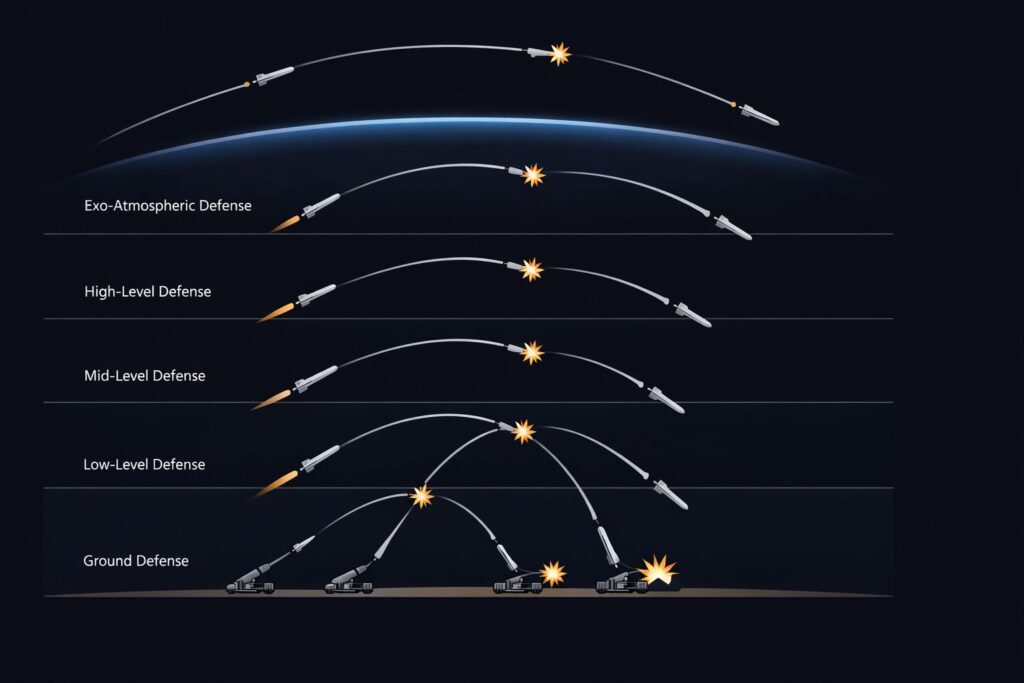
Each Iron Dome battery consists of three components: a radar (the EL/M-2084 by Elta Systems) that detects rocket launches and tracks flight paths; a Battle Management Center that processes the data in real time; and up to four launchers each carrying twenty Tamir interceptor missiles.
The radar detects a launch within seconds. The control center calculates the projected impact point. Then comes an intelligent decision that distinguishes the system from simple interceptors: it only fires if the projected impact zone threatens populated areas or critical infrastructure. Rockets headed for the sea or open terrain are ignored. That conserves ammunition – and ammunition is the decisive resource.
The Tamir interceptor is roughly ten feet long, weighs 200 pounds, and carries a fragmentation warhead. It does not detonate on direct impact but detonates in proximity to the target – the warhead’s shrapnel cloud destroys the incoming rocket. The advantage is that debris falls over unpopulated terrain.
Since entering service in 2011, Iron Dome has intercepted more than 5,000 rockets according to Israeli figures – with a success rate above 90 percent.
Numbers from the current war
Since February 28, 2026 – the first day of Operation Epic Fury – 262 ballistic missiles have been fired at Israel. 241 were shot down, 19 fell into the sea, 2 impacted. Of 1,475 Iranian drones, 1,385 were intercepted – 90 fell on Israeli territory. These are impressive numbers. And they conceal the actual problem.
The Cost Asymmetry: The Invisible War
One Tamir interceptor costs between $40,000 and $50,000. Two are often fired per target to increase intercept probability – up to $100,000 per threat neutralized.
An Iranian Shahed-136 kamikaze drone costs between $1,000 and $20,000. A Fajr-5 rocket costs Iran an estimated $3,000 to $5,000 in mass production.
Translated: Iran spends one dollar, Israel spends ten to fifty dollars to stop it. For the 1,385 drones and 241 missiles intercepted so far, Israel has consumed an estimated $50 to $80 million in intercept costs alone. Iran spent perhaps $5 to $10 million on the projectiles fired.
This is not a side issue. This is the fundamental strategic logic of asymmetric missile combat – and the reason why even a 90-percent system cannot be won in the long run when the attacker always shoots more cheaply than the defender intercepts.
Since 1943, the same law has held: every weapon generates its defense. Every defense generates its circumvention. On March 1, 2026, that law was confirmed over Israeli skies – by an Iranian missile no system in the world could stop. What connects the Panzerfaust to Iron Dome, Arrow-3, and Donald Trump’s $175 billion Golden Dome project is not a technical detail. It is a fundamental law of military history. And its consequences reach far beyond the Middle East.
Exclusive Analysis for Subscribers
This exclusive Deep-Dive-Analysis you will be able to find here
Michael Hollister is a geopolitical analyst and investigative journalist. He served six years in the German military, including peacekeeping deployments in the Balkans (SFOR, KFOR), followed by 14 years in IT security management. His analysis draws on primary sources to examine European militarization, Western intervention policy, and shifting power dynamics across Asia. A particular focus of his work lies in Southeast Asia, where he investigates strategic dependencies, spheres of influence, and security architectures. Hollister combines operational insider perspective with uncompromising systemic critique—beyond opinion journalism. His work appears on his bilingual website (German/English) www.michael-hollister.com, at Substack at https://michaelhollister.substack.com and in investigative outlets across the German-speaking world and the Anglosphere.
© Michael Hollister —
All rights reserved. Redistribution, publication or reuse of this text requires express written permission from the author. For licensing inquiries, please contact the author via www.michael-hollister.com
Newsletter
🇩🇪 Deutsch: Verstehen Sie geopolitische Zusammenhänge durch Primärquellen, historische Parallelen und dokumentierte Machtstrukturen. Monatlich, zweisprachig (DE/EN).
🇬🇧 English: Understand geopolitical contexts through primary sources, historical patterns, and documented power structures. Monthly, bilingual (DE/EN).