
by Michael Hollister
Exclusive published at Michael Hollister on March 08, 2026
4.308 words * 23 minutes readingtime
This analysis is made available for free – but high-quality research takes time, money, energy, and focus. If you’d like to support this work, you can do so here:

Alternatively, support my work with a Substack subscription – from as little as 5 USD/month or 40 USD/year!
Let’s build a counter-public together.
What China Is Actually Doing While Iran Burns
While the world watches burning oil depots on the Persian Gulf, intercepted missiles over Qatar, and debates whether the U.S. Navy has enough interceptors left to stop another Iranian salvo – something unusual is happening in the Taiwan Strait.
Nothing.
Since February 28, 2026, the day the first U.S.-Israeli bombs fell on Iranian nuclear facilities, China has not sent a single military aircraft into Taiwan’s Air Defense Identification Zone. Six days of silence. In a strait where Beijing has dispatched fighter jets, bombers, and drones on an almost daily basis for years – where the Taiwanese air force routinely scrambles to intercept – where permanent escalation has been the new normal since 2022 – this silence is extraordinary.
The reflex is to log this as good news. China is calming down. Tension easing. Maybe diplomacy is working.
A senior Taiwanese security official sees it differently. “Just because they’re not coming now doesn’t mean they won’t come back,” he told reporters. “We cannot rule out that they are preparing an even larger operation.”
The silence in the Taiwan Strait is not a sign of peace. It is the breath before the next round.
I. Justice Mission 2025: The Dress Rehearsal Nobody Wanted to See
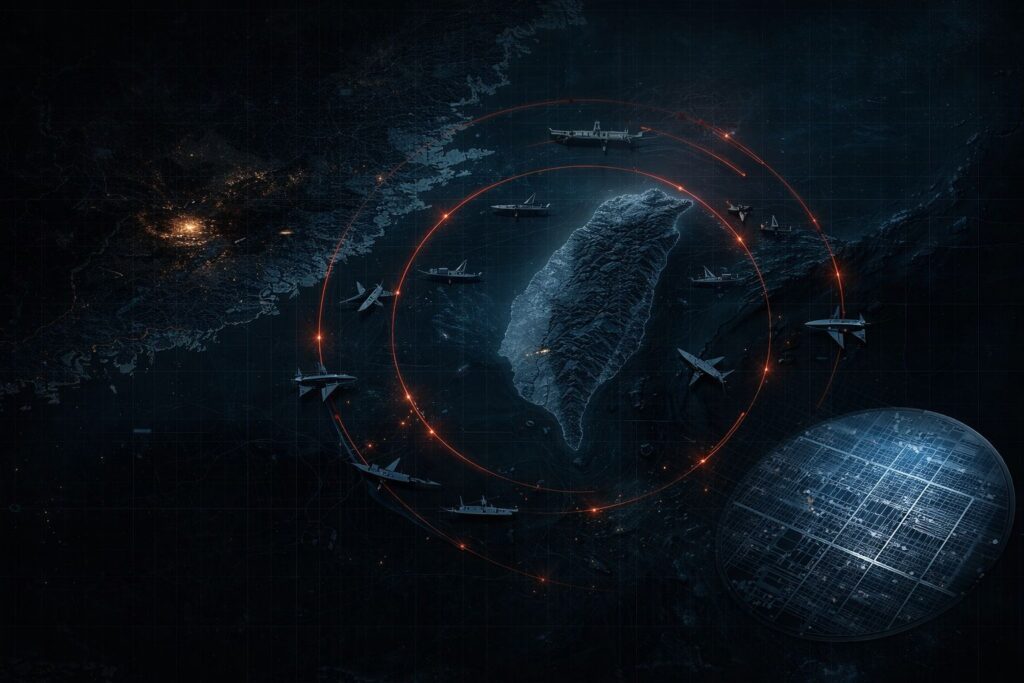
To understand why the current calm is deceptive, you have to go back to December 29, 2025. While the world was caught between New Year’s preparations and year-end retrospectives, China launched the largest military exercise around Taiwan since the current escalation spiral began in 2022.
“Justice Mission 2025” – the official designation – was no routine drill. In scope, complexity, and geographic reach, it was the largest exercise the People’s Liberation Army has ever conducted around Taiwan: larger than all six major drills since Nancy Pelosi’s visit to Taipei in August 2022. More than 130 aircraft sorties into Taiwan’s Air Defense Identification Zone, 14 warships, at least 15 coast guard and other official vessels. Destroyers, frigates, fighter jets, bombers, unmanned aerial vehicles, and long-range missiles – all together, coordinated, within a dense exercise framework that left nothing to chance.
What was being rehearsed is remarkable in its clarity: a complete maritime blockade of Taiwan. The simulation covered establishing air and sea superiority, sealing off Taiwan’s major deep-water ports – Keelung in the north and Kaohsiung in the south – repelling external intervention forces, and cutting civilian shipping and air traffic routes. More than 850 international flights were affected; over 100,000 travelers were stranded or rerouted. Seven temporary danger zones were established; the air corridors and sea lanes around Taiwan were, for hours, effectively under Chinese control.
That alone would be significant enough. But the truly decisive element of Justice Mission 2025 lies not in the numbers – it lies in a detail that received almost no attention in Western reporting: for the first time, Chinese military and coast guard vessels penetrated Taiwan’s 12-nautical-mile contiguous zone in significant numbers. That buffer zone had served for decades as the de facto boundary between routine provocation and serious territorial violation.
The zone was never formally recognized, but it was de facto respected. For some decades, then some years, then less and less. Justice Mission 2025 crossed it systematically and at scale for the first time. What was a red line in 2022 is today normal training ground.
That is the actual strategy: normalizing the encirclement.
Each exercise pushes the threshold a little further. What was a scandal last time is background noise next time. What is background noise next time is the baseline the time after that. Beijing does not change boundaries through unilateral declarations – it changes them through repeated practice that eventually reads as normal. The same happened with the Taiwan Strait median line, long treated as an informal buffer zone: China has crossed it almost daily since 2022, and today barely anyone mentions it.
The question is not whether the contiguous zone will meet the same fate. It is when.
II. The Pentagon’s Admission: 2027 Is Not a Date – It’s a Window
There are documents you should read before discussing Taiwan. One of them is the Pentagon’s annual report on China’s military and security developments, released December 23, 2025 – the 25th in a series mandated since 2000, and the sharpest in language to date.
The report states without diplomatic hedging: “The PLA is making steady progress toward its 2027 goals, at which point it must be capable of achieving a strategically decisive victory over Taiwan, establishing a strategic counterweight to the United States in nuclear and other strategic domains, and exercising strategic deterrence and control over other regional states. In other words: China expects to be capable of fighting and winning a war over Taiwan by the end of 2027.” (U.S. Department of Defense, “Annual Report to Congress: Military and Security Developments Involving the People’s Republic of China 2025,” December 23, 2025, https://media.defense.gov/2025/Dec/23/2003849070/-1/-1/1/ANNUAL-REPORT-TO-CONGRESS-MILITARY-AND-SECURITY-DEVELOPMENTS-INVOLVING-THE-PEOPLES-REPUBLIC-OF-CHINA-2025.PDF)
The Pentagon is not quoting Beijing here. It is stating its own assessment, based on intelligence findings. CIA Director William Burns added: the United States knows as an established intelligence fact that Xi Jinping has tasked the PLA with being ready for a possible invasion of Taiwan by 2027.
What does 2027 mean concretely? The report identifies three strategic objectives the PLA is being built toward:
First, a “strategically decisive victory” over Taiwan – meaning China must be capable of enforcing a blockade or credibly executing an invasion option, even if the United States intervenes.
Second, a “strategic counterweight” to the United States in nuclear and other strategic domains – including nuclear parity or at minimum the ability to deter American escalation. China currently has over 600 operational nuclear warheads; the Pentagon projects more than 1,000 by 2030.
Third, “strategic deterrence and control” over other regional states – meaning Japan, South Korea, Australia, and the Philippines must be deterred from intervening.
What the PLA is building toward 2027: hypersonic missiles that render existing U.S. missile defense systems obsolete. Drone swarms for mass attacks on ships and bases. AI-assisted command and control with autonomous decision cycles faster than human reaction. New large surface combatants and attack submarines, including the first Type-095 nuclear attack boat, spotted in early 2026. Cyber and space capabilities for disrupting GPS, satellite reconnaissance, and military communications. And a specialized coast guard force integrated into military operations since Justice Mission 2024A – a legal gray zone that blurs the distinction between maritime law enforcement and military action.
Here is the most important analytical caveat that serious reporting requires: 2027 is not an invasion date. The Pentagon itself makes this distinction. “Being ready” is not the same as “will attack.” Chinese law sets no timetable for an assault on Taiwan – it sets conditions, specifically any attempt by Taiwan to declare formal independence. Xi Jinping is politician enough to know that a fixed date would be a self-fulfilling prophecy with unpredictable consequences.
But: capability and intent are not the same thing – and they are still connected. From 2027 onward, China will have options it does not yet have today. A blockade that would today face substantial U.S. resistance might, under altered military balance conditions in 2028, appear more calculable. That is the strategic window the Pentagon is describing – and it is opening right now, while the world watches the Persian Gulf.
III. Understanding the Silence: Three Explanations, All of Them Unsettling
Back to the current pause. Why is China, at a moment when the United States is massively committed in Iran, no longer sending aircraft into Taiwan’s ADIZ?
There are three competing explanations. All are plausible. None of them are reassuring.
Explanation one: Tactical concession ahead of the Trump-Xi summit
In February 2026, Xi Jinping called Trump and explicitly warned him: the planned U.S. arms deliveries to Taiwan – $14 billion in air defense and missile systems designed to strengthen Taiwan’s ability to resist a blockade – would jeopardize bilateral relations. Trump delayed the packages, even though Congress had already approved them.
A Trump-Xi summit in Beijing is scheduled for late March or early April. China has an interest in not poisoning the atmosphere. A temporary reduction in visible pressure on Taiwan, combined with the successful delay of the weapons package, is a classic tactical maneuver: give the other side a win, keep the strategic position intact. The price: Taiwan does not receive the weapons systems it needs, at precisely the moment China is expanding its options.
Explanation two: An army in restructuring
Since 2023, Xi Jinping has run a sweeping anti-corruption campaign inside the PLA that has now reached dozens of senior generals and admirals, including the entire command staff of the Rocket Force. Taiwanese defense analyst Su Tzu-yun considers these purges the “primary reason” for the current pause: an army undergoing command restructuring pauses external pressure operations to avoid exposing internal weaknesses.
The Pentagon’s assessment is similarly nuanced: the purges create short-term turbulence in readiness and command continuity. Medium-term, the Pentagon suggests, the result could be a more disciplined and cohesive PLA – which limits the strategic time gain for the West.
Explanation three: Strategic calibration during the Iran window
China is not an emotional actor. It is a strategic one. And strategically, Beijing has no need for additional noise in the Taiwan Strait during the Iran crisis. The United States is committed in the Persian Gulf: carrier strike groups, Aegis destroyers, munitions stockpiles, political attention. That creates room for China in the Taiwan Strait without Beijing having to lift a finger.
At the same time, reports from Reuters and the Wall Street Journal indicate that China is providing Iran with satellite reconnaissance via its network of more than 500 satellites, Beidou navigation data for missile targeting, and commercial satellite imagery of U.S. bases in the region. These reports are not officially confirmed, but have been consistently described by multiple independent sources. China is not fighting directly in Iran. But it is keeping the United States busy, munitions-depleted, and strategically distracted – without fully sacrificing its credibility as a neutral actor.
The quiet in the Taiwan Strait is the price China pays to avoid appearing in Washington as an aggressor opening a second front. The strategic payoff remains unchanged.
Synthesis: All three explanations can be true simultaneously. And none of them means the danger has diminished. On the contrary: if Beijing is currently pausing because of command reforms, Trump summit preparation, and Iran calculations – what happens when none of those factors apply?
IV. What Taiwan Is Really About – Not Democracy, but Silicon and Power
There is a narrative about Taiwan that Western media like to reproduce: brave democracy against authoritarian giant, freedom against repression, a small people defending its right to self-determination. All of that may be true. But none of it explains why Taiwan is the most geopolitically sensitive piece of land on the planet.
The explanation is more sober. It consists of silicon, electricity, and everything that stops working without both.
Taiwan is the semiconductor factory of the world – with no alternative in sight
Taiwan Semiconductor Manufacturing Company – TSMC – accounts for 71 percent of global foundry revenues, according to current TrendForce data. Samsung, the global runner-up, comes in at 8 percent. For advanced chips below 5 nanometers – the technologies underpinning artificial intelligence, military electronics, quantum computing, and the next generation of autonomous systems – TSMC’s market share exceeds 90 percent. Taiwan as a whole produces 92 percent of global capacity for cutting-edge sub-6-nanometer logic chips. Taiwan’s integrated circuit exports totaled $184 billion in 2022 alone – nearly a quarter of the island’s entire GDP.
In concrete terms: Nvidia GPUs forming the foundation of global AI infrastructure. Apple processors in every iPhone. AMD chips in servers, PCs, and military electronics. F-35 avionics. Satellite control systems. Autonomous drone systems. Everything runs through TSMC. There is no Plan B. The Arizona fab that Trump is pushing with massive subsidies will produce relevant volumes no earlier than 2027 or 2028 – and then at a fraction of Taiwan’s capacity, at costs that TSMC itself estimates at 50 percent above Taiwan production levels.
There is a concept in Taiwanese society that locals always explain to foreigners: the “Silicon Shield.” The idea is simple: China cannot attack Taiwan because it does not want to destroy the TSMC fabs. The global economy would collapse. Including China’s. Stalemate.
It is a reassuring narrative. And it contains a fundamental logical flaw.
There is a serious counterargument that deserves fair treatment: economic interdependence between China and Taiwan runs deep. China is Taiwan’s largest trading partner. A blockade would not only hit Taiwan – it would also shake the Chinese export economy, which depends on Taiwanese chips, and permanently damage China’s reputation as a reliable economic partner. This logic – call it the extended Silicon Shield thesis – argues that economic interdependence creates structural deterrence that overrides military calculation. It is not a foolish argument. But it overlooks a basic historical rule: economic interdependence has not prevented wars when one side rates strategic necessity above economic damage. Europe traded intensively with itself in 1914. It changed nothing.
China does not need to destroy the factories. It is enough to cut the power.
The blockade calculus: How an island starves without a shot being fired
Taiwan is more than 95 percent dependent on energy imports. Coal, liquefied natural gas, crude oil – all arrive by ship. A maritime blockade keeping tankers and freighters from Taiwanese ports does not strike the factories directly. It strikes the power plants. And semiconductor manufacturing is one of the most energy-intensive industrial processes in existence.
TSMC produces its chips under conditions that must be microscopically clean, temperature-stable, and continuously powered. A single unplanned power interruption can destroy an entire production cycle – causing millions in losses and weeks of delay. A blockade disrupting Taiwan’s energy supply over weeks and months would not end chip production through destruction, but through attrition.
Beyond energy: Taiwan also imports food, specialty chemicals for chip fabrication, spare parts, shielding gases. All of it arrives by ship through the same corridors China rehearsed sealing off during Justice Mission 2025. The economic chokehold would not tighten within weeks, but within months – and it would tighten.
The global consequences would be felt immediately, long before Taiwan capitulated or did not. Data centers on three continents would report capacity shortfalls within months. Automobiles and medical devices would grow scarce. Military procurement programs worldwide – American, European, Japanese – would stall for lack of the chips that drive modern weapons systems.
China would not even need to occupy Taiwan to win strategically. It would only need to hold the window open long enough for the world to understand: the alternative to Chinese control over Taiwan is more expensive than the control itself.
V. The Rare Earth Trap: Why America May Not Be Able to Fight the War Over Taiwan
Even if the United States decides to intervene, it runs into a problem that does not lie on the battlefield. It lies in the supply chains.
Three numbers are sufficient to grasp the scale.
A single F-35 contains 920 pounds of rare earth materials. An Arleigh Burke-class destroyer – the backbone of U.S. air defense – requires 5,200 pounds. China controls 85 to 90 percent of global processing and refining capacity for these materials. Not mining – processing. That is the critical point: Australia may have ore in the ground. It still gets shipped to China for refining, because the industrial infrastructure is there and nowhere else at relevant scale.
The defense analytics firm Govini quantified this in 2025: 88 percent of DoD supply chains contain Chinese intermediate steps, even when raw materials originate elsewhere. In an active conflict with a full Chinese embargo, the effect would not be linear but exponential: F-35 production halted, precision munitions not reproducible, drone motors without magnets. (Govini, “2025 National Security Scorecard,” https://www.govini.com/insights/2025-national-security-scorecard)
The Pentagon itself acknowledges: realistic mine-to-magnet independence is achievable no earlier than between 2030 and 2035. If the 2027 window is what the Pentagon describes, that is a gap of at least three to five years.
A complete documentation of this structural dependency – with all figures, all weapons systems, and all seven Chinese export control rounds since 2023 – is available in my analysis “The Materials Paradox: How Critical Raw Material Dependencies Are Undermining U.S. Deterrence in the Indo-Pacific,” for subscribers at www.michael-hollister.com. https://www.michael-hollister.com/de/2026/02/01/das-us-materialien-paradoxon/
VI. Iran as Strategic Lever: How Beijing Keeps America Pinned in the Persian Gulf
Hudson Institute researcher Zineb Riboua argued directly in an analysis this week: the U.S.-Israeli strikes on Iran are fundamentally an anti-China operation. Iran was China’s “structural strategic asset” – an actor that tied down U.S. resources, attention, and munitions stockpiles in the Middle East, thereby limiting American freedom of action in the Pacific. Riboua’s thesis is compelling – with one caveat she does not name: neutralizing that asset also ties down U.S. resources. Possibly more than the asset itself ever did. (Taipei Times, “The US’ Iran strikes are about China: researcher,” March 3, 2026, https://www.taipeitimes.com/News/taiwan/archives/2026/03/03/2003853172)
Here is the geopolitical irony: fighting that asset consumes U.S. resources. Possibly more than the asset itself ever could.
More than 2,000 U.S. munitions were expended in the first phase of the Iran campaign. Aegis destroyers – the same ships that in a Taiwan scenario would form the first line of defense against Chinese missile attacks – are maneuvering in the Persian Gulf and must be withdrawn for rearming. The nearest available port for that is Diego Garcia, over 600 miles away. During repositioning, there is a window that Iran could exploit for targeted strikes on U.S. bases in the region – and that China is tallying as a strategic breathing space in the Taiwan Strait.
The munitions arithmetic, already strained by Ukraine deliveries, is deteriorating. North Korea alone produces more artillery ammunition per year than the entire NATO alliance. Russia’s defense industry is running at full capacity. The United States and Europe cannot double production capacity overnight – arms factories require years of lead time, and the very rare earths from which precision munitions are built come from China.
Meanwhile, Trump is delaying the $14 billion arms packages to Taiwan to avoid jeopardizing the Xi summit. Those are the air defense and missile systems Taiwan needs to repel a Chinese blockade. They are not coming. Not now. Perhaps not in time.
In this context, China’s ADIZ pause is not de-escalation. It is a strategic pause in a chess match in which the opponent is being weakened on three moves simultaneously: through Iran resource commitment, through Taiwan weapons delay, and through the quiet continued development of Chinese first-strike options.
VII. What Is at Stake – and Who Knows It
There is a sentence in the December 2025 Pentagon report that was barely cited in Western discourse. It does not appear in the executive summary but in the main text, in the analysis of China’s command structure: China’s military modernization objective for 2027 is “capabilities-based.” The question is not when China attacks. The question is that from a certain point onward, China has the choice.
That choice carries consequences that extend well beyond Taiwan.
If Taiwan comes under Chinese control – whether through invasion, blockade, or political collapse under economic pressure – China controls 90 percent of global production capacity for cutting-edge logic chips. Every smartphone worldwide. Every data center. Every AI infrastructure. Every piece of military electronics for which no domestic alternative exists.
That is not leverage in peacetime. That is existential leverage in every future geopolitical conflict. China would not even need to use or sabotage the factories. Mere control would be sufficient to force Western governments into negotiations that would have been unthinkable three years earlier.
Add to that the Taiwan Strait itself as a chokepoint for global maritime trade. Together with the Strait of Hormuz – which is under or is intended to come under U.S.-Israeli influence – and the Suez Canal, control over the Taiwan Strait would mean that three of the world’s four most critical maritime bottlenecks are controlled by the same two power blocs. Global trade would be structurally reorganized – not through negotiation, but through military reality.
Taiwan itself knows this. President Lai Ching-te has told his fellow citizens: “2026 will be a decisive year.” He has proposed a special defense appropriation of $40 billion over eight years. The opposition-controlled legislature is blocking it. The political paralysis, combined with delayed U.S. weapons deliveries and Chinese pressure buildup, is the most toxic combination imaginable – and Beijing is calculating precisely on it.
VIII. The Boxer in Round Six
There is an image that describes the current geopolitical situation better than any strategic analysis: a ten-round boxing match.
In the first six rounds, one boxer lets the other hammer away at him. He slips punches, absorbs blows, lets his opponent run. His trainer shouts from the corner: He’s losing! He’s going to quit! But the boxer knows what his trainer cannot see from outside: the opponent is burning calories. He is exhausting his reserves. He believes he is winning because his punches are landing – and does not notice that round seven is approaching, in which he will have no air left.
China is not fighting a war over Taiwan. Not yet. It is normalizing the encirclement, exercise by exercise, kilometer by kilometer, boundary shift by boundary shift. It is waiting for the United States to bleed out in Iran. It is pressing for weapons delays while rearming itself. It is building capabilities that by 2027 will create options that do not yet exist today. It is holding the silence in the Taiwan Strait – not because it wants peace, but because it does not need public confrontation right now.
The silence this week is the breath between rounds.
What comes after depends on what has happened by then. Will Taiwan receive the weapons systems Congress has approved? Will the United States be able to replenish its munitions stockpiles before China launches the next Justice Mission? Will the Trump-Xi summit produce genuine stabilization – or a deal that structurally weakens Taiwan while being sold diplomatically as a success?
And: will the right questions be asked before it is too late?
While all eyes are fixed on the Persian Gulf, the clock in the Taiwan Strait is ticking. Not loudly. Not dramatically. But steadily.
That is how geopolitical turning points work: not through the big bang, but through the accumulated shift that nobody individually considers significant – until the full picture emerges.
That picture is becoming clearer. And it is the opposite of silence.
This article is part of an ongoing analytical series on the geopolitical realignment of the Indo-Pacific. A detailed examination of U.S. defense industry dependence on Chinese critical materials is available in: “The Materials Paradox: How Critical Raw Material Dependencies Are Undermining U.S. Deterrence in the Indo-Pacific” – for subscribers at www.michael-hollister.com.
This analysis is made available for free – but high-quality research takes time, money, energy, and focus. If you’d like to support this work, you can do so here:
Alternatively, support my work with a Substack subscription – from as little as 5 USD/month or 40 USD/year!
Let’s build a counter-public together.
Michael Hollister is a geopolitical analyst and investigative journalist. He served six years in the German military, including peacekeeping deployments in the Balkans (SFOR, KFOR), followed by 14 years in IT security management. His analysis draws on primary sources to examine European militarization, Western intervention policy, and shifting power dynamics across Asia. A particular focus of his work lies in Southeast Asia, where he investigates strategic dependencies, spheres of influence, and security architectures. Hollister combines operational insider perspective with uncompromising systemic critique—beyond opinion journalism. His work appears on his bilingual website (German/English) www.michael-hollister.com, at Substack at https://michaelhollister.substack.com and in investigative outlets across the German-speaking world and the Anglosphere.
Sources
Chinese Military Exercises & Justice Mission 2025
The Diplomat: “China’s Taiwan Drills Are Crossing a New Line” (January 3, 2026) https://thediplomat.com/2026/01/chinas-taiwan-drills-are-crossing-a-new-line
Taiwan News: “China’s military drills normalize Taiwan’s encirclement” (January 8, 2026) https://www.taiwannews.com.tw/news/6278305
PBS NewsHour: “China stages military drills around Taiwan to warn ‘external forces'” (December 29, 2025) https://www.pbs.org/newshour/world/china-stages-military-drills-around-taiwan-to-warn-external-forces-after-us-japan-tensions
Visual Capitalist: “Mapped: China’s Military Drills Around Taiwan (2022–2025)” (December 30, 2025) https://www.visualcapitalist.com/mapped-chinas-military-drills-around-taiwan-2022-2025/
FAPA: “China’s Drill Near Taiwan Tests U.S. Deterrence” (January 5, 2026) https://fapa.org/2026-0105-chinas-drill-near-taiwan-tests-u-s-deterrence/
ADIZ Activity & Current Situation (March 2026)
Taipei Times: “PRC military flights around Taiwan fall” (March 6, 2026) https://www.taipeitimes.com/News/taiwan/archives/2026/03/06/2003853356
Taipei Times: “Trump delays Taiwan arms sales ahead of China trip” (March 1, 2026) https://www.taipeitimes.com/News/front/archives/2026/03/01/2003853056
Taipei Times: “The US’ Iran strikes are about China: researcher” (March 3, 2026) https://www.taipeitimes.com/News/taiwan/archives/2026/03/03/2003853172
PLA Modernization & the 2027 Window
Pentagon: Annual Report to Congress – Military and Security Developments Involving the People’s Republic of China 2025 (December 23, 2025) https://media.defense.gov/2025/Dec/23/2003849070/-1/-1/1/ANNUAL-REPORT-TO-CONGRESS-MILITARY-AND-SECURITY-DEVELOPMENTS-INVOLVING-THE-PEOPLES-REPUBLIC-OF-CHINA-2025.PDF
Breaking Defense: “China military buildup leaves US ‘increasingly vulnerable’: Pentagon report” (December 24, 2025) https://breakingdefense.com/2025/12/china-military-buildup-leaves-us-increasingly-vulnerable-pentagon-report/
Defense News: “How DC became obsessed with a potential 2027 Chinese invasion of Taiwan” (May 7, 2024) https://www.defensenews.com/pentagon/2024/05/07/how-dc-became-obsessed-with-a-potential-2027-chinese-invasion-of-taiwan/
USNI News: Pentagon Annual Report on Chinese Military and Security Developments (December 24, 2025) https://news.usni.org/2025/12/24/pentagon-annual-report-on-chinese-military-and-security-developments-2
AEI/ISW – China & Taiwan Updates
AEI/ISW: China & Taiwan Update, March 1, 2026 https://www.aei.org/articles/china-taiwan-update-march-1-2026/
AEI/ISW: China & Taiwan Update, February 23, 2026 https://www.aei.org/articles/china-taiwan-update-february-23-2026/
TSMC & Global Semiconductor Dependence
The Motley Fool / TrendForce: “Ranked: Global Semiconductor Manufacturers by Revenue” (January 2026) https://www.fool.com/research/semiconductor-manufacturers-by-revenue/
Nasdaq: “This 1 Number May Ensure TSMC’s Market Dominance” https://www.nasdaq.com/articles/1-number-may-ensure-tsmcs-market-dominance
Rare Earths & U.S. Defense Dependency
Govini: “2025 National Security Scorecard” https://www.govini.com/insights/2025-national-security-scorecard
International Crisis Group: “The Three-body Problem in the Taiwan Strait” (March 2, 2026) https://www.crisisgroup.org/cmt/asia-pacific/taiwan-strait-china-united-states/three-body-problem-taiwan-strait
Related Analysis (Author’s Own Publication)
Michael Hollister: “The Materials Paradox: How Critical Raw Material Dependencies Are Undermining U.S. Deterrence in the Indo-Pacific” (February 1, 2026)
https://www.michael-hollister.com/de/2026/02/01/das-us-materialien-paradoxon/
© Michael Hollister – All rights reserved. Redistribution, publication or reuse of this text requires express written permission from the author. For licensing inquiries, please contact the author via www.michael-hollister.com.
Newsletter
🇩🇪 Deutsch: Verstehen Sie geopolitische Zusammenhänge durch Primärquellen, historische Parallelen und dokumentierte Machtstrukturen. Monatlich, zweisprachig (DE/EN).
🇬🇧 English: Understand geopolitical contexts through primary sources, historical patterns, and documented power structures. Monthly, bilingual (DE/EN).