
by Michael Hollister
Published at apolut media on March 03, 2026
4.166 words * 22 minutes readingtime
This analysis is made available for free – but high-quality research takes time, money, energy, and focus. If you’d like to support this work, you can do so here:

Alternatively, support my work with a Substack subscription – from as little as 5 USD/month or 40 USD/year!
Let’s build a counter-public together.
El Mencho’s Death and America’s New Doctrine for Its Backyard
I. The Opening: The Burning Shack
Guadalajara, Sunday, February 22, 2026. A 78-year-old woman named Margarita leaves her house to buy meat. On the street she sees a burned-out car. Her Sunday mass had been nearly empty. She goes back to her apartment and locks the door. Outside lies a city that is supposed to host the FIFA World Cup in four months – and that is in the process of turning into a war zone.
In the mountains of Tapalpa, roughly 80 kilometers to the southwest, something happened in the early morning hours that will change Mexico. Nemesio Rubén Oseguera Cervantes, known as “El Mencho,” 59 years old, founder and leader of the Cártel de Jalisco Nueva Generación (CJNG), is wounded during a military operation and dies during the helicopter transfer to Guadalajara. One of the most wanted criminals in the world, on whom the United States had placed a $15 million bounty, is dead.
What follows is not a victory celebration. Within hours, CJNG members seal off large swaths of Mexico. 250 roadblocks across 20 states. Burning buses, looted supermarkets, vehicles under fire. 25 National Guard soldiers die in retaliatory attacks. Guadalajara stands still. “All hell has broken loose,” says Margarita, when she finally steps outside for a moment.
The international press writes of a historic success for Mexican security forces. Mexican sovereignty. National triumph. The brave strike of the Mexican military against the most powerful cartel in the Western Hemisphere.
But is that really true?
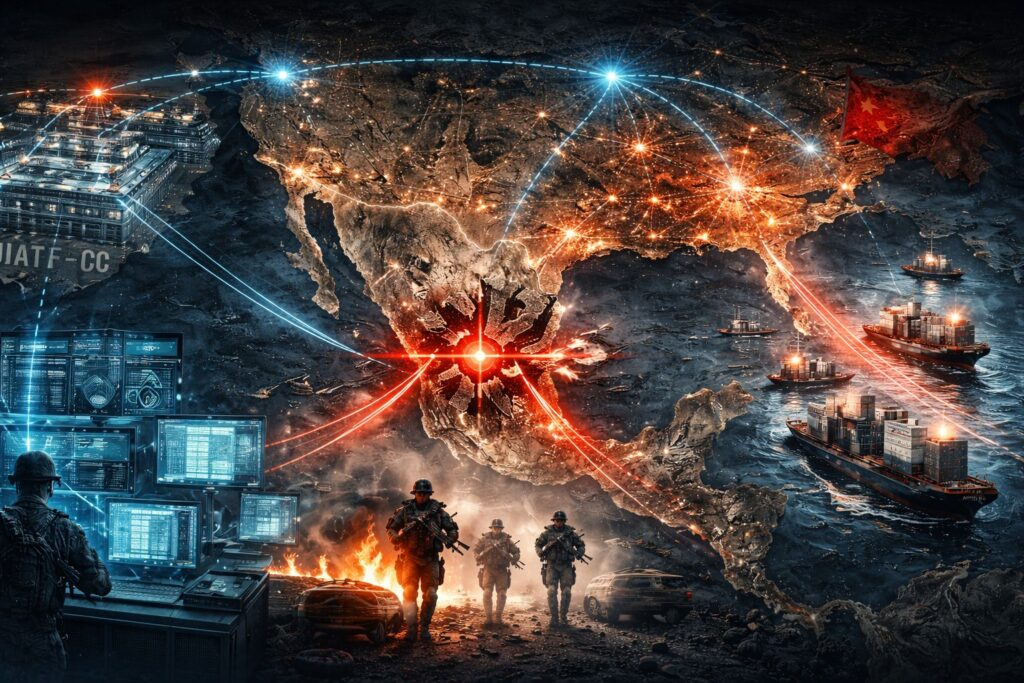
Or was what unfolded in the mountains of Jalisco something else entirely: the first public field test of a new U.S. doctrine for Latin America? An operation in which Mexico pulled the trigger – but Washington supplied the target, provided the ammunition, and had long since prepared the legal justification?
The gap between what we see (chaos) and what we should understand (calculation) is the real core of this story.
II. The Official Narrative: Mexico’s Great Triumph
Claudia Sheinbaum, Mexico’s president, had maintained a clear line for months: no U.S. soldiers on Mexican soil, no joint operations, no interference. México decide – Mexico decides. Given the massive pressure from Washington, which under Trump had extended to threats of military strikes on Mexican territory, this position was existentially important domestically.
After El Mencho’s death, Sheinbaum holds this line. The operation was carried out sovereignly. Mexican forces, Mexican decision. The population should remain calm.
Defense Minister Ricardo Trevilla Trejo delivers the operational account at a press conference: on February 20, 2026, army specialists identified a trusted associate who was accompanying one of El Mencho’s romantic partners to Tapalpa, Jalisco. The woman met with the cartel chief there. The Mexican army established a cordon in neighboring states – deliberately not in Jalisco itself, so as not to attract attention. On the morning of February 22, special forces moved in, supported by six helicopters and air force close air support. El Mencho attempted to flee into forested terrain, was wounded; a military helicopter had to make a forced landing after taking hits. El Mencho and two of his bodyguards died aboard the helicopter. For security reasons, the flight was diverted not to Guadalajara but to Morelia. (Wikipedia, “2026 Jalisco operation,” https://en.wikipedia.org/wiki/2026_Jalisco_operation)
This is the story both sides need. Trump needs the fentanyl win – concrete proof that his pressure on Mexico is bearing fruit. Sheinbaum needs the sovereignty – proof that Mexico can solve its own problems without tolerating American boots on its own soil. What we are witnessing is political theater for two domestic audiences simultaneously. A perfect arrangement. Almost too perfect.
III. The Documented Truth: The Invisible Hand
What the official narrative conceals seeps through multiple independent sources in the hours following the operation.
The Washington Post, citing two U.S. officials in Washington familiar with the matter, reports: CIA intelligence was instrumental – decisive – in locating El Mencho. The New York Times confirms the same, also with two independent U.S. sources. The CIA and other U.S. intelligence services provided information to Mexican authorities that made the operation possible in the first place. U.S. Deputy Secretary of State Christopher Landau publicly celebrates the operation on X the same Sunday: El Mencho had been “one of the most bloodthirsty and ruthless drug lords.” The U.S. Department of Defense confirms that an “interagency task force played a role.” (Washington Post/Union Leader, “CIA intelligence helped Mexican forces track down slain cartel boss,” February 23, 2026, https://www.unionleader.com/news/world/cia-intelligence-helped-mexican-forces-track-down-slain-cartel-boss/)
But who or what is this task force?
The Intercept reveals the answer: in January 2026, U.S. Northern Command (USNORTHCOM) established the Joint Interagency Task Force Counter Cartel, or JIATF-CC. Headquarters: Fort Huachuca, Arizona – one of the largest military intelligence training centers in the United States, located directly on the Mexican border. Commander: Air Force Brigadier General Maurizio Calabrese. In an interview with reporters, Calabrese describes his unit’s mission explicitly: he compares it to the targeted killing campaigns the United States conducted against Al-Qaeda and the Islamic State after September 11. The drug cartel threat, Calabrese says, may be even larger in scope. A former U.S. official confirms to The Intercept: Washington had assembled a detailed target package on El Mencho – and handed it to SEDENA, the Mexican Defense Ministry. (The Intercept, “Task Force Including ICE and FBI Helped Mexico Kill El Mencho,” February 24, 2026, https://theintercept.com/2026/02/24/el-mencho-mexico-fbi-task-force-counter-cartel/)
How you find a man like El Mencho
For readers without an intelligence background, it is worth briefly examining what such a target package actually means – and why Mexico could not have done this alone.
Professional target tracking by modern intelligence services combines three sources. HUMINT – Human Intelligence – are human sources on the ground: in this case, the surveillance of the trusted associate who drove the partner to Tapalpa. Behind this lie months of network analysis, informant cultivation, pattern-of-life observation – who moves how, when, with whom. SIGINT – Signals Intelligence – is electronic surveillance: metadata from mobile phones, location data, communications profiles, digital device movement traces. And drone reconnaissance delivers the visual confirmation: movement profiles from the air, real-time identification of vehicles and individuals.
Only when all three sources produce the same picture is a target package cleared for action. This is not a Mexican special unit stumbling upon Mexico’s most wanted criminal. This is industrial-scale surveillance – and Mexico simply does not possess these capabilities in this form.
The proof is an event from 2019: Mexican forces attempted in Culiacán to arrest Ovidio Guzmán López – El Chapo’s son, a Sinaloa cartel leader. The result: the Sinaloa cartel mobilized hundreds of heavily armed fighters within minutes, the city was paralyzed, six people died. After three hours, the Mexican government released Ovidio – too dangerous to hold the situation. (CNN, “Will the killing of El Mencho set off turf wars?” February 23, 2026, https://www.cnn.com/2026/02/23/americas/jalisco-cjng-sinaloa-mexico-cartels-war-intl-latam)
Tapalpa 2026: a brief, precise engagement. No retreat. El Mencho dead. The difference is not Mexican resolve. The difference is American targeting.
IV. The Legal Plow: The FTO Designation as an AUMF for Mexico
The military dimension of this story is spectacular. The legal dimension is at least as significant – and was largely overlooked by the international press.
The chronology of a paradigm shift
January 20, 2025, Trump’s first day in office: Executive Order 14157. Cartels and other organizations are designated as “Foreign Terrorist Organizations” and “Specially Designated Global Terrorists.” The order declares that cartels “functioned as quasi-governmental entities” and posed a national security threat “that goes beyond ordinary organized crime.” February 6, 2025: Secretary of State Marco Rubio makes the formal determination. February 20, 2025: Publication in the Federal Register, entry into force. Affected: CJNG, Sinaloa Cartel, Cártel del Noreste (formerly Los Zetas), Gulf Cartel, La Nueva Familia Michoacana, Carteles Unidos, MS-13, and Tren de Aragua. (Federal Register, “Foreign Terrorist Organization Designations,” FR Doc. 2025-02873, February 20, 2025, https://www.federalregister.gov/documents/2025/02/20/2025-02873/; Executive Order 14157, January 20, 2025, https://www.whitehouse.gov/presidential-actions/2025/01/designating-cartels-and-other-organizations-as-foreign-terrorist-organizations-and-specially-designated-global-terrorists/)
This is not a symbolic act. It is the activation of a legal toolkit.
Three levers that change everything
First: material support as a federal crime. Under 18 U.S.C. §2339B, it is a federal crime for any person subject to U.S. jurisdiction to knowingly provide “material support or resources” to a designated FTO – punishable by up to 20 years in prison, or life if death results. The term “material support” is defined extremely broadly: it encompasses not only money and weapons, but also goods, services, transportation, lodging, training, and expert advice. A Mexican transport company that pays the CJNG protection money – derecho de piso, as it is called in Mexico – could theoretically be prosecuted in the United States for supporting a terrorist organization. Attorney General Pam Bondi issued a memorandum on February 5, 2025 explicitly confirming the applicability of terrorism statutes to cartel proceedings. (WilmerHale, “Implications of EO 14157 and Recent FTO/SDGT Designations,” April 2025, https://www.wilmerhale.com/en/insights/client-alerts/20250422-implications-of-eo-14157-and-recent-foreign-terrorist-organization-and-specially-designated-global-terrorist-designations)
Second: extraterritorial reach. The law applies not only to U.S. citizens and U.S. companies. It has extraterritorial application – meaning non-American actors can also be targeted if a connection to U.S. interests exists. A Mexican avocado exporter, a Colombian cocaine supplier, a European bank with Mexico operations – all face potential legal exposure. The law firm WilmerHale warns explicitly in an analysis: “Compliance with foreign law and foreign government directives may not be a safe harbor” – because the executive order declares that many cartels have infiltrated foreign governments. Secondary sanctions additionally target foreign financial institutions that knowingly do business with FTO members.
Third: civil suits and asset forfeiture. Any U.S. citizen harmed by an “act of international terrorism” by an FTO can sue for treble damages – including against companies accused of supporting the perpetrators. All assets with FTO connections in the United States or held by U.S. persons are frozen. The case of Camarena v. Caro-Quintero, filed weeks after the FTO designation directly against the Sinaloa Cartel, is seen as a preview of a wave of similar suits. (Corporate Compliance Insights, “A Year After Designation of Cartels as Terrorists, What Is the Risk Landscape?” https://www.corporatecomplianceinsights.com/year-after-designation-cartels-risk-landscape-mexico/)
The AUMF parallel
Anyone who wants to understand the logic of this measure must look back to September 18, 2001. One week after the attacks on the World Trade Center, the U.S. Congress passed the Authorization for Use of Military Force – the AUMF. One sentence, 60 words, authorizing the president to use military force against any organization involved in the attacks or supporting such groups. From that one sentence came two decades of warfare in Afghanistan, Iraq, Syria, Somalia, Pakistan, and beyond – without Congress ever needing to vote again.
The FTO designation of the cartels is not legally identical to the AUMF – but it functions politically and strategically in an analogous way. It transforms criminals into “enemy combatants,” drug enforcement into counterterrorism, and in doing so opens an entirely different toolkit. The Center for Strategic and International Studies writes that the designation has “unlocked a suite of executive tools.” The Corporate Compliance Insights magazine warns companies explicitly: crisis management plans should “anticipate not just extortion and theft, but potential military operations or unilateral U.S. enforcement actions in Mexico” – citing the Maduro abduction directly as a precedent. (CSIS, “When Crime Becomes Terror: Rethinking the FTO Designation,” January 2026, https://www.csis.org/analysis/when-crime-becomes-terror-rethinking-fto-designation; Library of Congress/Congressional Research Service, “Designating Cartels as Foreign Terrorists: Recent Developments,” https://www.congress.gov/crs-product/IN11205)
The Congressional Research Service – the official research arm of Congress – notes that individual members of Congress are already examining whether legislation is required to explicitly authorize or prohibit military operations against FTO-designated cartels. The window is open.
El Mencho’s death as activation
His death is not the end of a chapter. It is the first spectacular strike that proves the new doctrine works. And the CJNG’s counterviolence in the hours that follow – 250 roadblocks, burning vehicles, attacks on National Guard soldiers – delivers the after-the-fact justification on a silver platter: look how dangerous these terrorists are. Our hard line was right.
V. The CIA and Its Long Shadows: No Historical Orphan
Anyone who wants to contextualize what happened in Tapalpa needs two historical data points – not as conspiracy theory, but as documented precedent.
The first: Kiki Camarena. DEA agent, murdered in 1985 in Guadalajara – of all places, Guadalajara. The Guadalajara Cartel was responsible. Mexico’s Dirección Federal de Seguridad, then the CIA’s primary partner agency in Mexico, was implicated in the kidnapping according to subsequent investigations. Camarena had dug too deeply into connections between CIA operations in Central America and Mexican drug networks – networks relevant to Contra financing. His death is the most direct historical evidence that the CIA and the Mexican drug world have not always stood on opposite sides of the barricade.
The second: Afghanistan. In 2000, the Taliban regime imposed a strict ban on opium poppy cultivation. Opium production collapsed by 94 percent – in a single year. In 2001, the United States invaded. What followed: production rose under NATO occupation from 185 metric tons to nearly 9,000 metric tons – an increase of over 4,700 percent. After the U.S. withdrawal in 2021, the Taliban again imposed a ban. The UNODC confirmed: of 233,000 hectares of cultivation in 2022, only 10,800 remained in 2023. One can explain this with the chaos of war. One cannot explain why an authoritarian Taliban regime achieved in two years what the United States failed to achieve in 20 – if one genuinely assumes that opium eradication in Afghanistan was ever a real priority. (UNODC, Afghanistan Opium Survey 2001, 2017, 2023, https://www.unodc.org/documents/crop-monitoring/Afghanistan/; CIA Inspector General Report, “Allegations of Connections Between CIA and the Contras in Cocaine Trafficking to the United States,” 1998, https://www.cia.gov/readingroom/document/06974496)
Both cases document the same pattern: control and destruction are two very different objectives. Anyone who knows this pattern reads El Mencho’s death differently.
A detailed timeline of documented CIA involvement in the global drug trade can be found in my analyses “US War on Drugs” and “CIA & Drug Trade” at www.michael-hollister.com.
VI. Cui Bono: Who Really Benefits from El Mencho’s Death?
The decisive question in geopolitical analysis is not: what happened? It is: who benefits?
Trump’s domestic politics: campaign ammunition
The fentanyl crisis kills over 70,000 Americans annually. It is the largest drug epidemic in American history – and Trump’s strongest domestic card. El Mencho’s death is the biggest anti-drug victory since the extradition of Joaquín “El Chapo” Guzmán to the United States in 2017. For Trump’s base, it is a direct, concrete result of “America First” pressure on Mexico: we put pressure on Mexico, and Mexico delivered. DEA Director Derek Maltz is publicly quoted by Trump immediately following the operation. This is not drug enforcement motivated by humanitarian concerns. It is campaign ammunition – produced on demand.
Mexico as leverage: the silent account
Sheinbaum gets a domestic triumph. Mexico has eliminated its most wanted cartel chief – without having to tolerate U.S. soldiers on its own soil. That is real, and valuable for her political standing.
But she pays the price elsewhere. The silent “you owe us” now sits on the negotiating table. Migration controls, border security, extradition pace, joint operations – Washington has accumulated a debt that it will collect. Ironically, El Mencho’s death makes Mexico more resilient in the short term against U.S. demands for unilateral drone strikes: some U.S. officials told The Intercept explicitly that the operation strengthens Mexico’s position. Sheinbaum can now say: we deliver results. You don’t need your own soldiers. This is a deal, not a partnership between equals.
The strategic flank: the grand context
In December 2025, the Trump administration published two documents that received almost no international attention but define the strategic framework for everything we have observed since: the new National Security Strategy and the National Defense Strategy. Both are unambiguous: Russia is no longer America’s primary adversary. The Indo-Pacific is the new primary theater. The containment of China is the strategic objective of the coming decade.
Anyone who wants to focus on China needs secured flanks. Venezuela has already been addressed: Operation Absolute Resolve, January 3, 2026 – U.S. special forces entered a presidential building in Caracas and took Nicolás Maduro into U.S. custody, where he has since been answering before a New York federal court on narco-terrorism charges. The country is under Washington’s control – and its oil reserves, the largest in the world, are once again accessible. El Mencho’s death is the next logical step in the same sequence: pacify the southern border, integrate Mexico as a reliable partner, clear the head for the actual objective.
El Mencho’s death is not an isolated event. It is balance-sheet consolidation before the big game.
CJNG as an industrial standard: the strategic problem
And then there is a consideration that is entirely absent from the reporting.
The CJNG under El Mencho was no longer an ordinary cartel. The organization operates in over 40 countries, maintains roughly 90 semi-autonomous factions in a franchise model, generates annual revenues in the billions, runs its own drone units, and maintains connections to Australia, China, and across Southeast Asia. This is not a criminal organization. It is a parallel state with its own foreign policy, its own logistics, its own coercive structure – and increasingly its own geopolitical logic.
An entity of this size and self-contained logic becomes, for Washington, a strategic risk that escapes control. Fragmentation – breaking it into smaller, competing, more easily infiltrated units – may, from a U.S. perspective, not be the collateral damage of this operation. It may be its calculated objective.
There is one further dimension entirely missing from international reporting. Manzanillo, the strategically important Pacific port under CJNG control, is not coincidentally the primary entry channel for Chinese chemicals used in fentanyl production. According to the U.S. Treasury Department, the CJNG maintains active connections to Chinese Money Laundering Networks (CMLNs) and sources precursor chemicals directly from China and India. Eliminating El Mencho and fragmenting the CJNG structure does not only disrupt a Mexican supply chain. It disrupts a Chinese-Mexican logistics axis. In preparation for a strategic confrontation with Beijing, this is not collateral damage. It is calculated groundwork.
VII. After El Mencho: The Power Vacuum and Its Heirs
El Mencho’s death leaves behind one of the most dangerous constellations in the Mexican drug war: an extremely powerful, extremely centralized cartel with no identifiable successor.
The broken line of succession
The natural heir was Rubén Oseguera González, known as “El Menchito.” El Mencho’s son had led the CJNG as number two for years and was the designated successor. But in March 2025, he was sentenced in the United States to life plus 30 years – along with a forfeiture of over $6 billion. The succession has been amputated.
El Mencho’s brother Abraham has been in Mexican custody since February 2025. His brother Antonio, known as “El Tony Montana,” was arrested in the greater Guadalajara area as early as 2022. A further sister and several brothers-in-law from the González Valencia family – the financial backbone of the cartel – are also in U.S. or Mexican custody.
The CJNG was extremely vertically structured. El Mencho had deliberately refrained from naming a designated successor – a classic autocratic strategy for preventing internal coups. This structure was his strength. Now it is his legacy as a weakness.
Five candidates for succession
Mexican security expert Víctor Manuel Sánchez Valdés and the InSightCrime analytical network identify five figures who will be decisive in the coming months: (InSightCrime, “What’s Next for Mexico’s CJNG After the Killing of ‘El Mencho’?” February 23, 2026, https://insightcrime.org/news/whats-next-for-mexicos-cjng-after-the-killing-of-el-mencho/)
Juan Carlos Valencia González – “El 03”: El Mencho’s stepson is the only candidate with dynastic legitimacy. He leads the Grupo Élite, the CJNG’s special operations military arm – responsible for targeted killings, territorial conquest, and high-value target operations. The American side identifies him as the de facto number two; the U.S. State Department has placed a $5 million bounty on him. The pointed detail: El 03 was born in California. He is a U.S. citizen. The possible future chief of the largest FTO-designated criminal organization in the Western Hemisphere is American.
Audias Flores Silva – “El Jardinero”: The regionalist. Flores Silva controls territory across five states – Jalisco, Michoacán, Nayarit, Zacatecas, Guerrero. Sanctioned by the U.S. Treasury Department, he is regarded as the architect of the CJNG’s alliance with the Chapitos faction of the Sinaloa Cartel against a rival Sinaloa faction – a diplomatic coup in Mexico’s underworld chess match. In the world of cartels, leadership figures do not communicate via press releases. They communicate via narcocorrido. A corrido from 2022, “El Sucesor,” describes Flores Silva as the designated successor. In 2025 another anthem appeared: “My sign and watchword is in the press: that I am the successor of the organization.” In this world, such lyrics are not art. They are communication.
Hugo Mendoza Gaytán – “El Sapo”: The institutionalist. Responsible for recruitment, training, control of armed cells, and port logistics – particularly in the strategically vital port of Manzanillo, the primary entry point for chemicals from China used in fentanyl production. El Sapo understands the organizational logic of the cartel. His leadership style would mean less spectacular violence – but more stable, institutional continuity. The CJNG would not become less dangerous; it would become more institutional.
Ricardo Ruiz Velasco – “El Doble R”: The city man. Guadalajara is more than a city for the CJNG – it is the historical place of origin, the logistics center, the nervous system of the cartel. El Doble R controls the urban infrastructure: internal security, financial logistics, coordination of cells in the metropolitan region. Without Guadalajara, the CJNG loses its cohesion.
Heraclio Guerrero Martínez – “Tío Lako”: The regional warlord. Specializing in huachicol – fuel theft from pipelines – a revenue source that has made the CJNG one of Mexico’s largest energy thieves. More a fragmentation candidate than an overall successor: should the cartel break apart, he would run his area autonomously.
The El Chapo comparison: a bad omen
When Joaquín “El Chapo” Guzmán was arrested in 2016 and extradited to the United States in 2017, his sons – the Chapitos – took over the Sinaloa Cartel. But even this apparently orderly dynastic succession triggered an internal civil war: the Chapitos faction against the faction of Ismael “El Mayo” Zambada. In 2024, this conflict escalated to open warfare in Culiacán. Hundreds dead.
The CJNG no longer has a dynastic option. The most likely development is not an orderly succession. It is a phase of brutal violence between factions, territorial battles between camps, possible splintering of regional warlords under their own flags.
And this phase of fragmentation and chaos provides precisely the framework that the FTO designation needs for further interventions.
VIII. Outlook: Who Governs Whom?
The official version reads: Mexico has triumphed. Sovereignty is intact. The rule of law has functioned.
The documented version looks different: Washington supplied the intelligence, JIATF-CC coordinated the target package, the CIA provided the decisive localization – and Mexico pulled the trigger. How sovereign is a state when the decisive intelligence comes from Fort Huachuca, Arizona?
The FTO designation is the legal plow. El Mencho’s death has plowed the field. What will be planted next?
And perhaps the most uncomfortable question of all: if the stated objective were the destruction of the cartels – why does every U.S. intervention in Mexico end historically with more fragmentation, more violence, and new factions moving to fill the space? Why does drug trafficking grow everywhere the CIA operates? And why does it shrink everywhere that authoritarian bans are consistently enforced – from the Taliban in 2001 to the Taliban in 2022?
Perhaps because control and destruction are two very different objectives.
And perhaps because a controllably fragmented Mexico – with competing, weaker cartels, all dependent on U.S. intelligence to survive – is more useful to Washington than a Mexico that has genuinely solved its drug problem.
This analysis is made available for free – but high-quality research takes time, money, energy, and focus. If you’d like to support this work, you can do so here:
Alternatively, support my work with a Substack subscription – from as little as 5 USD/month or 40 USD/year!
Let’s build a counter-public together.
Michael Hollister is a geopolitical analyst and investigative journalist. He served six years in the German military, including peacekeeping deployments in the Balkans (SFOR, KFOR), followed by 14 years in IT security management. His analysis draws on primary sources to examine European militarization, Western intervention policy, and shifting power dynamics across Asia. A particular focus of his work lies in Southeast Asia, where he investigates strategic dependencies, spheres of influence, and security architectures. Hollister combines operational insider perspective with uncompromising systemic critique – beyond opinion journalism. His work appears on his bilingual website (German/English) www.michael-hollister.com, at Substack at https://michaelhollister.substack.com and in investigative outlets across the German-speaking world and the Anglosphere.
© Michael Hollister – All rights reserved. Redistribution, publication or reuse of this text requires express written permission from the author. For licensing inquiries, please contact the author via www.michael-hollister.com.
Newsletter
🇩🇪 Deutsch: Verstehen Sie geopolitische Zusammenhänge durch Primärquellen, historische Parallelen und dokumentierte Machtstrukturen. Monatlich, zweisprachig (DE/EN).
🇬🇧 English: Understand geopolitical contexts through primary sources, historical patterns, and documented power structures. Monthly, bilingual (DE/EN).