
by Michael Hollister
Exclusive published at Michael Hollister on February 27, 2026
4.252 words * 22 minutes readingtime
This analysis is made available for free – but high-quality research takes time, money, energy, and focus. If you’d like to support this work, you can do so here:

Alternatively, support my work with a Substack subscription – from as little as 5 USD/month or 40 USD/year!
Let’s build a counter-public together.
Why Iran Cannot Escape the War
On Monday, February 24, 2026, twelve F-22 Raptor fighter jets landed at Ovda Air Base in the Negev Desert, south of Tel Aviv. It was the first time in history that the United States had stationed offensive combat aircraft directly on Israeli soil. No press conference. No official statement. The information leaked through open-source flight tracking.
Two days earlier, a dozen KC-135 Stratotankers – aerial refueling aircraft of the U.S. Air Force – had parked at Ben Gurion International Airport. Again: no announcement. Again: no comment.
Anyone who knows what tanker aircraft are for understands the message immediately.
Tanker aircraft are not a defensive weapon. They are the logistical prerequisite for long-range strikes. An F-22 cannot fly from Israel to Fordow – Iran’s uranium enrichment facility bored into a mountain – and back without refueling en route. The distance is just under 1,800 kilometers. The tankers in Tel Aviv mean: attack radii have been calculated. The supply chain has been laid.
While those aircraft are parked, negotiators are meeting in Geneva. On February 26, U.S. Special Envoy Steve Witkoff and Iranian Foreign Minister Abbas Araghchi sit down for the third round of nuclear talks. Both sides describe the talks as “constructive.” The United States has simultaneously assembled the largest strike fleet in the Middle East since the Iraq War of 2003.
This is not a contradiction. It is method.
The Fleet – What Is There and What It Means
To understand what is at stake, one must understand what the United States has concentrated in the Persian Gulf region and the eastern Mediterranean. Not as an inventory of weapons systems, but as what it is: an attack architecture.
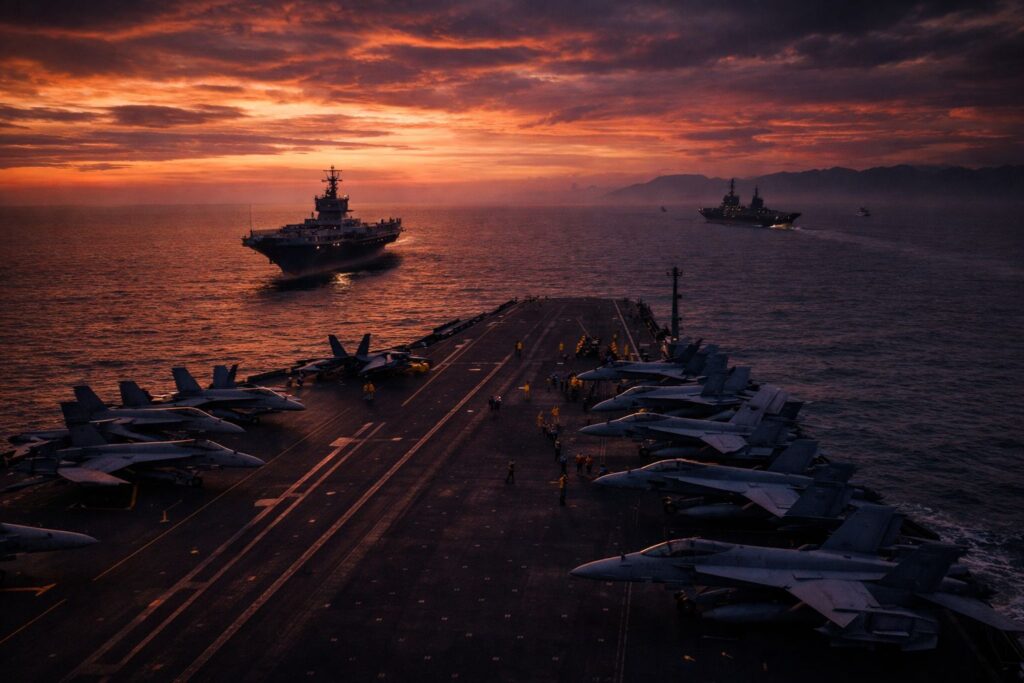
USS Abraham Lincoln (CVN-72) – in the U.S. Central Command Area of Responsibility since January 26. A Nimitz-class aircraft carrier: 333 meters long, nuclear-powered, with up to 90 aircraft aboard. On the Lincoln: F-35C Lightning II stealth fighters of the fifth generation, invisible to enemy radar; F/A-18E/F Super Hornets as the primary strike force; EA-18G Growlers for electronic warfare – the targeted disabling of enemy radar and communications systems; and E-2D Advanced Hawkeyes for airspace surveillance and battle management. (Army Recognition, “US Navy Redirects USS Abraham Lincoln Strike Group Toward Middle East,” https://www.armyrecognition.com/news/navy-news/2026/u-s-navy-redirects-uss-abraham-lincoln-strike-group-toward-middle-east-as-iran-tensions-surge; The War Zone, “Lincoln Carrier Strike Group Has Arrived In CENTCOM’s Area Of Responsibility,” https://www.twz.com/news-features/lincoln-carrier-strike-group-has-arrived-in-centcoms-area-of-responsibility)
Three Arleigh Burke-class guided missile destroyers escort the carrier: USS Frank E. Petersen Jr., USS Spruance, and USS Michael Murphy. At this point it is worth pausing, because most readers will not have a concrete picture of an Arleigh Burke destroyer.
An Arleigh Burke is not an escort ship in the sense that it protects the carrier and otherwise plays a minor role. It is a complete offensive and defensive system in one. 155 meters long, equipped with the Aegis combat system: an electronics platform capable of simultaneously tracking and engaging up to 100 air and sea targets. In its hull sit up to 90 missile launchers in vertical silos. These launchers can be loaded either with SM-3 missiles for ballistic missile defense – or with Tomahawk cruise missiles.
The Tomahawk has a range of 1,700 kilometers, an impact accuracy of under ten meters, and flies so low that conventional air defense systems can barely detect it. Three Arleigh Burke destroyers theoretically mean up to 270 such cruise missiles – in this group alone, for these three ships alone, apart from the carrier itself, apart from the aircraft, apart from what is still to come.
What is still to come is the USS Gerald R. Ford (CVN-78): On February 20, the most advanced warship in the world crossed the Strait of Gibraltar and entered the Mediterranean. On February 23, it was in Souda Bay, Crete. From Crete to the Israeli coast is a day’s march. (The War Zone, “Supercarrier USS Gerald R. Ford Has Crossed Into The Mediterranean,” https://www.twz.com/news-features/supercarrier-uss-gerald-r-ford-has-crossed-into-the-mediterranean; Stars and Stripes, “Ford carrier group arrives in Mediterranean, bringing more potential strike options against Iran,” https://www.stripes.com/branches/navy/2026-02-20/ford-middle-east-mediterranean-iran-20813486.html)
The Ford class is a step above the Nimitz class. It can sustain a higher sortie rate – more aircraft launching and landing per hour – with a smaller crew and greater automation. The Ford too comes with its own battle group: guided missile cruisers, additional Arleigh Burke destroyers, supply vessels, and almost certainly at least one nuclear attack submarine, whose identity is not confirmed for operational security reasons.
Two carrier groups operating jointly in CENTCOM – this is the first dual-carrier constellation in this operational area since the opening weeks of the Iraq War in March 2003. (Army Recognition, “US Deploys Second Aircraft Carrier USS Gerald R. Ford to Middle East,” https://www.armyrecognition.com/news/navy-news/2026/us-deploys-second-aircraft-carrier-uss-gerald-r-ford-to-middle-east-amid-tensions-with-iran)
Then the land-based air forces:
Muwaffaq Salti Air Base in Jordan: satellite imagery from February 20 shows every visible parking spot occupied. F-15E Strike Eagles, redeployed from RAF Lakenheath in England, stand wing to wing. The F-15E is the U.S. Air Force’s best strike aircraft for conventional long-range precision attacks – and it can carry bunker busters, bombs designed to penetrate reinforced concrete structures. Exactly the kind of bombs needed to hit a facility built into a mountain. (Wikipedia, “2026 United States military buildup in the Middle East,” https://en.wikipedia.org/wiki/2026_United_States_military_buildup_in_the_Middle_East)
Ovda Air Base, Negev: 12 F-22 Raptors, as described, stationed directly in Israel for the first time. The F-22 is not primarily a bomber. It is an air superiority fighter and – critically in this context – a SEAD specialist: Suppression of Enemy Air Defenses. That is the military term for “disabling enemy air defense.” Before bombers can strike, F-22s must ensure that Iranian surface-to-air missiles are blinded or neutralized. That is the first wave in every modern air campaign. The Raptors are the first wave. (Aerospace Global News, “US military build-up near Iran accelerates with F-22s and USS Ford,” https://aerospaceglobalnews.com/news/us-f22-raptors-israel-ford-middle-east/)
Lajes Field in the Azores – a staging point for aircraft en route from the United States to the Middle East: on February 18 and 19, the largest U.S. force buildup ever documented there: at least eleven KC-46 Pegasus tankers, twelve F-16 fighters, one C-17 transport aircraft, approximately 400 U.S. personnel. These are the reinforcement waves now under way. (The War Zone, “Supercarrier USS Gerald R. Ford Has Crossed Into The Mediterranean”)
E-3C AWACS airspace surveillance aircraft were repositioned from Al Udeid Air Base in Qatar to Prince Sultan Air Base in Saudi Arabia. The detail matters: Al Udeid sits directly on the Persian Gulf – within direct strike range of Iranian missiles. The move to Prince Sultan, farther from the border, shows that the U.S. military is pulling its most valuable intelligence assets out of first-strike range. Clearing the flank.
A nuclear-powered attack submarine escorts the Lincoln group. More will escort the Ford group. Virginia-class or Los Angeles-class – identity classified, presence treated as certain. Each of these boats can fire Tomahawk cruise missiles from a submerged position. No radar detection possible. No warning.
The overall picture: Two carrier strike groups. At least six Arleigh Burke destroyers with several hundred Tomahawks. Stealth fighters for the first attack wave. F-22s for air defense suppression. F-15Es for heavy bombing. Aerial refueling positioned in Israel. Electronic warfare embedded. Airspace surveillance active.
This is not a show of force. This is an attack architecture in its construction phase.
Negotiate and Arm – A Familiar Choreography
On Saturday, February 21, 2026, Steve Witkoff said the following in a Fox News interview: Trump was curious as to why Iran had not yet capitulated. “He’s curious as to why they haven’t… I don’t want to use the word ‘capitulated,’ but why they haven’t capitulated.” Witkoff offered that as a description of the president’s state of mind. It was not a slip. (Axios, “Witkoff says any Iran nuclear deal should last indefinitely,” https://www.axios.com/2026/02/25/witkoff-iran-deal-indefinite-geneva-talks)
Two days later, on February 23, Oman confirmed a third round of talks for February 26 in Geneva. Witkoff and Araghchi. The same men who first met in April 2025. (Al Jazeera, “Oman confirms US-Iran talks will take place in Geneva on Thursday,” https://www.aljazeera.com/news/2026/2/22/oman-confirms-us-iran-talks-will-take-place-in-geneva-on-thursday)
To put this in context, it is worth looking at what happened between that first meeting and today.
April through June 2025: Five rounds of negotiations in Oman and Rome. Iran signaled willingness to compromise on the nuclear issue. Talks were described as “constructive.” On June 12, 2025, the IAEA placed Iran in noncompliance with its nuclear obligations. Days later, U.S. forces, together with Israel, bombed Iran’s nuclear facilities at Fordow, Natanz, and Isfahan. While negotiations were ongoing, bombs were falling. (PBS NewsHour, “A timeline of tensions over Iran’s nuclear program as talks with U.S. approach,” https://www.pbs.org/newshour/world/a-timeline-of-tensions-over-irans-nuclear-program-as-talks-with-u-s-approach)
Now, February 2026: Talks are running again. The fleet is building up.
This is neither coincidence nor contradiction. Anyone familiar with the history of American military interventions over the past thirty years recognizes the pattern: negotiations proceed until they are declared failed – or until they are declared concluded in a way that leaves the other side no choice. In parallel, troops are positioned, logistics laid, political consensus built within the alliance. The military buildup does not run because of the negotiations – it runs independently of them.
One must go further back to understand the pattern fully. In 2015, the JCPOA was signed – the nuclear agreement between Iran, the five UN Security Council permanent members, and Germany. Iran accepted intensive IAEA inspections. Iran reduced its uranium enrichment level to 3.67 percent. Iran allowed inspectors into facilities that had previously been closed. The IAEA confirmed in every subsequent report: Iran was complying with the agreement. Until 2018. (PBS NewsHour, “A timeline of tensions over Iran’s nuclear program”)
In May 2018, the Trump administration – in its first term – unilaterally withdrew from the JCPOA. Justification: it was the “worst deal ever.” Not because Iran had broken it. Not because the IAEA had found violations. But because Washington had decided it no longer wanted the agreement. Iran was in compliance and still lost the deal.
The lesson Tehran drew from this: agreements with Washington offer no protection. Washington withdraws when it is opportune to do so. This knowledge shapes Iran’s current posture in the Geneva talks – and it is rational.
Why Iran Cannot Capitulate
Witkoff’s word – “capitulated” – is more precise than it sounds. It describes exactly what the United States is demanding.
The American conditions for concluding negotiations, taken in their entirety: complete halt of uranium enrichment, dissolution of the missile program, end of financing and support for regional proxy groups. Each of these three points is not merely politically difficult for Iran to fulfill. Each is structurally existential.
To understand this, one must know what Iran’s military strategy is – and why it is what it is. I have analyzed this in detail in my articles “Drones Against Hegemony” (Part 4) and “The Axis of Resistance” (Part 3) of this series. The short version for this context:
Iran has no conventional air force. The Iranian air force flies F-14 Tomcats from the 1970s and F-4 Phantoms from the Vietnam War era. The average age of the fleet exceeds forty years. Against F-22s and F-35s, it would be history within hours. This is not an assessment – it is physical reality. (Middle East Council on Global Affairs, “Iran’s Missile and Drone Program – Disrupting U.S. Aerial Hegemony,” July 2024, https://mecouncil.org/publication/irans-missile-and-drone-program-disrupting-u-s-aerial-hegemony/; CSIS Missile Defense Project, “Missiles of Iran,” https://missilethreat.csis.org/country/iran/)
Iran cannot achieve air superiority. That is the starting point. Everything else follows from it.
What Iran has developed instead is an asymmetric deterrence strategy. Missiles and drones, cheap enough for mass production, precise enough for strategic targets, numerous enough to overwhelm even the best air defense. A $20,000 drone can force a $3 million interceptor missile – or get through if there are not enough interceptors available. That is the cost-benefit logic on which Iran has built its entire defense doctrine.
These missiles and drones are not peripheral. They are the core of the only deterrence Iran has. When Washington demands the dissolution of this program, it is demanding Iran’s military defenselessness.
The same applies to the regional proxy groups – what Iran calls its “Axis of Resistance”: Hezbollah in Lebanon, the Houthis in Yemen, Iraqi Shia militias, Hamas. Iran describes these not as instruments of aggression, but as forward defensive lines. The strategic logic – omgh-e estratezhik, strategic depth – is the direct consequence of the Iran-Iraq War of the 1980s: a war Iran fought alone while the international community supported Saddam Hussein. The lesson: fight threats outside your own borders before they reach them. (Middle East Council on Global Affairs, “Hezbollah’s Defeat and Iran’s Strategic Depth Doctrine,” https://mecouncil.org/publication/hezbollahs-defeat-and-irans-strategic-depth-doctrine/)
This network has been badly damaged since October 2023, as I analyzed in Part 3: Hezbollah militarily decimated, Nasrallah dead, Assad’s Syria fallen, Hamas reduced to survival mode. Iran’s strategic depth has eroded. What Witkoff and Trump are demanding is the formal dissolution of what remains.
A regime that signs this has to explain to its own population and its Revolutionary Guards why it did so. It has to explain to the global Muslim public why it capitulated. It has to explain to its own history why it is surrendering everything it worked, bled, and economically suffered for over forty years.
This is not a political challenge. It is the death blow for the regime.
Araghchi said this directly in a CBS News interview. Iran had “very good capabilities in missiles” and since the U.S.-Israeli strikes of June 2025 was “in an even better position” than before. This is not a public posture. It is the factual description of the only negotiating position the regime can sustain domestically.
There is a serious counterargument that must be acknowledged. Ray Takeyh, Hasib J. Sabbagh Senior Fellow for Middle East Studies at the Council on Foreign Relations and one of the most prominent Western Iran analysts, argues in his analysis of February 10, 2026, that Tehran remains in negotiations despite everything because it is structurally weakened: Hamas largely destroyed, Hezbollah decimated, Assad’s Syria fallen, Iran’s air defenses penetrated by Israel in 2025. From this position, Takeyh argues, talks make strategic sense for Iran – not as capitulation, but as a means of buying time and attempting to split the international community. The regime negotiates to avoid fighting, as long as conditions still appear negotiable.
This reading is not wrong. It does not, however, explain why Washington is simultaneously deploying two carrier strike groups to the region, stationing F-22s on Israeli soil, and positioning tanker aircraft – measures that are operationally disproportionate for pure negotiating diplomacy. Takeyh himself notes that Iran has offered “few concessions” and that talks are largely proceeding on Iran’s terms. That is not a description of a side moving toward an agreement. It is a description of two sides playing for time – with different clocks.
The Strategic Context: Iran in the Grand Game
What is almost entirely absent from Western media coverage is the embedding of the Iran conflict within Trump’s global strategy. Those who understand where the journey is headed also understand why negotiations here must structurally fail.
In my article “Operation Pivot“, I analyzed Trump’s foreign policy doctrine on the basis of the National Security Strategy (November 2025) and the National Defense Strategy (January 2026). The conclusion in one sentence: Trump wants a free hand against China, and for that he must clear all disruptive variables from the board. (White House, National Security Strategy, November 2025, https://www.whitehouse.gov/wp-content/uploads/2025/12/2025-National-Security-Strategy.pdf; U.S. Department of Defense, National Defense Strategy, January 2026, https://www.defense.gov/National-Defense-Strategy/)
The RAND Corporation warned in its 2016 study “War with China: Thinking Through the Unthinkable”: the United States has eight to ten years to contain China’s rise. After that, China will be so dominant militarily, economically, and technologically that containment becomes impossible. 2016 plus ten years is 2026. This year. (RAND Corporation, “War with China: Thinking Through the Unthinkable,” 2016, https://www.rand.org/pubs/research_reports/RR1140.html)
Trump’s NDS makes the priority unmistakable: “China pacing challenge.” Everything subordinates to this. Europe is to defend itself against Russia. “Europe taking primary responsibility for its own conventional defense is the answer.” The United States has more important things to do.
In this context, Venezuela was the first step. On January 3, 2026, U.S. fighter jets bombed the Miraflores presidential palace in Caracas, Delta Force abducted President Maduro, and Trump announced that the United States would govern Venezuela and sell its oil. 303 billion barrels of proven oil reserves – the largest in the world – 2,200 kilometers from the U.S. coast. Energy security for what is to come.
Iran is step two. Not primarily because of the danger of its nuclear program – but because of its role as a potential disruptive variable while the United States is tied down in the Pacific. An Iran that exploits a Taiwan crisis to fire missiles at Israel? That would force the United States to redeploy forces from the Pacific. That is the strategic dilemma. So Trump eliminates it now.
Panama follows – recapturing the canal as a chokepoint against China. Then the main confrontation in the Indo-Pacific.
This is not a secret plan. It is written in the strategy documents.
Iran falls into this sequence not because it is the most dangerous adversary. Iran falls into this sequence because it is in the way, and because the window is closing.
There is another factor that barely appears in the Western mainstream media. The current negotiations are taking place against the backdrop of Iran’s Hormuz gambit: on February 17, Tehran declared a temporary closure of the Strait of Hormuz during the Geneva talks as a show of force. Twenty-one percent of globally traded oil flows through this 54-kilometer-wide strait. The message: if you attack us, we close Hormuz. Then oil prices explode. Then the global economy collapses.
That was once a reliable pressure instrument. It is weakening as the United States controls Venezuelan oil. Short supply lines, no Hormuz dependency.
The calculus is not substitution but asymmetry: if Iran closes the Strait of Hormuz and oil prices explode, the shock hits China – which has covered roughly a quarter of its oil needs through Venezuelan and Iranian deliveries – far harder than the United States, which secures its needs through short supply lines from Venezuela. An exploding oil price damages Trump’s primary geopolitical adversary. It is not collateral damage. It is a byproduct that is accepted – or factored in as a calculated benefit.
The Mechanics of the Attack
What happens if the negotiations in Geneva fail – or if Washington declares them failed?
This cannot be predicted with certainty. But the military positions point in a clear direction.
First wave: The F-22 Raptors from Ovda disable Iranian air defense systems. That is their core mission. SEAD – Suppression of Enemy Air Defenses. Simultaneously, Tomahawk cruise missiles from the Arleigh Burke destroyers in the Arabian Sea begin their approach to pre-designated targets. Tomahawk flight time at this distance: several hours. They will be fired before the main wave begins.
Second wave: F-35Cs from the Abraham Lincoln and F/A-18E/Fs for the primary targets. Fordow is the most difficult target – built deep into granite, barely reachable by conventional bombs. This requires either the GBU-57 Massive Ordnance Penetrator, a 14-ton bunker-busting bomb that only B-2 or B-52 bombers can carry – or repeated strikes on the same impact point. The repositioning of tanker aircraft to the Azores and Israel is also relevant in the context of strategic bombers: B-52s from Diego Garcia and B-2s from Whiteman Air Force Base in Missouri require aerial refueling over the Middle East.
Iran’s possible counterstrikes – ballistic missiles against Israeli cities, against U.S. bases in Jordan and Saudi Arabia, possibly drone attacks against aircraft carriers in the Arabian Sea – are documented and anticipated. The Arleigh Burke destroyers with their Aegis systems are built for this. Patriot batteries in Israel and the Gulf states are built for this. No system is one hundred percent effective. But the attacking side is calculating that the costs are manageable.
What cannot be calculated are the secondary effects: Iraqi Shia militias attacking U.S. bases in Iraq. Houthi missiles against Saudi oil infrastructure. A region in full conflagration. These are the risks that even the most optimistic Pentagon planners cannot ignore.
What remains of Iran afterward? A country without functioning nuclear facilities, without an air force, without missile bases, without a command structure – if the command centers are also struck. A population of 85 million people. An economy under sanctions. The Iraq scenario of 2003, this time without ground troops.
Whether the regime survives or collapses depends on factors no external analysis can predict. What is predictable: the Iran that exists afterward will not be a military factor for at least a generation. That is the objective.
What the Silent Ones Are Losing
There is a question that is systematically absent from Western reporting: what does the international community lose when yet another country is removed from the strategic equation following a template choreography of negotiations, threats, and bombardment?
The pattern is familiar. Afghanistan 2001. Iraq 2003. Libya 2011. Syria from 2012. Venezuela January 2026. Now Iran. The justifications change – counterterrorism, weapons of mass destruction, humanitarian intervention, democracy promotion, counternarcotics, revolutionary protection. The structure remains the same: negotiations proceed, troops are positioned, a trigger is found or constructed, bombardment follows.
Neither NATO nor the EU has published a critical statement regarding this buildup. Germany is silent. France is silent. Britain, which is reportedly being asked to make Diego Garcia available for an Iran strike – something Trump has explicitly lobbied for and which London has formally declined so far – is largely silent. (Al Jazeera, “Tracking the rapid US military build-up near Iran,” https://www.aljazeera.com/news/2026/2/20/tracking-the-rapid-us-military-build-up-near-iran)
The silence has reasons. Economic dependencies. Security guarantees. Pressure. The fact that European capitals, having analyzed the U.S. National Defense Strategy, know very well that they will be left alone by Washington when it comes to Russia – and therefore cannot afford to antagonize Washington elsewhere.
The result is a situation in which the largest concentration of military power in the Middle East in twenty years is being assembled without meaningful public debate. Not because no one sees it. But because silence is easier than naming it.
What Is Happening Now
Today, February 26, 2026, Witkoff and Araghchi are sitting in Geneva. The talks are, as everyone describes them, diplomacy’s third chance. Iran has reportedly prepared a proposal. Washington is waiting.
Meanwhile, tanker aircraft are parked in Tel Aviv. F-22s stand at Ovda. Two carrier groups are approaching the Persian Gulf.
The U.S. demands – complete enrichment halt, missile dissolution, proxy termination – are structurally non-negotiable, because fulfilling them would destabilize the regime. Witkoff knows this. The regime knows this. Witkoff articulated it publicly by using the word “capitulation” and simultaneously asking why it had not yet occurred.
This is not negotiating diplomacy. This is a countdown preceded by a negotiating backdrop.
When precisely the strike will come – whether after the failure of this round, after a constructed incident, after another round of talks as an extension of the timeline – that is the only open variable. The strategic decision, measured by troop disposition, logistical buildup, and the public statements of the actors involved, appears to have been made.
In my article “Operation Pivot,” I analyzed the overall architecture of this policy: Venezuela was the insurance policy for Hormuz, Iran is the flank cover for the Pacific, Panama is the chokepoint against China. What is being assembled before Iran is not a single event. It is the second chapter of a series.
Anyone who understands the tanker aircraft in Tel Aviv has already read the book to the end.
The only real variable is whether domestic or allied pressure forces Trump to pause again – as with Greenland. The troop disposition suggests that this time the calculus is different.
Editorial Note, February 27, 2026:
The third round of negotiations in Geneva ended yesterday without agreement. Both sides speak of “progress”; the core demands – enrichment ban, missile reduction, indefinite deal – remain irreconcilable. Technical talks follow next week in Vienna. The military buildup continues unchanged. (NPR, “US and Iran to hold a third round of nuclear talks,” https://www.npr.org/2026/02/26/g-s1-111595/u-s-iran-to-third-round-nuclear-talks; Euronews, “Oman confirms new round of US-Iran nuclear talks will be held on Thursday in Geneva,” https://www.euronews.com/2026/02/23/oman-confirms-new-round-of-us-iran-nuclear-talks-will-be-held-on-thursday-in-geneva)
This analysis is made available for free – but high-quality research takes time, money, energy, and focus. If you’d like to support this work, you can do so here:
Alternatively, support my work with a Substack subscription – from as little as 5 USD/month or 40 USD/year!
Let’s build a counter-public together.
Michael Hollister is a geopolitical analyst and investigative journalist. He served six years in the German military, including peacekeeping deployments in the Balkans (SFOR, KFOR), followed by 14 years in IT security management. His analysis draws on primary sources to examine European militarization, Western intervention policy, and shifting power dynamics across Asia. A particular focus of his work lies in Southeast Asia, where he investigates strategic dependencies, spheres of influence, and security architectures. Hollister combines operational insider perspective with uncompromising systemic critique – beyond opinion journalism. His work appears on his bilingual website (German/English) www.michael-hollister.com, at Substack at https://michaelhollister.substack.com and in investigative outlets across the German-speaking world and the Anglosphere.
© Michael Hollister – All rights reserved. Redistribution, publication or reuse of this text requires express written permission from the author. For licensing inquiries, please contact the author via www.michael-hollister.com.
Newsletter
🇩🇪 Deutsch: Verstehen Sie geopolitische Zusammenhänge durch Primärquellen, historische Parallelen und dokumentierte Machtstrukturen. Monatlich, zweisprachig (DE/EN).
🇬🇧 English: Understand geopolitical contexts through primary sources, historical patterns, and documented power structures. Monthly, bilingual (DE/EN).