
Who Pocketed €5 Billion from the EU NGO Budget
by Michael Hollister
Exclusive published at Michael Hollister on February 22, 2026
2.913 words * 15 minutes readingtime
A similar Analysis about NGOs please read here:
NGO´s – The Invisible Hand – How NGOs Became Tools of Regime Change
This analysis is made available for free – but high-quality research takes time, money, energy, and focus. If you’d like to support this work, you can do so here:

Alternatively, support my work with a Substack subscription – from as little as 5 USD/month or 40 USD/year!
Let’s build a counter-public together.
Government Organizations Classified as NGOs – And How the Same Recipients Are Financed from Multiple Pots Simultaneously
Summary: The European Court of Auditors documented in April 2025: 12,000 NGOs received EU funds, 40 percent of which flowed to just 30 organizations. Their names were redacted in the report and not disclosed by the Commission upon parliamentary inquiry. An independent evaluation of the EU financial database identifies these 30 organizations. Among them are state-controlled federal institutes fulfilling governmental functions—and these same organizations finance themselves not only from the NGO pot but simultaneously from up to 16 additional EU programs.
Sources: ECA SR-2025-11 · EU Financial Transparency System · CORDIS · Parliamentary Inquiries E-003339/2025, P-001894/2025, P-001458/2025
What Is an NGO? The Foundation
Before we examine numbers and names, we must clarify a question the EU Commission has not answered to this day:
What actually is a non-governmental organization?
The EU Commission published an updated definition in 2024.
According to this, an NGO is an organization that fulfills the following criteria:
- It is non-profit-oriented.
- It is legally independent from government entities.
- It pursues no commercial interests.
- It acts in the interest of the general public or specific social groups.
- It is not part of a government apparatus.
This definition sounds clear. But it is only clear on paper. In practice – this is the core of what this article shows – the European Commission has never systematically applied these criteria. Every organization that called itself an NGO was treated as an NGO.
External verification: none.
This is not a claim of this article. This is a finding of the European Court of Auditors.
Please remember these five criteria. We will return to them.
The ECA Report: What the Court of Auditors Actually Found
In April 2025, the European Court of Auditors published Special Report SR-2025-11. The ECA is not a political institution. It is the independent audit authority of the European Union. Its reports are not opinions but audit results.
The report examined the period 2021 to 2023. The result in numbers: Over 12,000 organizations received EU funds under the classification “NGO.” The total committed volume: €27 billion. Actually disbursed: €19.7 billion. For the area of internal EU policy – excluding development aid and external programs – the Court of Auditors quantifies NGO funding at €7.4 billion.
An independent evaluation of the EU Financial Transparency System for the same period yields a higher figure: Under the filter “Non-governmental organisations,” 7,578 organizations received a total of €11.2 billion in direct funds. The explanation for the discrepancy lies in different delimitation methods – the ECA report covers only a partial scope. The FTS database shows all payments classified by the Commission as NGO payments. This means: The €7.4 billion is not the complete picture. It is the section the Court of Auditors examined.
These numbers would be remarkable in themselves. What makes them significant are the findings the Court of Auditors places alongside them.
Finding 1: No uniform definition. The EU Commission possesses no binding definition of what an NGO is. Different Directorates-General handle classification differently. The definition published in 2024 exists on paper—in funding administration it is not systematically implemented.
Finding 2: Self-declaration without verification. Whoever wants to apply for EU funds as an NGO must declare themselves an NGO. External verification does not occur. The Court of Auditors notes: For 8 of 30 examined organizations, self-classification was erroneous. The organizations did not fulfill NGO criteria – but were treated and financed as NGOs.
Finding 3: Only 10 percent audited. Of the €7.4 billion, barely 10 percent underwent audit. 90 percent flowed without substantive control.
Finding 4: Commercial interests never examined. The EU NGO definition explicitly excludes organizations with commercial interests. The Court of Auditors states: The EU Commission has never systematically examined this criterion. For none of the 7,578 classified organizations was it investigated whether commercial interests exist.
These are audit results from an independent authority – not commentary, but findings.
The Imbalance: 40 Percent to 30 Organizations
Perhaps the most remarkable sentence in the ECA report: Over 40 percent of direct funds went to just 30 NGOs.
Translated into numbers: €7.4 billion distributed among over 12,000 organizations would yield an arithmetic average of around €617,000 per organization. What actually happens: 30 organizations divide 40 percent among themselves – an average of almost €100 million per organization. The remaining 11,970 organizations share the remaining 60 percent.
The independent FTS evaluation confirms and specifies this: The 30 largest recipients unite from the broader dataset of €11.2 billion exactly €5.0 billion – 44.5 percent. The mathematics of the ECA report align.
What followed was a democratically remarkable reaction: Several parliamentarians wanted to know which 30 organizations these are. In the ECA report itself, the names are redacted.
Parliamentary inquiry E-003339/2025, signed by 39 Members of Parliament from five factions – including ECR, PPE, and PfE – demanded disclosure. Similarly inquiries P-001894/2025 and P-001458/2025.
The Commission’s response: The names will not be disclosed.
I disclose them here. They appear in the next section.
The 30 Names: What the EU Database Shows
Method: The EU Financial Transparency System is a publicly accessible database of the European Commission. A query of all entries with the classification “Non-governmental organisations” for the period 2021 to 2023 yields 7,578 organizations with a total volume of €11.2 billion. The 30 largest recipients unite €5.0 billion – exactly the concentration the ECA report describes without naming names.
The Top 30 NGO Recipients of the EU 2021–2023 (Direct Funds in Million Euros)
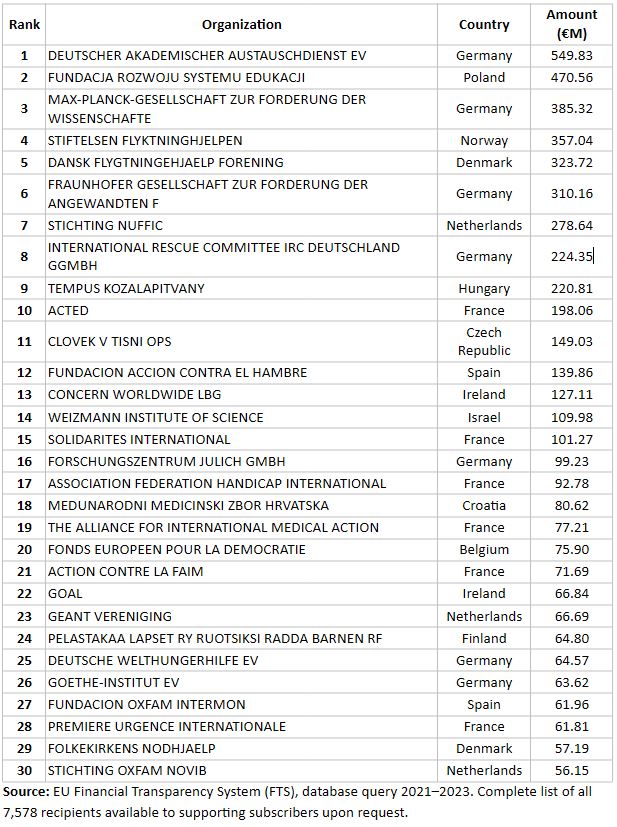
Look at this list. See what immediately stands out?
Rank 1: The German Academic Exchange Service – DAAD.
Rank 3: The Max Planck Society.
Rank 6: The Fraunhofer Society.
Rank 16: Forschungszentrum Jülich.
Rank 26: The Goethe-Institut.
Five of the thirty largest “NGO” recipients are German federal institutions. Together they received over €1.4 billion as “NGOs.” What these organizations have in common – and why this is relevant – the next section shows.
Four Case Studies: Governmental, But Classified as NGO
Remember the EU Commission’s NGO definition from 2024? Independent from the state. Non-profit. No commercial interests. Not part of a government apparatus.
DAAD – Rank 1: €549.8 Million
The German Academic Exchange Service was founded in 1925. Its official mission: international academic cooperation. Its actual function: instrument of German external cultural policy. The DAAD is financed over 90 percent from the federal budget, primarily through the Foreign Office. It conducts educational policy abroad on behalf of the Federal Government. Its leadership structure is closely interwoven with federal ministries.
The DAAD is the single largest “NGO” in EU direct funding distribution for the observation period. €549.8 million. Financed by the German state. Operating on behalf of the German state. Fifth criterion of the EU NGO definition: independent from the state.
Max Planck Society – Rank 3: €385.3 Million
The Max Planck Society is Germany’s largest basic research organization with over 80 institutes. It is financed 50 percent by the federal government and 50 percent by the federal states. The organization’s governance is closely interwoven with public authorities. Its research agenda is set in coordination with federal agencies. €385.3 million as “NGO.” Half federal, half state.
Fraunhofer Society – Rank 6: €310.2 Million
The Fraunhofer Society is Europe’s largest organization for applied research. It operates 76 institutes in Germany, employs over 30,000 staff, and receives substantial basic financing from the federal budget. Its work is directly aimed at the competitiveness of the German economy – a state policy goal. €310.2 million as “NGO.” Basic financed by the federal government.
Goethe-Institut – Rank 26: €63.6 Million
The Goethe-Institut is the official cultural institute of the Federal Republic of Germany. It operates over 150 institutes in 98 countries. Its financing: 95 percent comes from the Foreign Office. Its mission: implementation of German external cultural policy. The Goethe-Institut explicitly acts on behalf of the Federal Government. €63.6 million as “NGO.” 95 percent Foreign Office.
The ECA report SR-2025-11 notes that 8 of 30 examined organizations were erroneously classified as NGOs. The criteria for misclassification are clear: governmental dependence and commercial interests. Which eight organizations these were is not stated in the report—the names are redacted.
The Second AHA Moment: Multiple Funding from 16 Pots
What the Top 30 list shows is already remarkable. What the FTS database reveals beyond this is structurally even more illuminating.
The same organizations appearing in the EU NGO budget simultaneously appear in a multitude of other EU programs. A systematic query of the complete financing history of selected Top 30 recipients yields the following picture:
Multiple Funding 2021 – 2023
| Organization | Funding Program | Amount | Source |
|---|---|---|---|
| Fraunhofer Society | NGO Budget | €310M | FTS |
| Horizon Europe | €2,763M | CORDIS | |
| European Defence Fund | €400M | CORDIS | |
| Digital Europe Programme | €243M | CORDIS | |
| 11 other programs | €724M | CORDIS | |
| TOTAL | €4,440M | ||
| Max Planck Society | NGO Budget | €385M | FTS |
| Horizon Europe | €809M | CORDIS | |
| Euratom Research Programme | €317M | CORDIS | |
| Other programs | €24M | CORDIS | |
| TOTAL | €1,535M | ||
| DAAD | NGO Budget | €549M | FTS |
| Erasmus+ | €455M | FTS | |
| NDICI Global Europe | €69M | FTS | |
| European Social Fund | €27M | FTS | |
| Other programs | €24M | FTS | |
| TOTAL | €1,124M |
Source: EU Financial Transparency System and CORDIS database, period 2021 – 2023.
The Fraunhofer Society receives €310 million as “NGO.” Up to here this sounds like a large item. Until you see that the same organization simultaneously draws €2.76 billion from Horizon Europe, €400 million from the European Defence Fund, €243 million from the Digital Europe Programme, and funds from eleven additional programs. The NGO funds are less than 10 percent of the total volume. The total from 16 programs: over €4.4 billion. Nowhere in public reporting—and apparently nowhere in the EU Commission’s internal management – is the total volume of this multiple funding disclosed in consolidated form.
The Weizmann Institute:
Defense Research, Commercial Subsidiary, Almost €700 Million in EU Funds
At rank 14 of the Top 30 list stands the Weizmann Institute of Science from Israel. €109.9 million as “NGO” between 2021 and 2023. This sounds like a medium item in a long list. It is not.
Legal Status and Formal Classification
The Weizmann Institute was founded in 1934 as a public research university in Rehovot. It is legally a non-profit foundation under Israeli law and registered as a US 501(c)(3) organization. It thus formally fulfills the EU NGO definition from 2024—at least on paper.
The Commercial Subsidiary
In 1959, the Weizmann Institute founded Yeda Research and Development – a wholly owned subsidiary for commercial exploitation of research results and patents. Yeda markets drugs like Copaxone, Rebif, and Erbitux. Yeda’s annual revenue, according to publicly accessible sources, is $50-100 million. Yeda is an entirely commercial enterprise – in direct ownership of the institute that the EU classifies and finances as an NGO.
The EU NGO definition from 2024 explicitly excludes organizations with commercial interests. The European Court of Auditors explicitly notes in SR-2025-11: The EU Commission has never systematically examined this criterion for any of the 7,578 classified organizations. Yeda has existed for 65 years. It is publicly documented, recorded in IRS forms, described on Wikipedia. The Commission did not look.
Defense Research as Declared Objective
In October 2024, the Weizmann Institute announced an official research cooperation with Elbit Systems. Elbit Systems is Israel’s largest private defense contractor – and one of the world’s largest arms suppliers. The stated goal of the partnership: development of “groundbreaking bio-inspired materials for defense applications.” This is not a footnote and not a rumor – it is a public press release from both institutions.
Elbit Systems chairman Michael Federmann sits on the Weizmann Institute’s board of governors. Already in 2022, Elbit received a $16 million contract for a military space telescope within the Weizmann ULTRASAT program.
Total Financing: Almost €700 Million
As “NGO,” the Weizmann Institute received €109.9 million. However, this is not the complete picture of EU funding. From Horizon Europe – the EU research program that, according to Article 41 Paragraph 2 of the EU Treaty, is restricted to exclusively civilian research – the Weizmann Institute additionally received €597.84 million. The total volume of EU funds for the Weizmann Institute in the period 2021 to 2023: at least nearly €700 million.
What This Means
An institution with a wholly owned commercial subsidiary, with the chairman of one of the world’s largest defense contractors on its board of governors, with documented contracts for military technology and a publicly announced cooperation for development of defense materials – this institution receives nearly €700 million in EU funds, of which €598 million from a program contractually restricted to civilian research, and €110 million classified as NGO funding.
Whether this is legal, the Commission decides. Whether this was examined, the ECA report says: no. Whether the classification as NGO withstands the Commission’s own criteria is a question 39 parliamentarians have asked without receiving an answer.
The Circle: When the EU Finances NGOs That Finance EU Policy
At rank 20 of the list stands the Fonds Européen pour la Démocratie—the European Endowment for Democracy, EED in short – with €75.9 million. An at first glance unspectacular item. Upon closer examination, it reveals a structural peculiarity that places the entire NGO funding system in a different light.
The EED is an organization financed by the EU Commission to in turn finance NGOs in neighboring countries of the EU. Its mandate: promotion of democratic structures according to European model in countries like Moldova, Georgia, Tunisia, Egypt, Belarus, and Ukraine. Its financing: entirely from EU funds, primarily from the NDICI Global Europe program and directly from the EU budget. Its status in the EU database: itself classified as NGO.
The circuit functions as follows: The EU Commission finances the EED. The EED in turn finances civil society organizations, media, and political movements in third countries. These organizations produce political realities – reports, protests, election campaigns, media presence. The EU Commission and EED reports cite these realities as evidence of the effectiveness of their democracy promotion. External control or independent evaluation of this circuit does not exist in structured form.
Concretely: In Georgia, the EED financed between 2021 and 2023 dozens of organizations that played an active role in the context of protests against the “Transparency Law” in 2023 and 2024. In Tunisia, EED funds flowed to civil society organizations that were media-present in the context of the political crisis of 2021 and constitutional changes under President Saied. In Belarus, the EED supports exile media and opposition structures whose political orientation aligns with the EU Commission’s foreign policy goals.
An organization exclusively financed by the EU, exclusively operationalizing EU foreign policy, and yet classified in the EU database as NGO: Whoever compares this with the EU definition from 2024 – “independent from government entities,” “not part of a government apparatus” – must conclude that the EED possibly fulfills none of these criteria. And yet receives €75.9 million.
What Remains
This article has not made new claims. It has evaluated publicly accessible data from three official EU sources: the ECA report SR-2025-11, the EU Financial Transparency System, and the CORDIS database.
The result in three conclusions:
First: The European Court of Auditors documented in 2025 that EU NGO funding exhibits structural deficiencies – missing definitions, self-declaration without control, 90 percent unaudited funds. These findings are not opinion. They stand in an official audit report.
Second: The names of the 30 largest “NGO” recipients – those organizations that received 40 percent of direct funds and whose names the Commission refused to 39 parliamentarians – stand in a public database. They could be extracted through a database query. They now stand here.
Third: The multiple funding of the same organizations from up to 16 parallel EU programs is nowhere disclosed in consolidated form. The overall picture is reconstructable from public sources – but only if someone searches for it.
A final remark: The 39 parliamentarians who demanded disclosure of these names in inquiries E-003339/2025, P-001894/2025, and P-001458/2025 have received no answer from the EU Commission to this day. They can now read the names on this page. I will inform them where they stand.
This analysis is made available for free – but high-quality research takes time, money, energy, and focus. If you’d like to support this work, you can do so here:
Alternatively, support my work with a Substack subscription – from as little as 5 USD/month or 40 USD/year!
Let’s build a counter-public together.
Michael Hollister is a geopolitical analyst and investigative journalist. He served six years in the German military, including peacekeeping deployments in the Balkans (SFOR, KFOR), followed by 14 years in IT security management. His analysis draws on primary sources to examine European militarization, Western intervention policy, and shifting power dynamics across Asia. A particular focus of his work lies in Southeast Asia, where he investigates strategic dependencies, spheres of influence, and security architectures. Hollister combines operational insider perspective with uncompromising systemic critique—beyond opinion journalism. His work appears on his bilingual website (German/English) www.michael-hollister.com, at Substack at https://michaelhollister.substack.com and in investigative outlets across the German-speaking world and the Anglosphere.
© Michael Hollister — All rights reserved. Redistribution, publication or reuse of this text requires express written permission from the author. For licensing inquiries, please contact the author via www.michael-hollister.com.
Newsletter
🇩🇪 Deutsch: Verstehen Sie geopolitische Zusammenhänge durch Primärquellen, historische Parallelen und dokumentierte Machtstrukturen. Monatlich, zweisprachig (DE/EN).
🇬🇧 English: Understand geopolitical contexts through primary sources, historical patterns, and documented power structures. Monthly, bilingual (DE/EN).