
by Michael Hollister
Published at apolut media on February 08, 2026
4.031 words * 21 minutes readingtime
Please read Part 1 here:
Iran’s Nuclear Poker – Part 1 – Ambiguity as Strategy
Please read Part 2 here:
Who Really Governs Iran? – Power and Decision in Tehran
Please read Part 3 here:
The Axis of Resistance – Iran’s Regional Network Between Expansion and Erosion
Please read Part 4 here:
Drones Against Hegemony – Iran’s Asymmetric Military Strategy
This analysis is made available for free – but high-quality research takes time, money, energy, and focus. If you’d like to support this work, you can do so here:

Alternatively, support my work with a Substack subscription – from as little as 5 USD/month or 40 USD/year!
Let’s build a counter-public together.
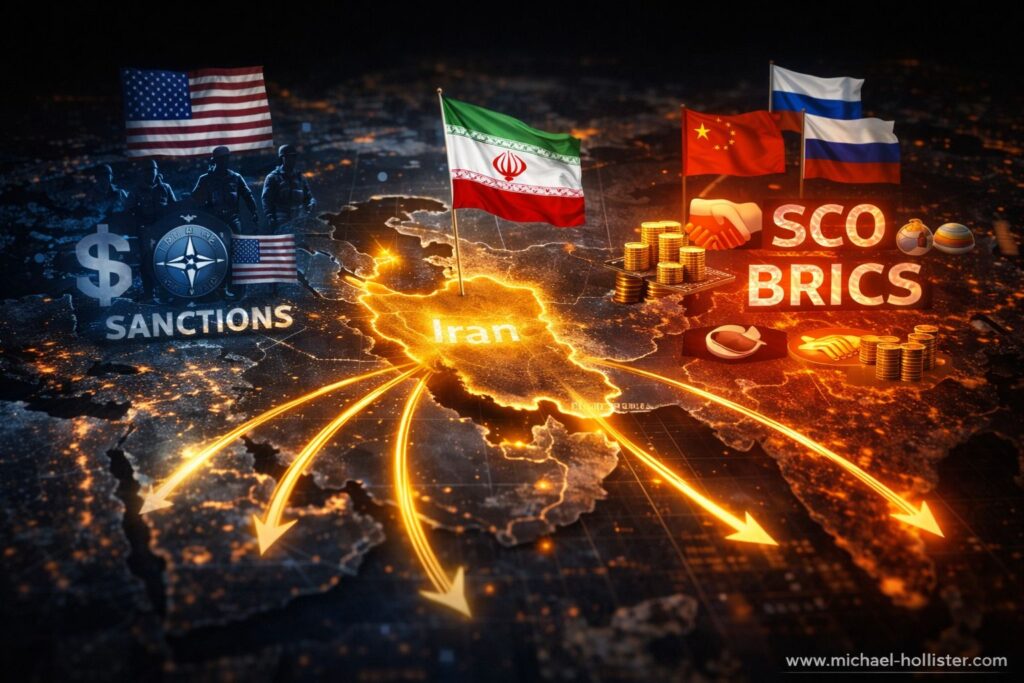
Iran’s Multipolar Balancing Act
How the Islamic Republic Attempts to Break Western Isolation Through SCO, BRICS, and Strategic Partnerships
On August 23, 2023, President Ebrahim Raisi stood in the Johannesburg Sandton Convention Centre before the assembled heads of state and government of the BRICS states and announced Iran’s accession to the group of emerging economic powers. “The world needs convergence to build a just system based on collective interests, and BRICS is considered a symbol of such a transformation in global relations,” Raisi declared. For the Iranian president, the invitation was more than just a diplomatic distinction – it was confirmation of a strategic reorientation Iran has pursued for two decades: the turn away from the West and integration into Asian and Eurasian structures.
A few weeks earlier, on July 4, 2023, Iran was already admitted as the ninth full member of the Shanghai Cooperation Organisation (SCO), after 15 years as an observer. Raisi spoke then of a “historic moment” and that “hegemony and unilateralism are failing” in favor of “independent” countries. These two accessions – SCO and BRICS within a few weeks – marked the provisional high point of a strategy that circulates in Iranian government circles under the slogan “Look East.” The question that arises is not whether this strategy exists, but what it actually achieves—and where its limits lie.
The Look East Doctrine: From Pragmatism to Ideology
Iran’s strategic turn toward Asia is not an invention of the conservative Raisi government but has roots reaching back to the early 2000s. After the collapse of reform-oriented nuclear negotiations under President Mohammad Khatami and the tightening of international sanctions against Iran’s nuclear program from 2006, Tehran systematically began building economic and political relations beyond the Western hemisphere. Under President Mahmoud Ahmadinejad (2005-2013), trade agreements with China, Russia, and Central Asian states were intensified, although these often contained more rhetoric than substance.
The actual institutionalization of “Look East” policy occurred under Supreme Leader Ali Khamenei, who elevated this strategy to official state doctrine at the latest after the failure of the nuclear agreement in 2018 – when US President Donald Trump unilaterally withdrew from the JCPOA and imposed maximum economic sanctions. Khamenei, who has harbored deep-seated skepticism toward Western motives since the 1980s, saw in American behavior confirmation of his basic conviction: The West is not a reliable partner, and Iran must seek its future in Asia and Eurasia.
President Hassan Rouhani (2013-2021), a pragmatist who had negotiated the JCPOA, still attempted to maintain a balance between Western orientation and Eastern partnerships. But after Trump’s withdrawal and the crushing sanctions, this position lost domestic political support. Conservative forces, already skeptical of compromises with the West, gained influence. With Raisi’s electoral victory in 2021, political consolidation was complete: all three branches of government—executive, legislative, judicial – were controlled by conservatives who understood “Look East” not as a tactical maneuver but as strategic necessity.
This reorientation also had an ideological component. Iranian state media and government officials began speaking of a “new world order” in which American hegemony would be replaced by a multipolar system. BRICS, SCO, and China’s Belt and Road Initiative were presented as building blocks of this new order—an order in which Iran could act not as a pariah state but as an equal actor. The question was: Would this vision become reality, or would it remain political wishful projection?
SCO: 15 Years of Waiting for Club Membership
Iran’s path into the Shanghai Cooperation Organisation was long and rocky. In 2005, Iran submitted an application for full membership but was initially accepted only as an observer. The reason was primarily political in nature: UN sanctions against Iran’s nuclear program made full membership complicated from the perspective of SCO founding states China and Russia. Moreover, there were reservations within the organization – particularly from India and the Central Asian republics—about admitting a state under massive international sanctions and whose foreign policy profile was highly controversial.
Only in 2021, at an SCO summit in Dushanbe, was the process toward full membership initiated. In September 2022, Iran signed a Memorandum of Obligations in Samarkand establishing the commitments for full membership. On July 4, 2023, Iran was finally admitted as the ninth member – together with China, Russia, India, Pakistan, Kazakhstan, Uzbekistan, Kyrgyzstan, and Tajikistan. Belarus followed as the tenth member in 2024.
The SCO was founded in 2001 as successor to the “Shanghai Five,” a group of states primarily concerned with border security and combating “terrorism, separatism, and extremism” – a formulation encompassing both Islamist militancy in Central Asia and Uyghur and Chechen separatism. Over time, the SCO developed into a political-economic organization with the stated goal of creating an alternative to Western-dominated structures. But despite large numbers – SCO members represent 40 percent of the world’s population, 60 percent of the Eurasian landmass, and 20 percent of global GDP – the organization remained limited in its concrete impact.
For Iran, SCO membership offered several symbolic and practical advantages.
First, it broke through Iran’s diplomatic isolation: As a full member of an organization dominated by China and Russia and in which India and Pakistan cooperate despite their rivalries, Iran gained access to a forum signaling global recognition.
Second, membership theoretically opened economic cooperation possibilities, particularly in the energy sector and infrastructure projects.
Third, it provided backing against Western sanctions: SCO members coordinate their positions in international bodies, and Iran could hope that China and Russia would use their diplomatic power to reduce pressure on Tehran.
However, the concrete economic returns of SCO membership have been modest so far. The organization possesses no binding trade mechanisms, no common currency, and no integrated markets. Economic cooperation occurs bilaterally, not multilaterally. Iranian exports to SCO countries did increase after 2022 – according to Iranian customs authorities by about 20 percent – but this increase was primarily due to Chinese oil purchases, not SCO membership per se. The SCO is, as a Western analyst formulated it, more a “platform for consultations” than a functioning economic community. Internal tensions – such as between India and China, between India and Pakistan, or between Central Asian states and Russia – prevent deeper integration.
Nevertheless, SCO membership was politically valuable for Iran. It underscored Iran’s self-presentation as a country that has found its place in Asia and Eurasia, and it offered institutional connection to China’s Belt and Road Initiative, which is coordinated through the SCO. For Iranian leadership, admission to the SCO was evidence that “Look East” had become not just rhetoric but tangible reality.
BRICS: From Investment Slogan to Geopolitical Signal
If the SCO is primarily a security-political-diplomatic platform, then BRICS understands itself as an economic and development policy counterweight to Western-dominated institutions like the G7, IMF, and World Bank. The acronym BRICS was coined in 2001 by Goldman Sachs economist Jim O’Neill to describe emerging economies: Brazil, Russia, India, China. South Africa was added in 2010, and BRIC became BRICS. What began as an investment term developed into a real political forum that assembles annually for summit meetings and formulates common positions.
The 2023 BRICS expansion was the largest since founding. Besides Iran, Egypt, Ethiopia, Saudi Arabia, and the United Arab Emirates were invited to become full members as of January 1, 2024. Argentina was also invited but declined after a government change in November 2023. Saudi Arabia still hesitates with formal confirmation of its membership but participates in BRICS activities. Indonesia joined in 2025, giving BRICS its first Southeast Asian member.
For Iran, the BRICS invitation was a diplomatic triumph. Raisi had officially submitted an application for membership in June 2022, and the admission in August 2023 was the result of intensive lobbying by Russia and China, who see Iran as a strategic partner in their confrontation with the West. Mohammad Jamshidi, deputy chief of staff for political affairs in the presidential office, called the admission a “strategic success” and a “historic development”. Conservative media in Iran celebrated the accession as proof that Iran’s “revolutionary government” was successful, while the failed nuclear diplomacy under Rouhani and Foreign Minister Javad Zarif was portrayed as a wrong path.
BRICS membership promised Iran several advantages. First, it would provide access to the New Development Bank (NDB), a development bank founded by BRICS in 2014 with headquarters in Shanghai, conceived as an alternative to the World Bank. The NDB has capital of $100 billion and provides loans for infrastructure projects in member countries – theoretically a financing source not tied to Western conditions. Second, BRICS offered a platform for Iran’s de-dollarization strategy: Several BRICS members, particularly Russia and China, are working to replace the US dollar in bilateral trade with national currencies or alternative payment systems. Raisi emphasized in Johannesburg that Iran was ready to trade in national currencies and end the “dominance of the dollar.” Third, BRICS membership signaled that Iran was no longer internationally isolated: An organization that after expansion represents 46 percent of the world’s population and 37 percent of global GDP (measured in purchasing power parity) has accepted Iran as a full member.
But the reality behind these promises is more complex. The NDB has not yet financed large projects in Iran – partly because Iran’s creditworthiness suffers under sanctions, partly because the bank itself acts cautiously to avoid conflict with international financial regulations. De-dollarization is making progress, but slowly: China buys Iranian oil in yuan, Russia and Iran conduct some business in rubles and rials, but the dollar remains dominant because most global commodity markets are settled in dollars. Moreover, BRICS as an organization is not very coherent: India and Brazil maintain close relations with the West, India has sharp border conflicts with China, and Saudi Arabia and Iran are regional rivals. Decisions are made by consensus, which complicates substantial cooperation.
A Western analyst put it succinctly: “BRICS is certainly useful as a means for diplomatically isolated states to escape isolation for Russia – the same applies to Iran.” Joseph Nye wrote in January 2025 that BRICS was functional “as a lifeline for isolated states” but not as an engine for a new world order. US President Donald Trump called BRICS “dead” on Truth Social in February 2025 and threatened 100 percent tariffs on countries introducing a BRICS currency or deviating from the dollar. This threat was both expression of Western nervousness and an indicator that BRICS’ economic clout is limited.
For Iran, BRICS membership nevertheless remains valuable – not because of concrete economic returns but because of the political signal. Iran can present itself as part of a global movement questioning Western hegemony. This strengthens the domestic legitimacy of the conservative government and provides diplomatic backing in international forums.
China-Iran: The $400 Billion Partnership and Its Reality
The centerpiece of Iran’s “Look East” strategy is the partnership with China. On March 27, 2021, Iranian Foreign Minister Mohammad Javad Zarif and his Chinese counterpart Wang Yi signed a 25-year cooperation agreement in Tehran, officially designated as “Comprehensive Strategic Partnership.” The agreement, signed on the occasion of the 50th anniversary of diplomatic relations between Iran and China, had been under discussion since 2016 – since Chinese President Xi Jinping’s visit to Tehran, shortly after implementation of the JCPOA nuclear agreement.
The details of the agreement were never fully published, but a leaked 2020 draft cited by the New York Times and other media outlined comprehensive economic, military, and security cooperation. According to this, China would invest up to $400 billion over 25 years in Iran’s energy, infrastructure, telecommunications, and banking sectors. In return, China would receive guaranteed access to Iranian oil and gas – with a discount of at least 12 percent from benchmark prices plus a risk premium of 6 to 8 percent. The agreement also envisioned that China could station security personnel in Iran to protect Chinese projects and that Iranian ports along the Persian Gulf and Gulf of Oman would be made accessible to Chinese naval vessels.
These figures triggered massive controversies in Iran. Critics, including opposition figures in exile and moderate politicians within Iran, accused the government of selling Iranian sovereignty. The accusation was that Iran would be degraded to a “Chinese colony,” Chinese troops allowed on Iranian soil, and strategic ports and islands handed over to Beijing. Zarif and other government representatives vehemently denied these claims. Zarif stated there was “no such agreement” with the mentioned details, and no islands or ports would be “leased.” The $400 billion figure was also relativized by the Chinese side: A spokesperson for the Chinese Foreign Ministry said the agreement contained “no quantitative, specific contracts or goals” but was merely a “general framework” for cooperation.
The reality likely lies between promises and denials. China has invested about $27 billion in Iran over the last 15 years – $400 billion over 25 years would thus be a massive increase, but given Western sanctions and Iran’s economic instability, this sum appears unrealistic. What is undisputed, however: China is Iran’s largest trading partner and most important customer for Iranian oil. Official Chinese statistics long showed only about 80,000 barrels per day, but independent estimates suggest 600,000 to 900,000 barrels per day reach China through ship-to-ship transfers and redeclarations (such as via Malaysia). These oil deals are vital for Iran: They generate foreign currency that cannot be obtained otherwise.
Within the framework of the 25-year agreement, China has begun investing in Iranian infrastructure – albeit on a smaller scale than hoped. A Chinese consulate was opened in 2022 in Bandar Abbas, a strategically important port on the Persian Gulf near the Strait of Hormuz. Chinese firms are involved in electrifying Iranian railway lines and developing the ports of Chabahar and Jask on the Makran coast. These projects are part of China’s Belt and Road Initiative (BRI), which aims to create land connections from East Asia to Europe. Iran lies geographically ideal on this route and could profit as a transit country – provided political and economic conditions stabilize.
But China’s engagement in Iran remains cautious. Beijing simultaneously maintains close relations with Saudi Arabia, the United Arab Emirates, and Egypt – all regional rivals or potential opponents of Iran. In 2023, China mediated a surprising agreement between Iran and Saudi Arabia to resume diplomatic relations that had been broken off in 2016. This step showed China’s interest in acting as a neutral mediator promoting regional stability without taking sides. China buys more oil from Saudi Arabia than from Iran, and Chinese investments in the kingdom far exceed those in Iran. From Beijing’s perspective, Iran is an important but not exclusive partner – and as long as US sanctions exist, Chinese investments remain limited to avoid themselves becoming targets of American secondary sanctions.
For Iran this means: China is a vital partner but not a panacea. Without Chinese oil purchases, Iran’s economy would have collapsed. But the hoped-for large investments remain absent, and Iran is vulnerable in its dependence on China—a dependence Beijing can use strategically.
Russia-Iran: From Crimea Conflict to Ukraine War
Iran’s relations with Russia have a long, checkered history. During the Soviet era, the relationship was tense, but after the collapse of the USSR in 1991, Moscow and Tehran approached each other – primarily for pragmatic reasons: Both states saw themselves isolated by the West, both had interests in cooperation in Central Asia and the Caucasus. Russia built Iran’s nuclear reactor in Bushehr, delivered air defense systems (S-300), and coordinated militarily with Iran in Syria from 2015 to stabilize the Assad regime.
The turning point in Russian-Iranian relations was Russia’s invasion of Ukraine in February 2022. Iran supported Russia – not from ideological solidarity but from strategic calculation. Already in summer 2022, Iran began delivering Shahed-136 kamikaze drones to Russia, which Moscow massively deployed against Ukrainian energy infrastructure. Reports spoke of “several hundred” drones worth €140 million, paid in cash and with captured Western weapons. For Iran, the deal was lucrative: It generated foreign currency, deepened military cooperation with Moscow, and demonstrated Iranian technology under war conditions.
The cooperation went beyond drones. Russia and Iran coordinate their positions in the SCO and at the United Nations, where Moscow regularly uses its veto to block resolutions against Iran. Economically, both countries have interest in de-dollarization and creating alternative payment systems. Russia sells oil and gas despite Western sanctions to Asia – exactly like Iran. Both countries see themselves as victims of Western “illegal sanctions” and as architects of a multipolar world order.
However, the Russian-Iranian partnership is not without tensions. In Syria, both pursue partially different goals: Russia wants to stabilize Assad and secure its military bases, Iran wants to build Shiite militias and establish a land connection to Lebanon. In the Caucasus, Russian and Iranian interests collide: Moscow is allied with Azerbaijan, which militarily advanced against Armenia in 2020 and 2023 – Iran sympathizes more with Armenia, also because a large Armenian diaspora lives in Iran. Moreover, Russia is an oil and gas producer – exactly like Iran. Both compete in Asian markets, even if they emphasize cooperation outwardly.
Nevertheless, Russia remains a strategic partner for Iran that provides political and military backing. The Ukraine war has intensified this bond because both states have become even more isolated from the West and share common interests in Eurasian integration.
Limits and Contradictions: The Reality Behind the Rhetoric
Iran’s “Look East” strategy sounds coherent on paper: Integration into SCO and BRICS, close partnerships with China and Russia, turn away from the West. But reality is more complex and contradictory.
First: Competition with regional rivals. The admission of Saudi Arabia, UAE, Egypt, and Iran into BRICS creates a platform where direct regional competitors sit together. Iran and Saudi Arabia did restore diplomatic relations in 2023, but distrust remains deep. The UAE are close allies of Israel, against whom Iran is hostile. These tensions limit what BRICS as an organization can achieve.
Second: China’s caution. Beijing does not want to lose Iran but also does not want to risk itself coming under US sanctions. Chinese investments in Iran therefore remain limited, and Beijing maintains parallel relations with Iran’s opponents. China acts as a neutral player, not as an Iranian patron.
Third: Internal Iranian opposition. The $400 billion partnership with China was domestically controversial. Critics accused the government of sacrificing Iranian sovereignty. The SCO and BRICS memberships were also viewed skeptically by parts of the Iranian public – not because they were fundamentally rejected but because concrete advantages remained unclear. Former diplomats like Kourosh Ahmadi warned that “illusions about potential benefits from SCO and BRICS could be more harmful than not being a member at all.”
Fourth: Lack of institutional depth. Neither SCO nor BRICS possess binding mechanisms for economic integration. Trade occurs bilaterally, not multilaterally. The SCO has no common currency, no free trade zone, no supranational institutions. BRICS is similarly loosely organized – consensus decisions among nine (soon eleven) members with highly divergent interests are difficult.
Fifth: Sanctions as hurdle. As long as US sanctions against Iran exist, foreign investments remain risky. Even Chinese and Russian firms hesitate to start large projects in Iran because they could lose access to Western markets and financial systems. The NDB has not yet provided large loans to Iran – presumably from fear of reputational risks.
Conclusion: Symbolic Success, Limited Substantial Integration
Iran’s “Look East” is real – but its effect is limited. SCO and BRICS memberships are symbolic successes that break through Iran’s diplomatic isolation and provide the government with domestic political legitimacy. They signal that Iran is part of a movement pursuing a multipolar world order. For Iranian leadership, particularly for Supreme Leader Khamenei and President Raisi, these memberships are confirmations of their strategic vision.
But substantively, the returns remain modest. The hoped-for Chinese large investments of $400 billion have not materialized. The SCO has brought no economic breakthroughs. BRICS as an organization is too heterogeneous to formulate coherent policy. The New Development Bank has not showered Iran with loans. The dollar remains dominant in global trade despite de-dollarization efforts.
What Iran has achieved is closer attachment to China and Russia – two powers that have their own reasons to support Iran but offer no unconditional solidarity. China needs Iranian oil but also wants good relations with Saudi Arabia and the UAE. Russia values Iran as arms supplier and diplomatic ally but pursues its own interests in the Caucasus and Central Asia that do not always align with Iranian ones.
Iran’s “Look East” is thus less a complete reorientation than a pragmatic balancing act: Iran uses Asian and Eurasian structures to compensate for Western isolation but remains constrained in its strategic autonomy. The rhetoric of the “new world order” sounds impressive, but reality is more sober. Iran has become part of a multipolar system – but as junior partner, not as equal architect.
The future of this strategy depends on whether Iran manages to stabilize its economic structures, whether sanctions are eased, and whether China and Russia are willing to deepen their support. As long as these questions remain open, Iran’s “Look East” will remain a strategic makeshift – important for survival but not sufficient for genuine prosperity.
This analysis is made available for free – but high-quality research takes time, money, energy, and focus. If you’d like to support this work, you can do so here:
Alternatively, support my work with a Substack subscription – from as little as 5 USD/month or 40 USD/year!
Let’s build a counter-public together.
Michael Hollister is a geopolitical analyst and investigative journalist. He served six years in the German military, including peacekeeping deployments in the Balkans (SFOR, KFOR), followed by 14 years in IT security management. His analysis draws on primary sources to examine European militarization, Western intervention policy, and shifting power dynamics across Asia. A particular focus of his work lies in Southeast Asia, where he investigates strategic dependencies, spheres of influence, and security architectures. Hollister combines operational insider perspective with uncompromising systemic critique—beyond opinion journalism. His work appears on his bilingual website (German/English) www.michael-hollister.com, at Substack at https://michaelhollister.substack.com and in investigative outlets across the German-speaking world and the Anglosphere.
SOURCES
- Anadolu Agency: “Iran becomes full member of Shanghai Cooperation Organization”, July 2023
- Caspian News: “Iran Becomes Full Member of Shanghai Cooperation Organization”, July 2023
- FDD: “Iran Becomes Full Member of Shanghai Cooperation Organization”, July 2023
- Atlantic Council: “Iran joining the SCO isn’t surprising. But Beijing’s promotion of illiberal norms in Eurasia should get more attention”, July 2023
- The Washington Institute: “Iran One Step Closer to SCO Membership”, September 2022
- Iran International: “Iran Becomes A Member Of BRICS, With Hopes And Challenges”, January 2024
- The Iran Primer (USIP): “Iran to Join the BRICS Alliance”, August 2023
- Tehran Times: “Iran joins BRICS group formally in 2024”, January 2024
- Stimson Center: “The Implications of Iran’s Inclusion in BRICS”, August 2023
- Al Jazeera: “Saudi Arabia, Iran among six nations invited to join BRICS”, August 2023
- Atlantic Council: “BRICS is doubling its membership. Is the bloc a new rival for the G7?”, August 2023
- Rasanah: “The Iran-China 25-Year Comprehensive Strategic Partnership: Challenges and Prospects”, April 2021
- İRAM Center: “The Latest Status of the 25-Year Comprehensive Cooperation Agreement Between Iran and China”, January 2022
- USCC: “China-Iran Relations: A Limited but Enduring Strategic Partnership”, June 2021
- AGSI: “Implementing the China-Iran Comprehensive Strategic Partnership: Not So Fast”, January 2022
- The Diplomat: “What’s in the China-Iran Strategic Cooperation Agreement?”, March 2021
- Al Jazeera: “Iran and China sign 25-year cooperation agreement”, March 2021
- Brandeis Crown Center: “The Iranian-Chinese Strategic Partnership: Why Now and What it Means”, April 2021
© Michael Hollister — All rights reserved. Redistribution, publication or reuse of this text requires express written permission from the author. For licensing inquiries, please contact the author via www.michael-hollister.com.
Newsletter
🇩🇪 Deutsch: Verstehen Sie geopolitische Zusammenhänge durch Primärquellen, historische Parallelen und dokumentierte Machtstrukturen. Monatlich, zweisprachig (DE/EN).
🇬🇧 English: Understand geopolitical contexts through primary sources, historical patterns, and documented power structures. Monthly, bilingual (DE/EN).