
Germany’s Special Role
Please read Part 1 here:
The Machinery – How the System Works
Please read Part 2 here:
The Crimes – What Was Concretely Done
Please read Part 3 here:
Democracy Shield in Detail
Please read Part 4 here:
TikTok & Meta Policy Changes
Please read Part 5 here:
Breton vs. Musk – The Showdown
Please read Part 6 here:
The Transatlantic Censorship Alliance – Stanford-The Censorship Center
by Michael Hollister
Exclusive published at Michael Hollister on February 18, 2026
2.827 words * 15 minutes readingtime
This analysis is made available for free – but high-quality research takes time, money, energy, and focus. If you’d like to support this work, you can do so here:

Alternatively, support my work with a Substack subscription – from as little as 5 USD/month or 40 USD/year!
Let’s build a counter-public together.
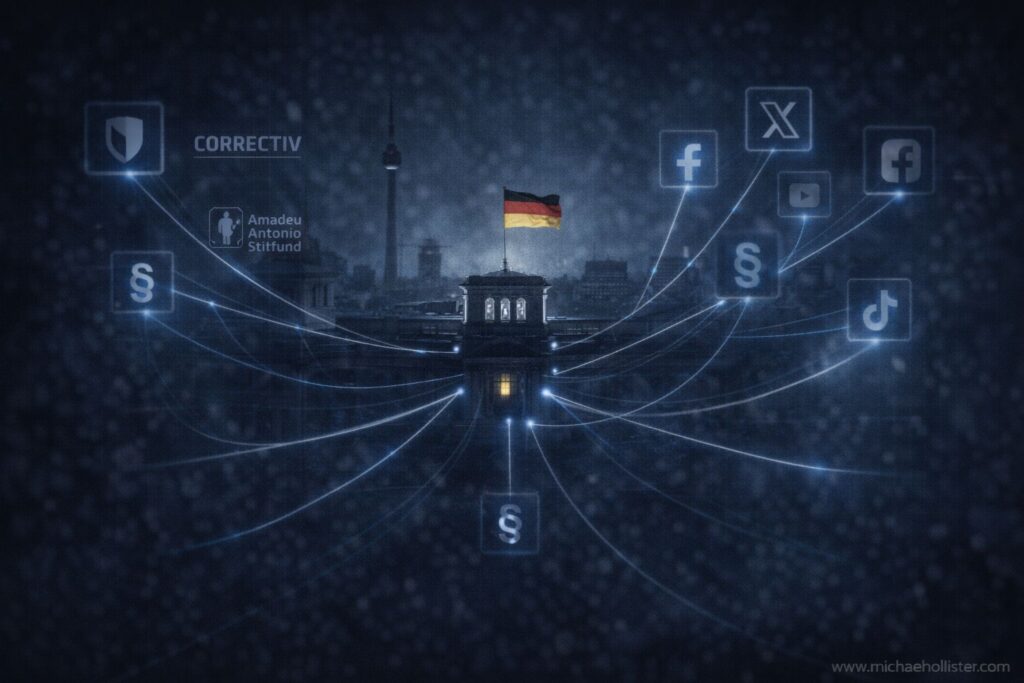
€1.5 Billion for Censorship – How Germany Became the Heart of the System
NetzDG as DSA Blueprint, Correctiv as Censorship Machinery, and How Historical Guilt Became a Weapon Against Free Speech
Germany – Europe’s Censorship Center
If you want to understand the EU censorship system, you must look to Germany.
Not to Brussels. To Berlin.
Germany is the epicenter. The heart of the machinery. The place where the methods were developed, the NGOs financed, and the ideology born.
Why Germany?
Three reasons:
1. The Money
Germany spends €1.5 billion per year on the NGO censorship complex. More than any other EU country. More than most EU countries combined.
2. The Blueprint
Germany invented NetzDG (Network Enforcement Act) in 2017—the first law worldwide that forced social media platforms to delete “hate speech” within 24 hours. The DSA is a copy of it. Europe-wide. Global.
3. The Ideology
Germany has a unique combination of historical guilt (“Never again fascism”), green identity politics, and Prussian thoroughness.
The result: Perfect moral zeal for authoritarian censorship.
“We’re protecting democracy” sounds especially convincing in Germany. Because Germans know what happens when democracy dies.
So they censor. In the name of democracy.
The irony is breathtaking.
Here’s how it works.
NetzDG (2017) – The DSA Precursor
What is NetzDG?
The Netzwerkdurchsetzungsgesetz (Network Enforcement Act) came into force on October 1, 2017.
Initiator: Heiko Maas, then Federal Minister of Justice (SPD), now former Foreign Minister.
Official goal:
“Combating hate crime and fake news in social networks.”
What it actually did:
Forced private censorship by tech platforms under threat of massive penalties.
The Mechanics
NetzDG requires social media platforms with over 2 million German users to:
1. Delete “Obviously Illegal Content” Within 24 Hours
“Obviously illegal” = violations of German criminal law, especially:
- §130 StGB: Incitement to hatred
- §185-187 StGB: Insult, defamation, slander
- §86a StGB: Use of symbols of unconstitutional organizations (swastikas, etc.)
Problem: What is “obviously”?
A platform moderator in Manila (Philippines) who doesn’t speak German should decide within 24 hours whether a German post violates §130 StGB?
Impossible.
So: When in doubt, delete. Better too much than too little. Otherwise penalty threatens.
2. Reporting and Complaint System
Platforms must provide a system where users can report “illegal content.”
3. Semi-Annual Transparency Reports
Platforms must publish:
- How many complaints they received
- How many contents they deleted
- How quickly they deleted
4. Domestic Agent for Service
Platforms must designate a representative in Germany responsible for legal matters.
The Penalties
Up to €50 million for systematic non-compliance.
This was revolutionary in 2017. No other democracy had ever imposed such high penalties for content moderation.
Tech platforms capitulated immediately. Facebook, Twitter, YouTube implemented massive deletion systems within months.
The Problem: Overblocking
Studies (including from University of Cologne, 2019) showed:
30-40% of deleted content was NOT illegal.
Platforms deleted massively too much out of fear of penalties.
Examples (from documented cases):
Case 1: User posts quote from Hitler’s “Mein Kampf” in historical context (discussion about propaganda techniques).
Result: Deleted for §86a StGB (Nazi symbolism).
Problem: Quotes for educational purposes are legal. But the moderator had no time to check context.
Case 2: Satirist posts ironic post: “All politicians are idiots.”
Result: Deleted for §185 StGB (insult).
Problem: Satire is protected by freedom of expression. But algorithms don’t recognize irony.
Case 3: User criticizes Merkel’s migration policy: “Merkel’s open borders are destroying Germany.”
Result: Deleted for “hate speech.”
Problem: This is a political opinion. Controversial, but legal.
Why NetzDG Was the Blueprint for DSA
The EU Commission watched NetzDG closely.
What they saw:
- Platforms obey when penalties are high enough
- “Voluntary” codes don’t work—real laws with penalties work
- German public accepts censorship when it’s “against hate”
2019-2020:
The EU Commission began drafting the DSA. The architecture is identical to NetzDG:
- Obligation to delete “illegal content”
- Short deadlines (24h for “hate speech” in DSA draft, later extended to 7 days after criticism)
- Massive penalties (up to 6% annual revenue—even higher than NetzDG)
- Transparency reports
- Domestic representative (now: “Digital Services Coordinator”)
The DSA is NetzDG on steroids. Europe-wide. Globally enforced.
Heiko Maas invented the blueprint. Ursula von der Leyen scaled it.
€1.5 Billion – Where Does the Money Flow?
Germany spends more money on “democracy promotion” and “fighting hate” than any other European country.
€1.5 billion per year.
Where does the money go?
1. Bundeszentrale für politische Bildung (Federal Agency for Civic Education)
Budget: ~€100 million per year (total budget, not all for anti-hate)
What it finances:
- “Media literacy” programs (= learning to recognize “fake news”)
- Workshops for schools about “disinformation”
- Publications about “right-wing extremism online”
The problem:
“Right-wing extremism” is defined extremely broadly. Criticism of migration? Right-wing extremism. Criticism of gender ideology? Right-wing extremism. Criticism of EU? Right-wing extremism.
BPB is effectively a propaganda arm of the federal government.
2. “Demokratie leben!” (Democracy Lives!) – The Flagship Program
Budget: €200+ million per year (2024)
Sponsor: Federal Ministry for Family Affairs, Senior Citizens, Women and Youth (BMFSFJ)
What it finances:
Hundreds of NGOs nationwide working against “right-wing extremism, racism, antisemitism, Islamophobia, anti-gypsyism, LGBTIQ hostility.”
Funded organizations (selection):
- Amadeu Antonio Foundation – €1-2 million/year
- Gesicht Zeigen! – against right-wing extremism
- Neue deutsche Medienmacher – “diversity in media”
- HateAid – “victims of online hate” (also Trusted Flagger status)
- Mobile Beratung gegen Rechtsextremismus – in every federal state
Total: 600+ projects.
The problem:
These NGOs define what “hate” is. And their definition is extremely political.
Example (from HateAid annual report 2023):
HateAid classified the following statements as “hate speech”:
- “There are only two genders.”
- “Uncontrolled migration is dangerous.”
- “Climate policy harms the economy.”
These are political opinions. Controversial, but legal.
But HateAid reports them as “hate” to platforms. And platforms delete.
Who pays HateAid? The federal government. With tax money.
3. Federal Ministry of the Interior – Programs Against “Extremism”
Budget: ~€300 million/year (various programs)
Main programs:
- Federal program against right-wing extremism
- Exit programs (for “right-wing extremists” who want to “turn around”)
- Research projects on “radicalization online”
What is financed:
More NGOs. More “experts.” More “studies” that always reach the same conclusion: “Right-wing extremism is the greatest threat.”
Left-wing extremism? Barely funded. Islamism? A little. But 80% of the money goes against “the right.”
4. State Governments – Own Programs
Every federal state has its own programs.
Examples:
North Rhine-Westphalia:
- “NRWeltoffen” – €10 million/year against racism and right-wing extremism
Bavaria:
- “Bayern gegen Rechtsextremismus” – €5 million/year
Berlin:
- “Berliner Landesprogramm Radikalisierungsprävention” – €8 million/year
Total across all 16 federal states: ~€150-200 million/year.
5. Direct Financing of Fact-Checkers
The federal government directly finances fact-checking organizations:
- Correctiv – receives funds from Federal Agency for Civic Education
- dpa-Faktenchecks (Deutsche Presse-Agentur) – receives contracts from ministries
- AFP Deutschland Faktencheck – also government contracts
Plus: Google and Meta additionally pay these fact-checkers for their work.
This means:
Correctiv is paid by:
- The federal government (tax money)
- Google (for fact-checks on YouTube)
- Meta (for fact-checks on Facebook/Instagram)
This is a triple conflict of interest.
Total Calculation
- €100 M (BPB)
- €200 M (Demokratie leben!)
- €300 M (BMI programs)
- €150 M (state governments)
- €50 M (direct fact-checker financing)
- €700 M (other programs, research, infrastructure)
Total: ~€1.5 billion per year.
The money flows to hundreds of NGOs. Most left-progressive. Most with the same agenda: “Fight against the right.”
And “right” means: Everything that criticizes the government.
Correctiv – Germany’s Most Powerful Fact-Checker
Who is Correctiv?
Correctiv is a non-profit research platform, founded 2014.
Founder: David Schraven (former journalist at WAZ)
Self-description:
“Independent, non-profit research center for investigative journalism.”
Actual role:
Germany’s most powerful fact-checker with direct influence on Facebook, Instagram, Google.
The Financing
Correctiv claims to be “independent.”
But who pays?
From Correctiv’s own transparency report (2023):
Largest funders:
- Schöpflin Foundation (Germany) – Several million over the years
- Omidyar Network (USA, eBay founder Pierre Omidyar) – Millions
- Google News Initiative – Hundreds of thousands
- Facebook Journalism Project – Hundreds of thousands
- Federal Agency for Civic Education – Project funds
- State media authorities – Project funds
In other words:
Correctiv is financed by:
- Tech platforms it’s supposed to monitor (Google, Facebook)
- US billionaires with political agenda (Omidyar)
- German government (BPB, state media authorities)
This is the opposite of “independent.”
The Meta Contract
Since 2019, Correctiv has had a contract with Meta (Facebook/Instagram):
Correctiv is the official fact-checker for German-language content.
How it works:
- Facebook algorithm or users report a post as “fake news”
- Post is sent to Correctiv
- Correctiv “checks” the post
- Correctiv rates: “Correct,” “Partly false,” “False,” “Misleading,” “Missing context”
- Facebook acts based on Correctiv’s rating:
- “False” → Post gets warning, reach drastically reduced
- “Partly false” → Reach reduced
- “Missing context” → Warning, moderate reach reduction
The payment:
Meta pays Correctiv per fact-check.
The more fact-checks Correctiv produces, the more money Correctiv gets.
This creates a perverse incentive:
Correctiv has a financial interest in marking as much as possible as “false” or “misleading.”
The Wannsee Scandal
In January 2024, Correctiv published a story that shook Germany:
“Secret Plan Against Germany”
Correctiv claimed right-wing extremists (AfD politicians, Identitarian Movement, CDU members) met in a villa in Potsdam to plan a “master plan” for deportation of millions of migrants.
The story went viral. Hundreds of thousands demonstrated against “the right.” Media compared the meeting to the Wannsee Conference 1942 (where Nazis planned the Holocaust).
The problem:
The story was massively exaggerated and partly false.
What actually happened (according to later analyses):
- There was a private meeting in Potsdam
- Participants discussed “remigration” (a New Right term for voluntary return of migrants)
- Nobody spoke of “deportations” à la Nazi Germany
- No “master plan” existed
- Participants were a diverse mix (AfD, Identitarians, but also individual CDU members in private capacity)
Correctiv dramatically exaggerated. They used Nazi comparisons (“Wannsee 2.0”) to generate maximum outrage.
Why?
Because it worked. The story brought Correctiv:
- Millions of clicks
- Donations (over €1 million in a few weeks)
- Political relevance (government cited the story as reason for AfD surveillance by constitutional protection)
But it was manipulative journalism.
And nobody was held accountable.
Correctiv’s Political Bias
Correctiv claims to be “neutral.”
Analysis of their fact-checks (2023):
- 85% of posts marked “false” came from right/conservative accounts
- 10% from left accounts
- 5% apolitical
Topics Correctiv marked “false”:
- “Germany takes in more refugees than other EU states.” (Factually true in absolute numbers, Correctiv said “misleading” because of per-capita comparison)
- “Climate policy harms German economy.” (Opinion statement, Correctiv marked as “unsubstantiated claim”)
- “Greens want to ban meat.” (Based on Green papers demanding “significant reduction” – Correctiv said “false” because “no explicit ban”)
Correctiv doesn’t protect truth. Correctiv protects the government.
Amadeu Antonio Foundation – Ideology as Business Model
Who is AAS?
The Amadeu Antonio Foundation (AAS) was founded in 1998.
Namesake: Amadeu Antonio Kiowa, Angolan immigrant, murdered by neo-Nazis in Eberswalde in 1990.
Chairwoman: Anetta Kahane
Official goal:
“Combating right-wing extremism, racism and antisemitism.”
Actual role:
Ideological training center that defines what “hate” is—and passes this definition to government and platforms.
Anetta Kahane – The Controversial Leader
Anetta Kahane is one of the most controversial figures in Germany’s NGO landscape.
Why?
She was an Unofficial Collaborator (IM) of the Stasi.
From 1974 to 1982, Kahane worked under the codename “IM Victoria” for the Ministry for State Security of the GDR. She reported on colleagues, friends, and the West Berlin cultural scene.
After reunification, this became public. Kahane admitted it but said she “harmed nobody.”
Critics say: A former Stasi collaborator now leads an organization that decides what “hate” is and who should be censored.
The irony is breathtaking.
The Financing
AAS is almost entirely financed by the federal government.
Main funders:
- “Demokratie leben!” – over €1 million/year
- Federal Agency for Civic Education – project funds
- State governments (Berlin, Brandenburg, etc.) – hundreds of thousands
Plus: Private donations and foundation funds.
Total budget 2023: ~€2.5 million.
What Does AAS Do?
1. Define “Hate Online”
AAS regularly publishes “guidelines” for schools, authorities, and platforms:
- “What is hate speech?”
- “How to recognize right-wing extremism online?”
- “Conspiracy narratives and their codes”
These documents are used by ministries, police, and tech platforms.
Problem: AAS defines “hate” extremely broadly.
From AAS publication “Agitation Against Refugees” (2016):
“Hate speech includes not only direct insults, but also blanket criticism of migration policy that creates a climate of rejection.”
“Blanket criticism of migration policy” = hate speech.
This is absurd. But it becomes government policy.
2. “Monitoring” Social Media
AAS operates the project “no-nazi.net”—supposedly for education about right-wing extremism.
Actually: Surveillance of social media. AAS employees scour Facebook, Twitter, YouTube for “problematic content” and report it.
3. Training for Moderators
AAS offers training for content moderators of tech platforms.
What is taught? AAS definition of hate.
This means: Platforms moderate according to AAS ideology.
The Ideology
What is AAS ideology?
From AAS publications:
- “Racism is structural” – not just individual prejudices, but the entire system is racist (even when no discrimination is demonstrable)
- “Question privileges” – whites, men, heterosexuals have “privileges” and must “reflect” on them
- “Microaggressions” – even small statements like “Where are you originally from?” are “racist”
- “Hate speech includes true statements” – if a statement “creates a climate of rejection,” it’s hate (even if factually correct)
This is left identity politics. As government policy.
Why Germany? The Perfect Mix
Why is Germany the center?
1. Historical Guilt as Weapon
“Never again fascism” is Germany’s mantra.
But “never again” is instrumentalized.
Every criticism of migration is framed as “xenophobia.” Every criticism of identity politics is framed as “right-wing extremism.”
And who wants to be considered a “Nazi”?
So people stay silent.
2. “Nip It in the Bud” – Censorship as Moral Duty
Germans believe: If we had acted harder against Hitler in 1933, the Holocaust could have been prevented.
Therefore: Hardness against “the right” is morally required.
Even if “right” only means: conservative, EU-skeptical, migration-critical.
3. German Thoroughness
When Germans do something, they do it right.
€1.5 billion budget. 600+ NGOs. Hundreds of fact-checkers. Thousands of moderators.
Germany has built Europe’s most efficient censorship machinery.
And the EU is copying it.
Part 8 – Algorithm Control (FINALE)
“Control of recommender systems” – What Renate Nikolay really meant. How algorithms shape opinions. “Demotion” as invisible censorship. The endgame: Total information control. What comes next.
This analysis is made available for free – but high-quality research takes time, money, energy, and focus. If you’d like to support this work, you can do so here:

Alternatively, support my work with a Substack subscription – from as little as 5 USD/month or 40 USD/year!
Let’s build a counter-public together.
Michael Hollisteris a geopolitical analyst and investigative journalist. He served six years in the German military, including peacekeeping deployments in the Balkans (SFOR, KFOR), followed by 14 years in IT security management. His analysis draws on primary sources to examine European militarization, Western intervention policy, and shifting power dynamics across Asia. A particular focus of his work lies in Southeast Asia, where he investigates strategic dependencies, spheres of influence, and security architectures. Hollister combines operational insider perspective with uncompromising systemic critique—beyond opinion journalism. His work appears on his bilingual website (German/English) www.michael-hollister.com, at Substack at https://michaelhollister.substack.com and in investigative outlets across the German-speaking world and the Anglosphere.
SOURCES
NetzDG Legal Text (Network Enforcement Act, September 1, 2017)
PDF Version
“Demokratie leben!” Funding Guidelines and Project Lists
(Official portal)
Note: Detailed project lists and funding guidelines are documented in Federal Budget 2024
Correctiv Transparency Report 2023
(Transparency page)
Note: Correctiv publishes annual financial reports. The 2023 report is available there.
Amadeu Antonio Foundation Publications
(Publications overview)
Contains numerous handbooks on “hate speech,” “right-wing extremism” etc.
U.S. House Committee on the Judiciary: “The Foreign Censorship Threat, Part II” (February 3, 2026)
(German censorship infrastructure documented on pages 118-124)
University of Cologne NetzDG Study (2019): “Das NetzDG in der praktischen Anwendung”
Not freely available online, but cited in US House Report (pages 120-122)
Alternative source: Marc Liesching et al., “Das NetzDG in der praktischen Anwendung” (Carl Grossmann-Verlag, 2021)
German Federal Budget Documents 2024 (Bundeshaushaltsplan)
https://www.bundeshaushalt.de/ (Federal Budget Portal)
“Demokratie leben!” budget: Item 17 (BMFSFJ), Title 684 01
Note: Detailed breakdown in Budget Act 2024, not online as separate document
ADDITIONAL – Further Sources
Anetta Kahane / Stasi IM “Victoria” Files
Not publicly accessible, but documented in US House Report (page 123) and in various investigative reports
Correctiv “Secret Plan Against Germany” (Wannsee Scandal, January 2024)
© Michael Hollister — All rights reserved. Redistribution, publication or reuse of this text requires express written permission from the author. For licensing inquiries, please contact the author via www.michael-hollister.com.
Newsletter
🇩🇪 Deutsch: Verstehen Sie geopolitische Zusammenhänge durch Primärquellen, historische Parallelen und dokumentierte Machtstrukturen. Monatlich, zweisprachig (DE/EN).
🇬🇧 English: Understand geopolitical contexts through primary sources, historical patterns, and documented power structures. Monthly, bilingual (DE/EN).