
by Michael Hollister
Published at apolut media on February 08, 2026
4.775 words * 25 minutes readingtime
Please read Part 1 here:
Iran’s Nuclear Poker – Part 1 – Ambiguity as Strategy
Please read Part 2 here:
Who Really Governs Iran? – Power and Decision in Tehran
This analysis is made available for free – but high-quality research takes time, money, energy, and focus. If you’d like to support this work, you can do so here:

Alternatively, support my work with a Substack subscription – from as little as 5 USD/month or 40 USD/year!
Let’s build a counter-public together.
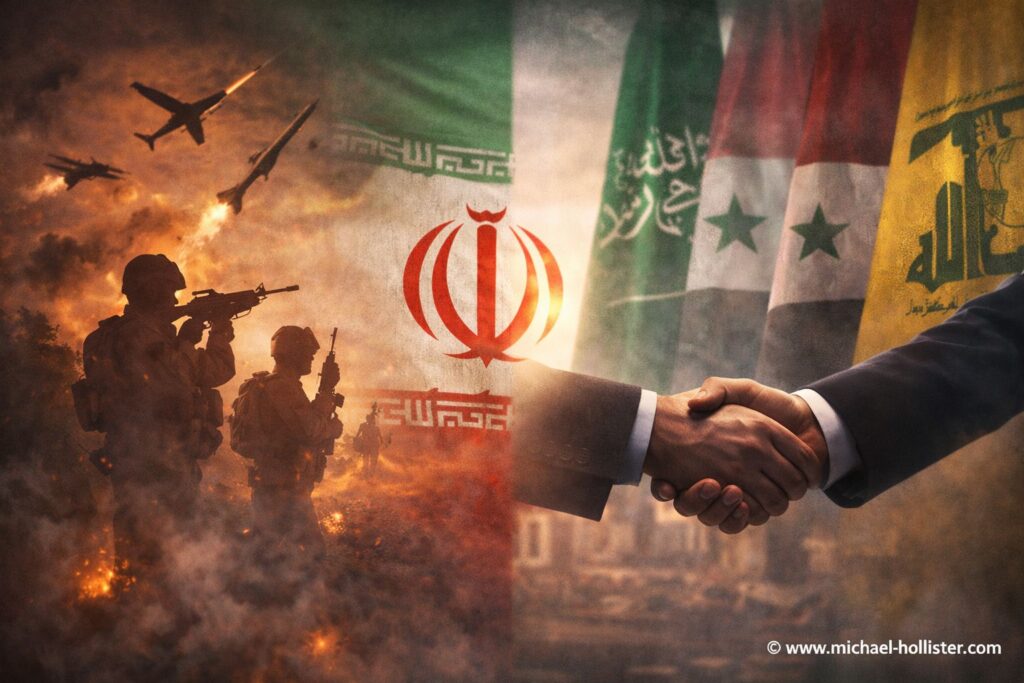
Iran’s Regional Network Between Expansion and Erosion
When Hamas fighters breached the Israeli border on October 7, 2023, and carried out one of the most devastating attacks in Israel’s history, Western commentators immediately spoke of an Iranian operation. Tehran, the logic went, controls Hamas like a remote control. The reality is more complex—and more illuminating for understanding what Iran calls its “Axis of Resistance.” Hamas acted autonomously, but within a strategic framework created by Iran. This framework—a network of allied non-state actors in Lebanon, Syria, Iraq, Yemen, and Palestine—is Iran’s most important instrument of regional power projection. But fourteen months after October 7, this network is more fragile than ever before. Hezbollah has been militarily decimated, Hamas is isolated, the Syrian Assad regime fell in December 2024, and the Houthis are fighting for survival. What remains of Iran’s regional strategy?
To answer this question, one must understand how Iran built its sphere of influence, what logic underlies it, and why the events since October 2023 represent not merely a tactical defeat but a strategic crisis.
The Doctrine of Strategic Depth
Iran’s regional strategy is based on a concept known in Persian as “omgh-e estratezhik”—strategic depth. The idea is simple but effective: Instead of waiting until enemies stand at one’s own borders, one creates forward defense lines in other countries. Ayatollah Ali Khamenei formulated this explicitly in 2019: “Do not lose sight of the vast geography of resistance. This transnational perspective is sometimes more important than the most urgent domestic concerns.” The message was clear: Iran’s security does not begin at its borders, but in Beirut, Damascus, Baghdad, Sanaa, and Gaza.
This doctrine did not emerge in a vacuum. It is a direct consequence of the Iran-Iraq War (1980-1988), when Saddam Hussein’s troops occupied Iranian territory and waged a brutal war of attrition for eight years. Iran fought alone at the time—the international community largely supported Iraq, the West delivered weapons, the Gulf states financed Baghdad. The lesson Iran’s strategic planners drew from this: Conventional superiority is unattainable, but a network of regional allies can deter enemies and tie them down in a conflict.
The 2006 Lebanon War cemented this conviction. Hezbollah, a Shiite militia built and financed by Iran, fought a 34-day war against Israel—and achieved at least a strategic stalemate. Israel could not disarm Hezbollah, Hezbollah could not defeat Israel, but the fact that a non-state militia held the strongest army in the Middle East in check was a triumph for Tehran’s asymmetric strategy. Qassem Soleimani, then commander of the Revolutionary Guards’ Quds Force, was in Beirut during the war and coordinated the defense. For Iran, Hezbollah became the model.
Strategic depth fulfills several functions simultaneously. First, it creates deterrence: An attack on Iran would not only strike Iranian territory but would trigger a coordinated response from the entire network—rocket attacks by Hezbollah on Israeli cities, drone strikes by Houthis on Saudi oil fields, attacks by Iraqi militias on US bases. Second, it allows Iran to exert influence without direct responsibility: When Hezbollah fires on Israeli positions, that is formally a Hezbollah decision, not Tehran’s—even when Iranian advisors are operating in the background. Third, it gives Iran a negotiating position: Every group in the network is a potential pressure point or concession in negotiations.
But this model has a fundamental flaw: It only works as long as the allies are strong enough to play their role. And this is precisely the problem of 2024.
Building the Network: The Axis of Resistance
The term “Axis of Resistance” is not a Western invention but a self-designation by Iran and its allies. It suggests ideological unity—resistance against Israel, against the USA, against Western hegemony. In reality, the network is a patchwork of different actors with different motives that Iran holds together through a combination of ideological affinity, material support, and strategic necessity.
Hezbollah in Lebanon is the oldest and closest partner. Founded in 1982 during the Lebanese civil war, the organization was built by the Revolutionary Guards and has been financed by Iran to this day—estimates put annual funding at between $700 million and one billion dollars. Hezbollah is more than a militia: It operates hospitals, schools, a television station (Al-Manar), and controls large parts of the Lebanese economy. Politically it is one of the most powerful parties in Lebanon with a de facto veto over strategic decisions. Militarily it possesses an estimated 150,000 rockets of varying range capable of reaching any city in Israel. Hassan Nasrallah, its Secretary-General since 1992, was considered one of the most influential actors in the Middle East until his assassination in September 2024.
In Palestine, Iran supports both Hamas in the Gaza Strip and Islamic Jihad. The relationship with Hamas is complicated: Hamas is Sunni, while Iran is Shiite; Hamas emerged from the Egyptian Muslim Brotherhood, a movement many Iranian hardliners reject. But shared hostility toward Israel bridges these differences. Iran delivered money (an estimated $100 million annually before October 7), weapons, and training. Qassem Soleimani visited Gaza several times and coordinated weapons deliveries through tunnels from Egypt and later through Sudan and Libya.
In Yemen, Iran’s support for the Houthis (officially: Ansar Allah) began late, around 2009, and intensified massively after the Saudi-led military intervention began in 2015. Unlike Hezbollah, the Houthis are not an Iranian creation—they emerged in the 1990s as a Zaidi revitalization movement in northern Yemen. But Iran delivered weapons, rocket components, drone technology, and military training. The Houthis at times controlled the capital Sanaa and approximately two-thirds of the Yemeni population. Their ability to strike targets in Saudi Arabia and the United Arab Emirates with ballistic missiles and drones made them an indispensable element of Iran’s regional deterrence.
The connecting element of all these groups is not primarily religious in nature—the Houthis are Zaidis, Hezbollah follows Twelver Shiism, Hamas is Sunni—but strategic-ideological: Opposition to Israel and US hegemony in the Middle East. Iran offers financial and military support, political backing, and a transnational identity as the “Axis of Resistance” against a common enemy.
Iraq: The Invisible Backbone of the Axis
While Hezbollah, Hamas, and the Houthis receive public attention, Iraq is the underestimated pillar of Iran’s regional network. Since the US invasion in 2003 and the fall of Saddam Hussein, Iran has systematically built influence in Iraq—not through direct occupation, but through a complex network of political parties and armed militias.
The key is the Popular Mobilization Forces (PMF; Arabic: al-Hashd al-Shaabi), founded in 2014 as a response to the Islamic State’s advance. When ISIS conquered large parts of Iraq and the regular Iraqi army collapsed, Grand Ayatollah Ali al-Sistani, the highest Shiite authority in Iraq, called for defense. Tens of thousands of volunteer fighters signed up—many organized in already existing, pro-Iranian militias like the Badr Organization, Kata’ib Hezbollah, or Asaib Ahl al-Haq.
The PMF is not a monolithic bloc but an umbrella organization of over 60 different militias with an estimated 150,000 fighters. Some of these groups are closely linked to Iran and follow the Quds Force’s instructions directly. Others are Iraqi nationalist and reject Iranian dominance. The pro-Iranian factions dominate, however: Kata’ib Hezbollah, led by Abu Hussein al-Hamidawi, is effectively an extension of the IRGC and has repeatedly attacked US bases in Iraq.
The PMF’s economic power is enormous. They control border crossings between Iraq and Syria, collect customs and smuggling fees, operate protection rackets, and have access to state budgets. Estimates suggest pro-Iranian militias earn hundreds of millions of dollars annually through legal and illegal activities. This economic base makes them independent of direct Iranian financing and simultaneously difficult for the Iraqi government to control.
Politically, the PMF is deeply embedded in the Iraqi state. After the victory over ISIS in 2017, the militias were officially integrated into the security structures—formally they answer to the Prime Minister, but in practice many operate autonomously. In the 2018 parliamentary elections, the Fatah Alliance, the PMF’s political arm, won 48 seats and became the second-strongest faction. Even though it dropped to 17 seats in 2021 (after internal conflicts and public dissatisfaction), the PMF remains a powerful veto player in Iraqi politics.
Iraq’s strategic importance for Iran lies in three dimensions. First, Iraq serves as a buffer zone against potential threats from the west—particularly against US military presence. The approximately 2,500 US soldiers still stationed in Iraq are regularly targeted by pro-Iranian militias with rockets and drones. Second, Iraq is the land bridge between Iran and Syria/Lebanon: weapons deliveries, fighter transfers, and logistical support for Hezbollah run across Iraqi territory, controlled by PMF militias at the border. Third, Iraq is an economic lifeline: Iran exports over $10 billion annually in electricity, gas, and consumer goods to Iraq—vital revenues in the face of Western sanctions.
Yet Iran’s dominance in Iraq is not unchallenged. The Iraqi government under Prime Minister Mohammed Shia al-Sudani is cautiously trying to bring the militias under greater control. Nationalist actors like the cleric Muqtada al-Sadr reject Iranian interference and mobilize mass demonstrations against corrupt, pro-Iranian politicians. Economically, US influence is also growing: Washington uses control over Iran’s frozen dollar reserves to force Baghdad to restrict trade with Tehran. Nevertheless: Iraq remains the most stable component of Iran’s regional axis—less exposed than Hezbollah, less isolated than the Houthis, deeply rooted in state and society.
Syria: The Lost Land Bridge
Syria was not merely an ally of Iran—it was the geographical precondition for the Axis of Resistance. Without Syria, there is no continuous overland connection between Tehran and Beirut, no secure weapons corridors for Hezbollah, no Iranian military bases within striking distance of Israel. When Bashar al-Assad’s regime fell in December 2024, Iran lost more than a partner—it lost the infrastructure of its regional strategy.
Iran’s engagement in Syria began in 2011, when peaceful protests against Assad escalated into civil war. While the Syrian army deserted and collapsed, Iran sent thousands of fighters: Quds Force officers as advisors, Lebanese Hezbollah fighters as elite troops, Iraqi Shiite militias (particularly Kata’ib Hezbollah and the Badr Brigades), and specially recruited Afghan and Pakistani refugees organized in the Fatemiyoun Brigade (Afghans) and the Zainabiyoun Brigade (Pakistanis). These units—totaling an estimated 20,000 to 30,000 men—fought on the decisive fronts: around Aleppo, around Damascus, along the road connecting both cities.
Russia’s air support from September 2015 was decisive for Assad’s survival, but the ground troops were predominantly coordinated by Iran. Qassem Soleimani traveled regularly to Damascus and commanded operations personally. Iranian losses were high: Over 2,000 members of the Revolutionary Guards fell in Syria, including senior officers. But the strategic objective was achieved: Assad remained in power, and Iran established a permanent military presence.
This presence included military bases, weapons depots, and production facilities. The T-4 airbase east of Homs became an Iranian strongpoint from which drones and rockets were launched for operations against Israel. The Imam Ali base south of Damascus housed Iranian commanders and weapons stockpiles. In and around Damascus, factories were built to produce precision-guided rockets destined for Hezbollah. Israel conducted over 300 airstrikes in Syria between 2017 and 2024 to destroy this infrastructure—with limited success because Iran rapidly delivered replacements.
Financially, Syria was a bottomless pit. Estimates suggest Iran invested between $15 and $20 billion in Assad’s survival: military expenditures, oil deliveries (as Syria’s own production collapsed), credit lines for reconstruction, salaries for militias. For a country under sanctions with a struggling economy, this was an immense burden. But from Iran’s perspective it was indispensable: Syria was the bridge to Hezbollah, the forward post against Israel, and proof of Iran’s ability to protect its allies.
When Assad fell in December 2024—overrun by a surprise offensive by Hayat Tahrir al-Sham and other rebel groups—this entire architecture collapsed. Iran evacuated its troops in haste, left weapons behind, and lost access to military bases. The new Syrian government, dominated by Sunni Islamists, is openly anti-Iranian. The land bridge is severed: Weapons deliveries to Lebanon must now go by aircraft through Iraqi airspace or along dangerous overland routes through hostile territory. Hezbollah, already weakened, is now additionally cut off from its most important supply route.
The loss of Syria is not merely military-logistical but symbolically devastating. For over thirteen years, Iran had invested massive resources to save Assad—and within a matter of days everything was lost. For Iran’s allies in the region, the message is clear: Tehran cannot always protect you, even if it has tried for years.
Neighborhood Policy: Pragmatism in the Shadow of Confrontation
Parallel to the confrontational Axis of Resistance, Iran pursues a surprisingly pragmatic neighborhood policy. These two strategies appear contradictory—Iran supports militias that attack Saudi Arabia while simultaneously normalizing diplomatic relations with Riyadh—yet they are two sides of the same coin: Iran maximizes its influence through all available means.
The rapprochement with Saudi Arabia, brokered by China in March 2023, was a diplomatic coup. After seven years of severed relations—triggered in 2016 by the execution of the Shiite cleric Nimr al-Nimr in Saudi Arabia and the subsequent attack on the Saudi embassy in Tehran—both countries agreed to resume diplomatic relations, reopen embassies, and commit to non-interference in internal affairs.
For Saudi Arabia, the deal was a strategic necessity. The Yemen war, begun in 2015 with the aim of defeating the Houthis and pushing back Iranian influence, had proven a costly debacle: tens of thousands dead, over $200 billion in costs, international criticism over humanitarian catastrophe, and militarily a stalemate. Crown Prince Mohammed bin Salman needed an exit to advance his Vision 2030—an ambitious economic reform program to diversify the Saudi economy. Regional stability was a prerequisite for foreign investment and tourism.
Iran benefited equally. The maximum pressure sanctions of the Trump administration had sent the economy into collapse: inflation over 40 percent, the Rial at historic lows, oil exports drastically reduced. The rapprochement with Riyadh offered economic prospects (trade, pilgrim traffic to Mecca) and diplomatic legitimization. More importantly: the deal reduced military pressure in Yemen without Iran having to abandon its support for the Houthis.
China’s role as mediator was decisive. Beijing, the largest oil importer from both countries, had an economic interest in regional stability. Chinese diplomats bridged distrust, offered neutral negotiating venues, and guaranteed implementation. The mediation was also a geopolitical signal: China positioned itself as a peacemaker in the Middle East—a role traditionally held by the USA but neglected under Biden.
Yet this neighborhood policy has clear limits. The rapprochement with Saudi Arabia does not mean Iran is abandoning the Houthis. When the Houthis began attacking ships in the Red Sea from October 2023 onward (in solidarity with Gaza), they effectively ignored the Saudi-Iranian deal. Riyadh responded with restraint—a sign that the deal is fragile. The Turkish-Iranian relationship is another example of pragmatism despite rivalry. In Syria, both stood on opposing sides: Iran supported Assad, Turkey the opposition. But economically they depend on each other: Turkey imports Iranian gas and oil (often via roundabout routes to circumvent US sanctions), Iran imports Turkish consumer goods. This neighborhood policy reflects Iran’s strategic flexibility. Confrontation and cooperation are not contradictions but tools of the same goal: securing regional influence.
The Gaza War: Turning Point and Erosion
October 7, 2023 was more than a spectacular attack—it was the beginning of a cascade that brought Iran’s entire regional architecture crashing down. On that Saturday morning, officially over 3,000 Hamas fighters breached the Israeli border in a way that shocked Israel’s security apparatus. They blew the border fence at dozens of points simultaneously, overran Israeli military posts on motorcycles, pickup trucks, and on foot, penetrated kibbutzim and the city of Sderot, and attacked the Supernova music festival. Over 1,200 people were killed, mostly civilians, approximately 250 taken hostage to Gaza. The operation had been planned for months, militarily coordinated, and tactically brilliant—Hamas had circumvented Israel’s surveillance systems, exploited vulnerabilities, and within hours achieved effective control over parts of southern Israel.
For Iran, October 7 was a strategic dilemma. On one hand, the operation demonstrated the effectiveness of Iran’s investment in Hamas—years of training, weapons deliveries, financial support paid off in a strike that humiliated Israel and destabilized the region. On the other hand, Hamas had acted autonomously: Tehran was not informed in advance, Supreme Leader Khamenei publicly denied any involvement in the planning. This distancing was partly tactical (avoiding direct confrontation with the USA and Israel), but partly also honest—Hamas operates largely autonomously, Iran is a supporter, not a commander.
Israel’s response was devastating. Within weeks, Operation “Iron Swords” turned Gaza into rubble: over 45,000 dead by end of 2024 (according to Palestinian sources, mostly civilians), nine out of ten residents displaced, hospitals destroyed, the tunnel infrastructure systematically demolished. The Hamas leadership was decimated: Yahya Sinwar, architect of October 7, killed by Israeli forces in October 2024; Mohammed Deif, military chief, eliminated in an airstrike in July 2024. Hamas survives, but as a shadow of its former strength.
The actual turning point came in September 2024, however, when Israel turned its attention to Hezbollah. Since October 8, Hezbollah had sporadically shelled Israeli positions in northern Israel—symbolic solidarity with Gaza, without risking full escalation. Hassan Nasrallah, a pragmatic tactician, wanted to provoke Israel but not start an open war. But Israel interpreted this as a declaration of war.
On September 17, 2024, hundreds of pagers carried by Hezbollah members exploded simultaneously—an unprecedented Mossad operation in which manipulated devices functioned as bombs. The next day, walkie-talkies exploded. Dozens of Hezbollah fighters died, hundreds were injured, many blinded or maimed. The psychological impact was devastating: If even pagers are lethal, no communication is safe anymore. Hezbollah was exposed technologically.
Israel followed with massive airstrikes on Hezbollah’s infrastructure in southern Lebanon and Beirut’s southern suburbs. On September 27, 2024, a bunker-busting bomb struck Nasrallah’s headquarters in Dahiyeh, Beirut. Nasrallah and large parts of the Hezbollah leadership died in the strike. His death was a symbolic and operational shock: For 32 years he had led the organization, built it into the most powerful non-state militia in the Middle East, and was considered Khamenei’s closest non-Iranian ally. His successor Naim Qassem is a theologian, not a military commander—Hezbollah is leaderless at a moment of maximum vulnerability.
Israeli ground forces pushed into southern Lebanon, destroyed tunnel systems, demolished weapons depots, and continued eliminating commanders. By end of 2024, Hezbollah had lost an estimated 4,000 fighters, a large portion of its rocket stockpiles, and organizational cohesion. The militia that had withstood Israel in 2006 was dismantled within three months.
For Iran, this was catastrophic. Hezbollah was not only the oldest partner but also the militarily strongest—the first line of defense against Israel. Yet Tehran did not intervene directly. In April 2024, after an Israeli strike on the Iranian consulate in Damascus, Iran had symbolically fired rockets and drones at Israel—a controlled escalation that caused little damage but demonstrated capability. In September/October 2024, as Hezbollah was being destroyed, Iran remained passive. The reason: Direct confrontation with Israel would mean US intervention, which could endanger the regime.
What Remains? Iran’s Regional Strategy After the Collapse
At the end of 2024, Iran stands amid the ruins of its Axis of Resistance. Hezbollah is militarily weakened, Nasrallah dead, Hamas survives only in tunnels, Assad has fallen, the Houthis are isolated. Iraqi militias are the only reasonably intact component of the network—but even there, internal pressure is growing as the Iraqi government attempts to bring the militias under greater control.
Three scenarios are conceivable.
First: Iran attempts reconstruction. Hezbollah can recruit, rearm, and reorganize over years. Hamas could return under new leadership if Israel does not permanently occupy Gaza. The Houthis have already proven they can survive military defeats. But reconstruction requires resources, time, and above all regional stability—three things Iran currently lacks.
Second: Iran accepts a reduced regional role. The Axis of Resistance was expensive and brought international isolation. A focus on neighborhood policy—good relations with Saudi Arabia, the UAE, Iraq, perhaps even Turkey—could bring economic benefits and diplomatically rehabilitate Iran. But this would mean abandoning the ideological core identity of the Islamic Republic: Resistance against Israel and the USA has been a central pillar of the revolution since 1979.
Third: Iran escalates. A direct military confrontation with Israel—avoided until now—could become an option if Tehran feels it has nothing left to lose. The development of nuclear weapons, officially rejected until now, could become more realistic. But escalation carries existential risks: A war with Israel would mean US intervention, which could endanger the regime.
Reality will likely be a mixture: selective reconstruction where possible (Iraq, possibly Lebanon), pragmatic diplomacy where necessary (Gulf states), and maintenance of rhetorical confrontation for domestic legitimation.
The Logic of Strategic Depth: Success or Hubris?
Looking back, Iran’s Axis of Resistance was both brilliant and fatal. Brilliant because it allowed Iran to build considerable regional influence with limited resources. A country with an economy smaller than Turkey’s or Saudi Arabia’s became the dominant actor in four countries (Lebanon, Syria, Iraq, Yemen) and could keep Israel, the strongest military power in the region, in check. Fatal because this strategy rested on the strength of its partners—and when these partners fell, the entire construct collapsed.
The doctrine of strategic depth had an inherent contradiction: It was supposed to give Iran security, but made Iran dependent on actors outside its control. Hamas decided autonomously to attack on October 7, inadvertently drawing the entire axis into a conflict. Hezbollah had to act in solidarity, but risked its own existence in doing so. Iran could neither prevent the escalation nor effectively protect its partners.
The events since October 2023 also reveal the limits of asymmetric warfare. Rockets and drones can cause damage, but they cannot stop a conventional military strike. When Israel decided to take out Hezbollah, no amount of rockets helped—Israeli air superiority, intelligence services, and special forces dismantled the organization piece by piece. Asymmetric warfare works against a restrained opponent, not a determined one.
For the further development of the Middle East, it is decisive how Iran responds to this collapse. A return to pragmatic neighborhood policy could foster regional stability—Saudi Arabia and Iran as partners instead of rivals, economic integration instead of proxy wars. But the ideological identity of the Islamic Republic makes this path difficult: How does a regime that has preached “resistance” for 45 years explain that it is now making compromises?
The Axis of Resistance is not dead, but it is severely wounded. Whether it recovers or whether Iran must develop a new regional strategy will shape the coming years—not only for Iran, but for the entire Middle East.
This analysis is made available for free – but high-quality research takes time, money, energy, and focus. If you’d like to support this work, you can do so here:

Alternatively, support my work with a Substack subscription – from as little as 5 USD/month or 40 USD/year!
Let’s build a counter-public together.
Michael Hollisteris a geopolitical analyst and investigative journalist. He served six years in the German military, including peacekeeping deployments in the Balkans (SFOR, KFOR), followed by 14 years in IT security management. His analysis draws on primary sources to examine European militarization, Western intervention policy, and shifting power dynamics across Asia. A particular focus of his work lies in Southeast Asia, where he investigates strategic dependencies, spheres of influence, and security architectures. Hollister combines operational insider perspective with uncompromising systemic critique—beyond opinion journalism. His work appears on his bilingual website (German/English) www.michael-hollister.com, at Substack at https://michaelhollister.substack.com and in investigative outlets across the German-speaking world and the Anglosphere.
SOURCES
Primary Sources (Middle East Council on Global Affairs):
- Hezbollah’s Defeat and Iran’s Strategic Depth Doctrine, Middle East Council on Global Affairs, April 2025
- Iran’s Neighborhood Policy: An Assessment, Middle East Council on Global Affairs, Chapter from: Iran in the Middle East
- Iran-Syria Relations Amid Regional Reset Dynamics, Middle East Council on Global Affairs, April 2024
- Opportunities and Challenges Along the Path of Saudi-Iran Relations, Middle East Council on Global Affairs, April 2024
- Iran’s Role in the Yemen War: Real Influence and Regional Gains, Middle East Council on Global Affairs, April 2024
- From Rivals to Allies: Iran’s Evolving Role in Iraq’s Geopolitics, Middle East Council on Global Affairs, April 2024
- Iran in the Middle East: Building Bridges or Expanding Influence?, Middle East Council on Global Affairs, April 2024
Academic Analyses on Hezbollah and Strategic Depth:
- Norton, Augustus Richard: Hezbollah: A Short History, Princeton University Press, 2018
- Wege, Carl Anthony: “Hezbollah’s Bekaa Organization,” Perspectives on Terrorism, Vol. 6, No. 3, 2012, https://www.jstor.org/stable/26296866
- Daher, Joseph: Hezbollah: The Political Economy of Lebanon’s Party of God, Pluto Press, 2016
- Levitt, Matthew: Hezbollah: The Global Footprint of Lebanon’s Party of God, Georgetown University Press, 2013
Iran-Iraq Relations and PMF:
- Knights, Michael / Malik, Hamdi: “The Future of Iraq’s Popular Mobilization Forces”, The Washington Institute, Policy Watch 3423, March 2021
- Mansour, Renad: “More Than Militias: Iraq’s Popular Mobilization Forces Are Here to Stay”, War on the Rocks, April 2018
- International Crisis Group: “Iran in Iraq: How Much Influence?”, Middle East Report No. 38, March 2005, https://www.crisisgroup.org/middle-east-north-africa/gulf-and-arabian-peninsula/iran/iran-iraq-how-much-influence
Hamas and Palestine:
- Schanzer, Jonathan: Hamas vs. Fatah: The Struggle for Palestine, Palgrave Macmillan, 2008, https://link.springer.com/book/10.1057/9780230616219
- Milton-Edwards, Beverley / Farrell, Stephen: Hamas, Polity Press, 2010, https://politybooks.com/bookdetail/?isbn=9780745642550
- Robinson, Glenn E.: “Hamas as Social Movement,” in Islamic Activism: A Social Movement Theory Approach, Indiana University Press, 2004, https://iupress.org/
Houthis and Yemen:
- Al-Muslimi, Farea: “Iran’s Role in Yemen Exaggerated, but Destructive”, The Century Foundation, May 2017
- Salisbury, Peter: “Yemen: National Chaos, Local Order,” Chatham House Research Paper, December 2017, https://www.chathamhouse.org/2017/12/yemen-national-chaos-local-order
- Kendall, Elisabeth: “Iran’s Fingerprints in Yemen? Unpacking the Narrative,” Arab Gulf States Institute, February 2017, https://agsiw.org/irans-fingerprints-yemen-unpacking-narrative/
Syria and the Assad Regime:
- Lund, Aron: “Into the Tunnels,” The Century Foundation, December 2016, https://tcf.org/content/report/into-the-tunnels/
- Hokayem, Emile: Syria’s Uprising and the Fracturing of the Levant, Routledge/IISS, 2013, https://www.routledge.com/Syrias-Uprising-and-the-Fracturing-of-the-Levant/Hokayem/p/book/9780415690126
- Phillips, Christopher: The Battle for Syria: International Rivalry in the New Middle East, Yale University Press, 2020
Saudi-Iran Rapprochement:
- Ulrichsen, Kristian Coates: “The Saudi-Iran Détente: Breakthrough or Breakdown?”, Baker Institute, Rice University, March 2023
- International Crisis Group: “Impact of the Saudi-Iranian Reconciliation on Middle East Conflicts,” April 2023, https://www.crisisgroup.org/middle-east-north-africa/gulf-and-arabian-peninsula/iran-saudi-arabia/impact-saudi-iranian-reconciliation-middle-east-conflicts
- Parsi, Trita / Yadlin-Gadot, Trita: “How China Brokered the Saudi-Iran Deal”, The Diplomat, March 2023
Quds Force and Qassem Soleimani:
- Arango, Tim / Fassihi, Farnaz: “The Soleimani Strike: How Months of Tension Led to Open Conflict”, The New York Times, January 2020
- Neriah, Jacques: “Iran’s Quds Force: A Force Designed for Exporting Terrorism,” Jerusalem Center for Public Affairs, 2019, https://jcpa.org/
- Rubin, Michael: “Qassem Soleimani’s Deadly Ambitions,” American Enterprise Institute, January 2020, https://www.aei.org/articles/qassem-soleimanis-deadly-ambitions/
Gaza War (from October 2023):
- “War in Gaza: What We Know About the Conflict Between Israel and Hamas”, BBC News, continuously updated, https://www.bbc.com/news/world-middle-east-67039975
- International Crisis Group: “The Gaza War One Year On: Toward an Endgame?”, Briefing, October 2024
- Shapiro, Jeremy / Lovatt, Hugh: “How October 7 Shattered the Middle East Status Quo,” European Council on Foreign Relations, November 2023, https://ecfr.eu/article/how-october-7-shattered-the-middle-east-status-quo/
Israel-Hezbollah Conflict (2024):
- “Hassan Nasrallah: Hezbollah Leader Killed in Israeli Strike on Beirut”, The Guardian, September 2024
- “Israel’s War on Hezbollah: A Timeline”, Al Jazeera, continuously updated, https://www.aljazeera.com/news/2024/israel-hezbollah-conflict-timeline
- Neriah, Jacques: “The Targeted Elimination of Hassan Nasrallah: Strategic Implications,” Jerusalem Center for Public Affairs, October 2024, https://jcpa.org/
Fall of Assad (December 2024):
- “Syria’s Assad Regime Falls After Rebels Enter Damascus”, BBC News, December 2024, https://www.bbc.com/news/world-middle-east
- “The Collapse of Assad: What It Means for Iran and Russia”, The Economist, December 2024, https://www.economist.com/middle-east-and-africa
- Lund, Aron: “Syria After Assad: The New Power Dynamics”, The Century Foundation, December 2024
Axis of Resistance: Strategic Analyses:
- Katz, Brian / Neubauer, Seth: “Iran’s Axis of Resistance Under Pressure”, CSIS, November 2024
- Ostovar, Afshon: “Iran’s Axis of Resistance: Myth and Reality,” War on the Rocks, November 2024, https://warontherocks.com/
- Smyth, Phillip: “Iran’s Expanding Militia Army in Syria,” The Washington Institute for Near East Policy, January 2019, https://www.washingtoninstitute.org/policy-analysis/irans-expanding-militia-army-syria
ENGLISCH:
© Michael Hollister — All rights reserved. Redistribution, publication or reuse of this text requires express written permission from the author. For licensing inquiries, please contact the author via www.michael-hollister.com.
Newsletter
🇩🇪 Deutsch: Verstehen Sie geopolitische Zusammenhänge durch Primärquellen, historische Parallelen und dokumentierte Machtstrukturen. Monatlich, zweisprachig (DE/EN).
🇬🇧 English: Understand geopolitical contexts through primary sources, historical patterns, and documented power structures. Monthly, bilingual (DE/EN).