
How NGOs Became Tools of Regime Change
by Michael Hollister
Exclusive published at Michael Hollister on February 15, 2026
3.425 words * 18 minutes readingtime
Exclusive Analysis for Subscribers
From Venezuela to Iran, from NED to Correctiv – an analysis of state-funded “civil society” as an instrument of geopolitical control
Tehran, January 2025. Once again, young Iranians take to the streets. Once again, Western media report on “courageous protests against the Mullah regime.” Once again, NGOs based in Washington provide the numbers: arrested, injured, dead. What the coverage omits: At least two of these organizations are directly financed by the U.S. government. The National Endowment for Democracy (NED) alone invested over $900,000 in 2024 in “human rights documentation” and “media support” for Iranian opposition groups. Coincidence? Humanitarian aid? Or system?
The answer isn’t found in Tehran, but in Kyiv, Caracas, Yangon, and Berlin. Everywhere the West wants to assert its interests—or must defend them—operates a network of foundations, NGOs, and “civil society organizations” equipped with billions of dollars and pursuing a clear mission: shaping political systems according to Western models. What the CIA once did covertly now happens publicly—just under a different name.
NGOs are the drones of democracy. They don’t fire missiles but narratives, networks, and new elites. Yet their goal is the same: control.
The System: Three Stages to Destabilization
The pattern becomes recognizable once you look for it. From Ukraine to Venezuela to Myanmar, the operation follows the same script:
Stage 1: Preparation (Years in Advance)
Long before the first demonstrator hits the streets, the groundwork is laid. Young academics receive scholarships for study abroad in the U.S. or Europe. Journalists are trained in “independent” media workshops. Lawyers attend seminars on “rule of law.” NGOs build local networks that officially promote human rights but factually establish opposition structures. This takes time—but the investment pays off.
Stage 2: Mobilization (Months of Escalation)
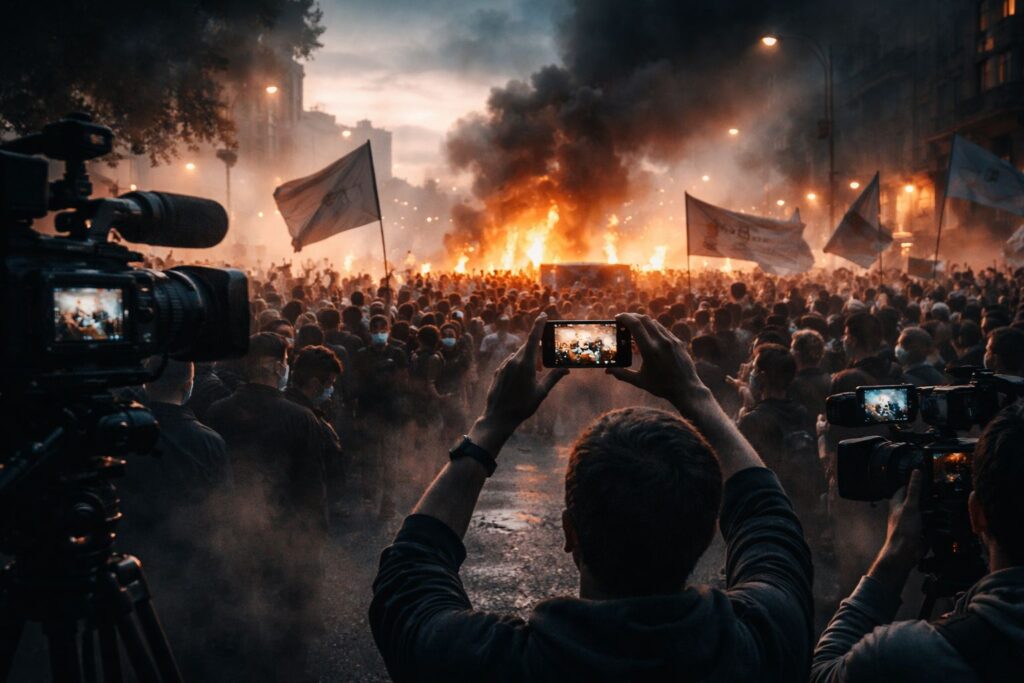
When the political moment is favorable—a disputed election, a scandal, an economic crisis—the prepared networks are activated. Suddenly, professionally designed social media campaigns appear. Demonstrations aren’t spontaneously organized but follow proven protest techniques: nonviolent resistance, symbolic occupations, media-friendly images. The activists know when to demonstrate (rush hour), where the cameras are positioned, and which slogans work internationally. This isn’t coincidence—it’s training.
Stage 3: Narrative Consolidation (Days of Decision)
Now Western media take over. CNN, BBC, Deutsche Welle report around the clock on the “popular uprising.” Think tanks provide analyses. “Experts” explain why the government is “illegitimate.” NGOs supply casualty figures—often unverifiable but highly effective in media terms. The UN is brought in, sanctions prepared. Within weeks, a government stands accused that was considered a negotiating partner just months earlier.
The system works because it has three decisive advantages: First, it’s cheap. Ten million dollars for NGO financing can accomplish more than a billion for military intervention. Second, it offers plausible deniability. If regime change fails, it was “civil society,” not Washington. And third, it’s morally unassailable. Anyone who criticizes NGOs is considered an enemy of democracy.
The Actors: An Empire in the Shadows
NED – The Legalized CIA
“A lot of what we do today was done covertly 25 years ago by the CIA.” This quote doesn’t come from a conspiracy theorist but from Allen Weinstein, one of the founders of the National Endowment for Democracy (NED). The interview appeared in 1991 in the Washington Post—and no one objected.
What is presented as “civil society” has long become a geopolitical tool.
This investigation reveals how Western-funded NGOs prepare regime change, shape narratives, and cultivate political elites – from Tehran to Kyiv to Berlin.
An uncompromising analysis of the invisible power structures behind democracy promotion, human rights rhetoric, and moral legitimacy.
Exclusive Analysis for Subscribers
This exclusive Deep-Dive-Analysis you will be able to find here.
Michael Hollister is a geopolitical analyst and investigative journalist. He served six years in the German military, including peacekeeping deployments in the Balkans (SFOR, KFOR), followed by 14 years in IT security management. His analysis draws on primary sources to examine European militarization, Western intervention policy, and shifting power dynamics across Asia. A particular focus of his work lies in Southeast Asia, where he investigates strategic dependencies, spheres of influence, and security architectures. Hollister combines operational insider perspective with uncompromising systemic critique—beyond opinion journalism. His work appears on his bilingual website (German/English) www.michael-hollister.com, at Substack at https://michaelhollister.substack.com and in investigative outlets across the German-speaking world and the Anglosphere.
Newsletter
🇩🇪 Deutsch: Verstehen Sie geopolitische Zusammenhänge durch Primärquellen, historische Parallelen und dokumentierte Machtstrukturen. Monatlich, zweisprachig (DE/EN).
🇬🇧 English: Understand geopolitical contexts through primary sources, historical patterns, and documented power structures. Monthly, bilingual (DE/EN).