
by Michael Hollister
Published at apolut media on February 08, 2026
4.464 words * 24 minutes readingtime
Please read Part 1 here:
Iran’s Nuclear Poker – Part 1 – Ambiguity as Strategy
This analysis is made available for free – but high-quality research takes time, money, energy, and focus. If you’d like to support this work, you can do so here:

Alternatively, support my work with a Substack subscription – from as little as 5 USD/month or 40 UDS/year!
Let’s build a counter-public together.
Power and Decision in Tehran
When news broke in March 2023 that Iran and Saudi Arabia would resume diplomatic relations, Western media spoke of a surprise. But who exactly had negotiated this deal? The Iranian Foreign Minister? No. It was Ali Shamkhani, then Secretary of the Supreme National Security Council (SNSC), who led the negotiations—a man with a military background, not a diplomat in the classical sense. A few weeks later, Shamkhani was fired and replaced by Ali Akbar Ahmadian, a retired general of the Islamic Revolutionary Guard Corps (IRGC). The message was clear: In Tehran, it is not the Foreign Ministry that decides on strategic foreign policy.
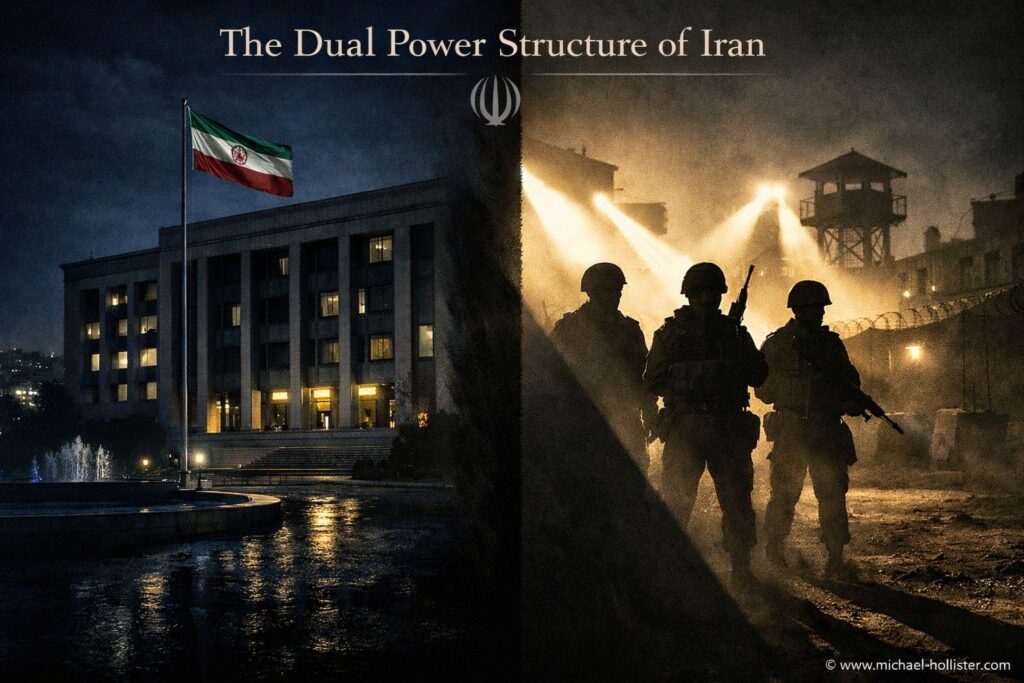
This episode illustrates a fundamental reality of the Iranian system that is often misunderstood in the West: Iran has two foreign policies. One formal, enshrined in the constitution and represented by the Foreign Ministry. And one informal, dominated by security apparatuses and making the actual decisions. Anyone who wants to understand Iran—its nuclear policy, its regional policy, its relationship with the West—must understand how these two levels interact and how their relationship has shifted dramatically in recent years.
The Architecture of Power: Formal Structures
The Iranian Constitution of 1979 establishes a complex system that combines religious and republican elements. At the top stands the Supreme Leader, currently Ayatollah Ali Khamenei, who has been in office since 1989. The Constitution gives him final authority over all strategic foreign policy questions, particularly the nuclear program and relations with the USA. Khamenei appoints the commanders of the armed forces, the head of the judiciary, and has informal decisive influence over the appointment of the SNSC Secretary. However, his role is more complex than that of an absolute ruler: Khamenei must balance between various centers of power and depends on his decisions being implemented by key institutions.
The President formally leads the executive and is the public face of Iranian foreign policy. He appoints the cabinet, including the Foreign Minister, and represents Iran at international forums like the United Nations. But his actual power is limited. Under President Hassan Rouhani (2013-2021), the historic nuclear agreement JCPOA was successfully negotiated—but only because Khamenei gave the green light and because the then SNSC Secretary Ali Shamkhani secured the deal internally. When Donald Trump withdrew from the agreement in 2018, Khamenei quickly distanced himself and retrospectively called the JCPOA “pure damage.” The episode shows the pattern: The supreme leadership claims successes, failures are attributed to others.
The Foreign Ministry should theoretically be the center of Iranian diplomacy. Under Rouhani, Foreign Minister Mohammad Javad Zarif led the JCPOA negotiations and was internationally respected. But even during this time, Zarif complained internally about systematic sabotage by military actors. In leaked audio from 2021, he said: “The country has two foreign policies: one from the Foreign Ministry and one from the armed forces. The battlefield repeatedly sabotaged my diplomatic efforts.” Under Rouhani’s successor Ebrahim Raisi (2021-2024), the Foreign Ministry was further marginalized. Raisi’s Foreign Minister Hossein Amirabdollahian, who died together with Raisi in a helicopter crash in May 2024, was openly IRGC-aligned and formulated the new doctrine explicitly: “There is close coordination between diplomacy and battlefield.”
The Supreme National Security Council (SNSC) functions as a bridge between the various power structures. It consists of the President (chair), representatives of the military, judiciary, legislature, as well as the Foreign and Interior Ministers. The SNSC Secretary, formally appointed by the President, requires Khamenei’s approval in practice. Between 2003 and 2013, the SNSC led nuclear negotiations under Ali Larijani and later Saeed Jalili. Rouhani shifted this responsibility to his Foreign Ministry in 2013, but since 2021 it has returned to the SNSC—now under Ahmadian, who is not only an ex-general but also has close connections to IRGC leadership. The SNSC led the Saudi rapprochement, negotiates with Russia on strategic partnership, coordinates positions on SCO and BRICS. This means: Security logic dominates over diplomatic considerations.
The Invisible Hand: Informal Power Structures
Alongside these constitutional institutions exists a network of informal actors who often have more influence than formal officeholders. First and foremost are the Islamic Revolutionary Guards (IRGC, Persian: Sepah-e Pasdaran). The IRGC were founded in 1979 to protect the revolution—not the nation, but the revolution. They answer only to the Supreme Leader, not the government, and have no civilian control. With an estimated 190,000 active soldiers and their own naval unit, they are organized parallel to the regular army. Their Quds Force (translated: Jerusalem Force) is responsible for foreign operations and has been building the so-called “Axis of Resistance” for decades—a network of allies in Lebanon, Syria, Iraq, Yemen, and Palestine.
But the IRGC is far more than a military organization. It controls large parts of the Iranian economy: construction conglomerates, oil smuggling networks, telecommunications. Through this economic power, the Guards have a vested interest in certain foreign policy constellations. Sanctions, for example, create lucrative black markets dominated by IRGC-affiliated traders. In April 2024, the Revolutionary Guards invited the Swiss ambassador to transmit a message to the USA—an unprecedented breach of diplomatic protocol showing that the IRGC now openly acts as a foreign policy actor.
Another informal power center is the Strategic Council on Foreign Relations (SCFR), founded in 2006 as an advisory body for Khamenei. The chairman is Kamal Kharrazi, who was Foreign Minister from 1997 to 2005. The SCFR functions as a kind of foreign policy think tank for the supreme leadership and conducts informal track-two diplomacy with foreign delegations. Kharrazi himself made headlines in May 2024 when he publicly mentioned the possibility of revising Iran’s nuclear doctrine—a statement that could only have been made with Khamenei’s approval.
Finally, political factions played a role in foreign policy discourse until 2021. Reformists and moderates, represented by figures like Mohammad Khatami (President 1997-2005) and Hassan Rouhani, argued for engagement with the West, while conservatives and hardliners pursued confrontation. But since 2020, this pluralistic phase is over. Through a process Iranian insiders call “purification,” reformists were systematically removed from all centers of power: Parliament has been hardliner-dominated since 2020, after the Guardian Council disqualified thousands of moderate candidates. The presidential elections of 2021 and 2024 followed the same pattern.
Four Paths of Transformation
Between 2021 and 2024, the Iranian system has experienced radical restructuring that can be categorized in four ways: legal, institutional, functional, and personnel changes. Each of these transformations has contributed to marginalizing the Foreign Ministry and strengthening the security apparatuses.
The legal transformation is most evident in the Development Plan Law passed in January 2024. Originally, this law stipulated that military units, the Atomic Energy Organization (AEOI), and intelligence services no longer had to inform the Foreign Ministry about their international activities. After public protests, particularly from ex-Foreign Minister Zarif, the law was slightly modified: AEOI and intelligence must now inform, but the military—meaning the IRGC—does not. Zarif’s comment was scathing: “Every ministry has its own Foreign Ministry.” The legal fragmentation of foreign policy is thereby codified.
Institutionally, the role of the SNSC has fundamentally changed. While Rouhani largely bypassed the SNSC and directly tasked Zarif with JCPOA diplomacy, the SNSC under Raisi has become the center of all strategic foreign policy decisions. Nuclear diplomacy lies with the SNSC again, as do relations with Saudi Arabia, Russia, China, and regional neighbors. Negotiations on SCO and BRICS membership run through the SNSC. This institutional shift means that technocratic expertise (which the Foreign Ministry could provide) is replaced by security policy calculations.
The functional transformation is evident in the new hierarchy between “diplomacy” and “battlefield.” Zarif described constant tension under Rouhani: While he tried to negotiate with Saudi Arabia, the IRGC undermined these efforts through military operations via their proxies. Amirabdollahian reversed this logic: Diplomacy should now support military strategy, not vice versa. The classical primacy of politics over military was inverted. A symbolic example: When the IRGC invited the Swiss ambassador in April 2024 to transmit a message to Washington (Switzerland represents US interests in Iran), this occurred bypassing the Foreign Ministry. The IRGC now acts as an independent foreign policy actor.
The personnel transformation finally eliminated the last pragmatic voices from the system. Ali Shamkhani, who served as SNSC Secretary from 2013 to 2023, was an experienced security expert with military background (he fought in the Iran-Iraq War) but also a pragmatist. He not only negotiated the Iran-Saudi deal but was also a supporter of JCPOA implementation. In May 2023, only two months after the triumph of the Saudi rapprochement, he was fired. His successor Ahmadian is a former IRGC general without diplomatic experience. Ali Larijani, who as Parliamentary Speaker (2008-2020) played a central role in Iranian politics and mediated negotiations for the 25-year deal with China (2021), was also marginalized. The reason for these purges lies in preparation for the post-Khamenei era: IRGC leadership wants to ensure that no independent power bases exist that could play a role after Khamenei’s death (he is 85 years old).
Four Trends with Far-Reaching Consequences
These structural changes have created four overarching trends that shape and will continue to shape Iran’s foreign policy.
The first trend is centralization. Under Rouhani, foreign policy dualism existed: The Foreign Ministry pursued engagement with the West, while hardliner institutions (IRGC, judiciary, conservative media) sabotaged this policy. The classic example is the failed rapprochement with Saudi Arabia: Rouhani and Zarif repeatedly attempted to initiate talks with Riyadh, but each time IRGC operations (such as attacks on Saudi oil facilities by Yemeni Houthis) torpedoed these efforts. Under Raisi, the situation was fundamentally different: The entire foreign policy elite—President, SNSC, Foreign Ministry, IRGC—pursued the same strategy. When Ahmadian and Shamkhani negotiated with the Saudis in 2023, there were no internal blockades. The paradox: The Iran-Saudi deal succeeded not despite but because of hardliner dominance. Centralization creates short-term capacity to act but simultaneously eliminates any course correction through internal debates.
The second trend is anti-Westernism as ideological foundation. While Rouhani between 2013 and 2021 pursued a dual strategy—engagement with the West plus hedging through Eastern partners (Russia, China)—the Raisi administration has completely written off the West. The ideology behind this is simple: The USA is a superpower in decline, Europe is a vassal of Washington, the West is historically hostile toward Iran, and compromises are useless because the West always breaks them (Trump proof: withdrawal from JCPOA 2018). Khamenei himself formulated this view in numerous speeches where he spoke of “shattered hegemony”—the crumbling US dominance. This ideology is not just rhetoric: It translates into concrete policy decisions. Under Raisi, there were no serious efforts to revive the nuclear agreement, although Biden would have been willing. Instead, the “Look East” strategy was intensified: SCO full membership (2023), BRICS accession (2024), strategic partnership with Russia, 25-year agreement with China. This orientation is now systemically anchored, not person-dependent. Even if a “moderate” president like Masoud Pezeshkian (in office since July 2024) seeks rapprochement with the West, he lacks the institutional levers for it.
The third trend is militarization of foreign policy. Foreign policy decisions are increasingly viewed through a security lens, not a diplomatic one. An example from January 2024 illustrates this: Iran fired missiles at Kurdish positions in northern Iraq and at separatist groups in Pakistan’s Baluchistan province. Officially these were anti-terror operations, but the message was political: Iran showed strength toward Israel (which allegedly uses Kurdish targets in Iraq for Mossad operations) and toward Pakistan (which is allied with Saudi Arabia). Traditional diplomacy would have viewed such actions as escalatory and counterproductive—from IRGC perspective, they were rational signals. The Axis of Resistance, meaning support for Hezbollah, Hamas, Iraqi Shiite militias, and Yemeni Houthis, is entirely coordinated by the IRGC Quds Force, not the Foreign Ministry. The export of Iranian Shahed drones to Russia (used in Ukraine) was an IRGC deal, not a government decision. The risk of this militarization lies in miscalculations: Military logic tends toward escalation, diplomatic channels for de-escalation are neglected.
The fourth trend is authoritarianism, both internally and externally. Domestically, the regime intensified repression after the massive protests of 2022 (triggered by the death of Mahsa Amini in police custody): Internet censorship, surveillance, suppression of civil society. Externally, this authoritarianism manifests in close cooperation with Russia and China on cyber-technology, information security, and surveillance systems. In 2023, Iran signed an agreement with Russia on “information security” that includes technical exchange on internet filtering. China’s social credit system inspires Iranian platforms for monitoring citizens. The advantage of this authoritarian cooperation is that Eastern partners do not exercise human rights criticism—unlike the West, for which human rights are (at least rhetorically) part of foreign policy. Internal repression and external orientation mutually reinforce each other: The more authoritarian the system, the less compatible with Western democracies, the more necessary the bond with authoritarian partners.
What Does This Mean in Practice?
These structural and ideological changes have concrete effects on Iran’s foreign policy behavior. Centralization makes Iran more predictable short-term: When Khamenei, SNSC, and IRGC pursue the same line, it gets implemented. The Saudi rapprochement shows that Iran is indeed capable of pragmatic regional policy when internal sabotage is absent. The stabilization of relations with the United Arab Emirates and Turkey follows this logic. Iran systematically improved its relations with regional neighbors in 2023 and 2024—not from ideological conviction but because it was strategically sensible and because internal coordination functioned.
At the same time, this same centralization creates long-term risks. Systems without internal dissenting voices tend toward poor decisions because groupthink is not corrected. The complete elimination of reformist or moderate perspectives means that nobody internally argues “maybe we should talk to the West after all” or “this military escalation could backfire.” Ali Larijani, for example, was someone who had both conservative credentials (he was never a reformist) and acted pragmatically. Such figures are now completely absent.
Anti-Westernism as ideology leads to a self-fulfilling prophecy: Iran acts as if the West is irrelevant, which confirms Western politicians who want to isolate Iran, which in turn reinforces Iran’s ideology. This spiral makes diplomacy extremely difficult. Even if a US president or EU foreign minister offers negotiations, the Iranian side is ideologically programmed to interpret this as deception. The JCPOA worked in 2015 because both sides believed they had something to gain; the conditions for a “JCPOA 2.0” no longer exist today because nobody in Tehran believes the West can be a reliable partner.
Militarization increases the danger of escalations that no side really wants. The Gaza war since October 2023 is an example: The IRGC supports Hamas, but Iran has no interest in a direct war with Israel. Nevertheless, military dynamics—missile launches, drone attacks, Israeli retaliatory strikes—force both sides into a spiral. Diplomats could create offramps, but when military officers set the agenda, such exits are missing. The killing of General Qassem Soleimani (January 2020) and the subsequent Iranian reaction (missile strikes on US bases in Iraq) already showed how quickly such dynamics can spiral out of control.
Authoritarianism finally makes Iran immune to certain Western pressure attempts, but not to all. Sanctions, for example, have massively damaged the economy: Inflation is over 40 percent, GDP stagnates, the currency (Rial) has collapsed. But as long as the regime can control the population, economic pressure does not translate into political concessions. The 2022 protests were the biggest challenge since the 1979 revolution—and the regime survived because it was willing to respond with brutal violence. This brutality is possible because the IRGC and Basij militias (a paramilitary volunteer organization under IRGC control) are ideologically loyal. External sanctions even strengthen IRGC power because it controls the black markets.
The Shadow of Succession
An often overlooked but crucial factor for the structural changes of recent years is the question of Khamenei’s succession. At 85 years old, the Supreme Leader is statistically in his last term. Iranian history knows only one transition between Supreme Leaders: 1989, when Ayatollah Ruhollah Khomeini died and Ali Khamenei became his successor. This transition went smoothly because Khamenei was supported by Hashemi Rafsanjani (then Iran’s most powerful politician) and the entire revolutionary elite. Today’s situation is more complex.
The systematic removal of Ali Larijani, Ali Shamkhani, and other pragmatic figures from positions of power is part of a strategy to eliminate possible alternative power bases. The IRGC wants to ensure that after Khamenei’s death, only IRGC-loyal candidates are eligible for succession. The Assembly of Experts, which formally elects the Supreme Leader, has been completely hardliner-dominated since 2016. One name circulating internally is Mojtaba Khamenei, the Supreme Leader’s second son—a taboo break because this would amount to dynastic succession, which contradicts revolutionary ideology. But the IRGC could support this if it can thereby secure its own power position.
This succession dynamic explains why the structural changes of recent years were so radical. It’s not just about foreign policy but about the architecture of the entire system for the post-Khamenei era. The marginalization of the Foreign Ministry, the strengthening of the SNSC, IRGC dominance—all these are building blocks of a system that should function even without Khamenei. From this perspective, Raisi’s death in May 2024 was less dramatic than Western observers expected: The system continued running because it depends not on individual persons but on structures.
Illusions and Realities: What the West Must Understand
Western analyses of Iran often suffer from three misperceptions. The first is hope for “moderates” who could reform the regime from within. This hope was partially justified under Khatami (1997-2005), barely plausible under Rouhani (2013-2021), today it is illusion. The purification of the political landscape is complete. Even Pezeshkian’s presidency, labeled “moderate,” changes nothing about the system: He has neither the power to control the IRGC nor can he determine the SNSC agenda. His role is to present a friendlier face outward while hardliners make policy.
The second misperception is seeing Iran as a monolithic bloc. Iran is not monolithic, but the remaining plurality lies not on the ideological level (all relevant actors are hardliners) but on the institutional level: Khamenei, IRGC, SNSC, judiciary, parliament, economic actors have different interests and priorities. The IRGC, for example, profits from sanctions and therefore has less incentive for compromises than economic elites outside the IRGC sphere. These internal tensions exist, but they no longer run between “reformists” and “hardliners” but between different hardliner factions.
The third misperception concerns the role of individuals. Western diplomacy often focuses on the Foreign Minister as counterpart because this corresponds to the logic of Western systems. But in Iran, the Foreign Minister is often the least important actor in strategic questions. Anyone who wants to negotiate with Iran must understand that decisions are made elsewhere: with the Supreme Leader, with the SNSC Secretary, with IRGC leadership. Zarif had this power temporarily because Rouhani gave it to him and Khamenei agreed; his successors do not have it.
Outlook: Stability Through Rigidity
The structural transformations of recent years have paradoxically made Iran’s foreign policy both more stable and riskier. More stable because internal conflicts were minimized and strategic decisions are now implemented more efficiently. The Saudi rapprochement, the de-escalation with the UAE, pragmatic regional policy—all this would have failed under Rouhani due to internal resistance. Riskier because the militarization of decision-making processes leads to calculations that ignore diplomatic exits.
Iran under the current system is not an irrational actor, but one that operates according to fundamentally different logic than Western democracies. IRGC dominance means that foreign policy is primarily viewed through the prism of security, deterrence, and regional power projection. Economic prosperity, international trade, foreign investment—goals that would be important to a Foreign Ministry—are secondary. This makes Iran difficult to calculate for Western counterparts who operate with economic incentives or sanctions: These instruments do not hit the decision-makers.
For European states wanting to maintain their own channels to Iran, this means that track-two diplomacy and informal contacts become more important than official negotiations. The SCFR, for example, is open to talks with European think tanks and former diplomats because such formats have no official character and are thus easier to justify domestically. Oman has also established itself as a mediator because Muscat maintains good relations with both Iran and Western capitals.
The fundamental question for the coming years is whether Iran’s structural rigidity—the elimination of dissenting voices, ideological narrowing, militarization—means long-term strength or weakness. Short-term, it has provided the system with stability: The 2022 protests were suppressed, the economy functions at survival level despite sanctions, regional policy was partially successful. Long-term, however, precisely these factors could lead to strategic errors: Foreign policy without correctives tends toward overstretch, an economy without foreign investment stagnates, a regime without legitimacy must spend ever more resources on repression.
Iran’s foreign policy structure is not a puzzle but a system—a system that has fundamentally changed in recent years and whose logic must be understood to interpret Iran’s actions. Who governs in Tehran is not a simple question with a simple answer. Formally, the Supreme Leader governs. Practically, a network of IRGC, SNSC, and Khamenei’s closest advisors governs. The Foreign Ministry does not govern—it executes what others have decided. Accepting this reality is the first step toward realistic Iran policy.
Michael Hollister is a geopolitical analyst and investigative journalist. He served six years in the German military, including peacekeeping deployments in the Balkans (SFOR, KFOR), followed by 14 years in IT security management. His analysis draws on primary sources to examine European militarization, Western intervention policy, and shifting power dynamics across Asia. A particular focus of his work lies in Southeast Asia, where he investigates strategic dependencies, spheres of influence, and security architectures. Hollister combines operational insider perspective with uncompromising systemic critique—beyond opinion journalism. His work appears on his bilingual website (German/English) www.michael-hollister.com, at Substack at https://michaelhollister.substack.com and in investigative outlets across the German-speaking world and the Anglosphere.
This analysis is made available for free – but high-quality research takes time, money, energy, and focus. If you’d like to support this work, you can do so here:

Alternatively, support my work with a Substack subscription – from as little as 5 USD/month or 40 UDS/year!
Let’s build a counter-public together.
SOURCES
Primary Sources (Middle East Council on Global Affairs):
- Iran’s Evolving Foreign Policy Structure: Implications on Foreign Relations, Middle East Council on Global Affairs, June 2024
- Raisi’s Foreign Policy: Revitalizing Iran’s International Position with a Non-Strategy, Middle East Council on Global Affairs, Chapter from: Iran’s Foreign Policy Under Raisi
- Iran on the Rise: Changing Perceptions and Global Ambitions Under Raisi, Middle East Council on Global Affairs, Chapter from: Iran’s Foreign Policy Under Raisi
Supplementary Academic Literature:
- Vakil, Sanam: Iran and the West: Continuous Antagonism or Potential Partnership?, Chatham House, 2023, https://www.chathamhouse.org/
- Barzegar, Kayhan: Iran’s Foreign Policy Strategy After Saddam, The Washington Quarterly, Vol. 28, No. 3, 2005, https://www.tandfonline.com/toc/rwaq20/current
- Ehteshami, Anoushiravan: Iran’s International Posture in the Wake of the Arab Uprisings, LSE Middle East Centre Paper Series, 2014, https://www.lse.ac.uk/middle-east-centre/publications
- Tabatabai, Ariane: No Conquest, No Defeat: Iran’s National Security Strategy, Oxford University Press, 2020
- Maloney, Suzanne: Iran’s Political Economy Since the Revolution, Cambridge University Press, 2015, https://www.cambridge.org/
Primary Documents:
- Constitution of the Islamic Republic of Iran, Articles 110, 176, 177, Iran Human Rights Documentation Center Archive
- Leaked Audio: Mohammad Javad Zarif on IRGC-Diplomacy Tensions, April 2021, Transcript published by BBC Persian and Iran International, https://www.iranintl.com/
- Speech by Ayatollah Ali Khamenei to IRGC Commanders, September 2019
- Iran’s Seventh National Development Plan (2022-2026), Parliament of the Islamic Republic of Iran (Majles), January 2024, https://rc.majlis.ir/en
News Sources and Analyses:
- “Iran and Saudi Arabia Agree to Resume Diplomatic Relations”, The Guardian, March 10, 2023
- “Iran’s Revolutionary Guards Invite Swiss Ambassador in Rare Diplomatic Move”, Financial Times, April 15, 2024
- “Death of Ebrahim Raisi: What It Means for Iran’s Power Structure”, Al Jazeera, May 20, 2024
- “Masoud Pezeshkian Wins Iran Presidential Election”, BBC News, July 6, 2024
- “Iran’s SNSC Takes Control of Nuclear Negotiations”, Reuters, August 22, 2021
- “Ali Shamkhani Removed as Iran’s Security Council Chief”, Iran International, May 22, 2023
Background Analyses on IRGC and Security Structures:
- Wehrey, Frederic / Thaler, David et al.: The Rise of the Pasdaran: Assessing the Domestic Roles of Iran’s Islamic Revolutionary Guards Corps, RAND Corporation, 2009
- Alfoneh, Ali: Iran Unveiled: How the Revolutionary Guards is Turning Theocracy into Military Dictatorship, AEI Press, 2013, https://www.aei.org/
- Ostovar, Afshon: Vanguard of the Imam: Religion, Politics, and Iran’s Revolutionary Guards, Oxford University Press, 2016, https://global.oup.com/academic/
- Juneau, Thomas: Squandered Opportunity: Neoclassical Realism and Iranian Foreign Policy, Stanford University Press, 2015, https://www.sup.org/
Economic and Social Dimension:
- Katzman, Kenneth: Iran’s Foreign and Defense Policies, Congressional Research Service Report, January 2024, https://crsreports.congress.gov/
- International Crisis Group: Iran’s Priorities in a Turbulent Middle East, Middle East Report No. 184, April 2018, https://www.crisisgroup.org/middle-east-north-africa/gulf-and-arabian-peninsula/iran
- “How Iran’s Revolutionary Guards Built an Economic Empire”, The Economist, January 14, 2023, https://www.economist.com/middle-east-and-africa
- “Iran’s Internet Censorship: Collaboration with Russia and China”, Freedom House Report, 2023
Historical Contextualization:
- Rakel, Eva Patricia: Power, Islam, and Political Elite in Iran, Brill, 2009, https://brill.com/
- Axworthy, Michael: Revolutionary Iran: A History of the Islamic Republic, Oxford University Press, 2013, https://global.oup.com/academic/
- Takeyh, Ray: Guardians of the Revolution: Iran and the World in the Age of the Ayatollahs, Oxford University Press, 2009, https://global.oup.com/academic/
Nuclear Diplomacy and JCPOA:
- Samore, Gary (ed.): The Iran Nuclear Deal: A Definitive Guide, Belfer Center, Harvard Kennedy School, 2015, https://www.belfercenter.org/
- Mousavian, Seyed Hossein: The Iranian Nuclear Crisis: A Memoir, Carnegie Endowment for International Peace, 2012, https://carnegieendowment.org/
- Parsi, Trita: Losing an Enemy: Obama, Iran, and the Triumph of Diplomacy, Yale University Press, 2017, https://yalebooks.yale.edu/
Regional Policy and “Axis of Resistance”:
- Smyth, Phillip: The Shiite Jihad in Syria and Its Regional Effects, Washington Institute for Near East Policy, Policy Focus 138, 2015, https://www.washingtoninstitute.org/policy-analysis
- Hokayem, Emile / Roberts, David: The War in Yemen, Survival: Global Politics and Strategy, Vol. 58, No. 6, 2016, https://www.iiss.org/publications/survival/
- Wehrey, Frederic: The Burning Shores: Inside the Battle for the New Libya, Farrar, Straus and Giroux, 2018, https://us.macmillan.com/
Media and Public Discourse in Iran:
- “Inside Iran’s Propaganda Machine”, Foreign Policy, March 8, 2022, https://foreignpolicy.com/
- Sreberny, Annabelle / Khiabany, Gholam: Blogistan: The Internet and Politics in Iran, I.B. Tauris, 2010, https://www.bloomsbury.com/
- “How Iran’s Hardliners Consolidated Power Through Purification”, Carnegie Endowment, June 15, 2021
© Michael Hollister — All rights reserved. Redistribution, publication or reuse of this text requires express written permission from the author. For licensing inquiries, please contact the author via www.michael-hollister.com.
Newsletter
🇩🇪 Deutsch: Verstehen Sie geopolitische Zusammenhänge durch Primärquellen, historische Parallelen und dokumentierte Machtstrukturen. Monatlich, zweisprachig (DE/EN).
🇬🇧 English: Understand geopolitical contexts through primary sources, historical patterns, and documented power structures. Monthly, bilingual (DE/EN).