
Sovereignty? Only on Paper.
by Michael Hollister
Exclusive published at Michael Hollister on February 08, 2026
4.402 words * 26 minutes readingtime
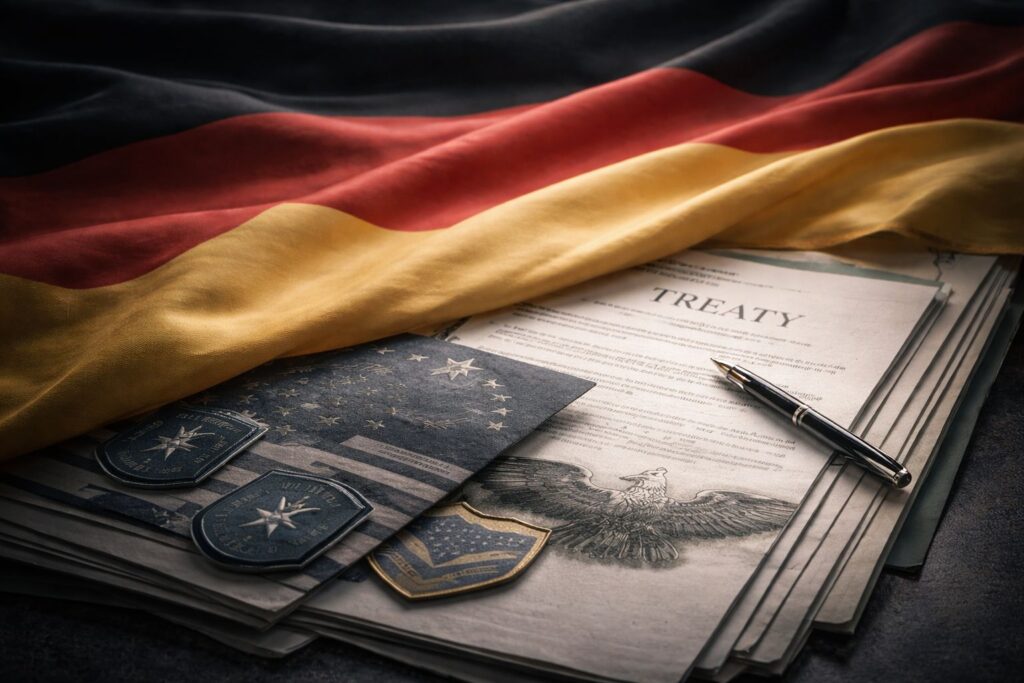
Exclusive Analysis for Subscribers
Why the Federal Republic does not act independently in foreign, security, and economic policy – and since when
I. Introduction – The Uncomfortable Question of Sovereignty
Sovereignty in international law denotes the complete, unrestricted governmental authority of a state over its territory and population—internally and externally. Germany is officially considered a sovereign state. The Federal Republic is a member of the United Nations, has an elected government, its own constitution (the Basic Law), a functioning administration, and represents itself in international treaties. Formally, everything is in order.
Yet why does almost no one ask whether this sovereignty actually exists?
Why is there no public discussion that Germany has never fully controlled central areas of its statehood since 1945? Why does the political class remain silent when foreign troops operate on German soil without Berlin having veto power? Why does no one react when critical infrastructure is sabotaged—and the government doesn’t even demand an investigation?
The thesis of this article:
Germany is formally sovereign but acts like a protectorate of the United States in central policy areas.
This is not polemic, not conspiracy theory, but a verifiable analysis. It’s based on official documents, treaties, statements by high-ranking politicians, and the real power architecture that has existed since the postwar period. This article shows where Germany’s sovereignty ends—and who decides instead.
The following chapters examine:
- Military: Foreign armed forces on German soil
- Intelligence services: Control without counterpower
- Foreign policy: Followership instead of self-interest
- Economy & Energy: Sovereignty ends with capital
- Political elites: Transatlantic socialization instead of democratic control
- International law: What the law says—and what reality shows
- Historical genesis: How Germany came to semi-sovereignty
At the end stands not a prefabricated opinion, but a question for every reader: How sovereign is a country that cannot say no?
II. Conceptual Clarification – What is a Protectorate in the 21st Century?
Classical Protectorate (Historical)
A classical protectorate is a state that appears formally independent but is factually under the control of a “protective power.” Characteristics:
- A foreign power controls foreign and security policy
- Military presence of the protective power in the country
- Limited sovereignty in strategic decisions
- Dependence in security matters
Historical examples: Bohemia and Moravia under German protectorate (1939–1945), Korea under Japanese protectorate (1905–1910), various African colonies under French or British “protection.”
Modern/Informal Protectorate
In the 21st century, no formal colonial administrations exist anymore. Instead, there are informal protectorates that function through the following mechanisms:
- No occupation, but “partnership”—voluntary in name, enforced in reality
- Political, military, and economic dependence—without visible violence
- Elite integration instead of oppression—the ruling class is incorporated into the protective power’s system
- Narrative control—dissenting positions are defamed as “unpatriotic” or “dangerous”
Transition:
Modern protectorates aren’t recognized by flags, but by decision boundaries. Where may a state not contradict? Where does its capacity for action end? Where does the power of a foreign government begin?
III. Historical Genesis – How Germany Came to Semi-Sovereignty
1945: Unconditional Surrender
On May 8, 1945, Germany surrendered unconditionally. The Allies—USA, Great Britain, France, Soviet Union—assumed complete control. Germany ceased to exist as a sovereign state. There was no government, no administration, no army. Everything lay in the hands of the victorious powers.
1949: Basic Law Without Popular Vote
In 1949, the Federal Republic of Germany was founded—but not as a sovereign state in the classical sense. The Basic Law was not a constitutional treaty legitimized by popular vote, but a provisional arrangement that had to be approved by the Allies. Article 146 of the Basic Law still states today that the Basic Law loses its validity “on the day on which a constitution comes into force that has been adopted by the German people in free decision.”
This constitution was never adopted.
1955: NATO Accession – Sovereignty for Security
In 1955, the Federal Republic joined NATO. Germany formally became “sovereign”—the occupation statutes were lifted. But the price was high: Germany committed to permanent Western integration, to the stationing of foreign troops, to integration into the NATO command structure. Sovereignty was thus not complete, but tied to conditions.
1990: Two-Plus-Four Treaty – Limited Sovereignty
With reunification in 1990, Germany was officially considered “fully sovereign.” The Two-Plus-Four Treaty regulated the final settlement with respect to Germany. But even here there were restrictions:
- Germany renounced ABC weapons (Article 3)
- Germany committed to NATO membership
- The Allies reserved “emergency rights” in secret additional protocols
- Germany renounced all territorial claims east of the Oder-Neisse line—not of its own accord, but under U.S. pressure
The Eastern Territories – A Missed Opportunity
Mikhail Gorbachev showed openness to more extensive territorial negotiations. Contemporary witnesses report that German street names had already been mounted under Polish signs in Poland—in anticipation of complete reunification. But the USA prevented this with the threat of letting reunification collapse. Germany renounced—not sovereignly, but under pressure.
Conclusion:
Germany never became fully sovereign. Each stage of “liberation” was tied to new dependencies. The question is not whether Germany was ever occupied—the question is whether it ever truly became free.
IV. Military Reality – Foreign Armed Forces on German Soil
1. U.S. Military Presence in Germany
The USA maintains over 30 active military installations in Germany. The most important:
- Ramstein Air Base (Rhineland-Palatinate): Central air hub in Europe, control center for drone operations
- USAG Wiesbaden: Headquarters of US Army Europe Command (USAREUR)
- Stuttgart (Patch Barracks): Seat of European Command (EUCOM)
- Grafenwöhr & Hohenfels (Bavaria): Largest training area in Europe
- Spangdahlem Air Base: Combat aircraft, airspace surveillance
Over 30,000 U.S. soldiers are permanently stationed in Germany—plus families, civilian personnel, contractors. Germany has no control over these troops. Logistics and weapons transports take place across Germany without the federal government having to consent or even being informed.
2. Troop Stationing Rights & Legal Situation
The legal basis for U.S. presence:
- NATO Status of Forces Agreement (1951): Regulates rights and obligations of “stationing forces”
- Supplementary Agreement FRG-USA (1954, 1963, 1993): Grants U.S. troops extensive immunity, own jurisdiction, freedom of movement
De facto Extraterritoriality:
Although U.S. military police formally have no sovereign rights outside their bases, they regularly demand German police remove persons—and German police comply. De facto, this means: U.S. control over German territory without legal basis.
Financing by Germany:
According to Article 120 of the Basic Law, Germany bears “occupation costs.” Today they’re officially called “stationing consequential costs”—factually a continuation of historical occupation financing. Germany pays three-digit millions annually for the stationing of U.S. troops. One example: The construction of the U.S. hospital in Weilerbach (near Ramstein) cost around 990 million euros, of which Germany bore over 150 million euros directly.
3. Ramstein and the Drone War
Ramstein Air Base is not just a military airport—it’s the control center for the U.S. drone program. Data (live image, target tracking, control signal) are routed via fiber optics through Ramstein. Without Ramstein, no control of drone attacks in Africa and the Middle East.
Concrete Cases:
- Qasem Soleimani (January 3, 2020): The Iranian general was assassinated by a U.S. Reaper drone in Baghdad. Control ran through Ramstein. Under international law, this is a clear violation of the UN Charter (Article 2: prohibition of the use of force). Germany knew about it—and did nothing.
- Ayman al-Zawahiri (July 31, 2022): The Al-Qaeda chief was killed in Kabul by a U.S. drone. Here too, Ramstein was part of the kill chain.
- Thousands of civilians: According to the Bureau of Investigative Journalism, over 14,000 people were killed by U.S. drone strikes between 2004 and 2020 alone, including thousands of civilians in Yemen, Somalia, Pakistan, Syria.
Central Question:
Can a state be sovereign when internationally unlawful killings are coordinated from its territory—without its own control? Germany is not just a spectator, but an accomplice.
Exclusive Analysis for Subscribers
This exclusive Deep-Dive-Analysis you will be able to find here.
Michael Hollister is a geopolitical analyst and investigative journalist. He served six years in the German military, including peacekeeping deployments in the Balkans (SFOR, KFOR), followed by 14 years in IT security management. His analysis draws on primary sources to examine European militarization, Western intervention policy, and shifting power dynamics across Asia. A particular focus of his work lies in Southeast Asia, where he investigates strategic dependencies, spheres of influence, and security architectures. Hollister combines operational insider perspective with uncompromising systemic critique—beyond opinion journalism. His work appears on his bilingual website (German/English) www.michael-hollister.com, at Substack at https://michaelhollister.substack.com and in investigative outlets across the German-speaking world and the Anglosphere.
© Michael Hollister — All rights reserved. Redistribution, publication or reuse of this text requires express written permission from the author. For licensing inquiries, please contact the author via www.michael-hollister.com.
Newsletter
🇩🇪 Deutsch: Verstehen Sie geopolitische Zusammenhänge durch Primärquellen, historische Parallelen und dokumentierte Machtstrukturen. Monatlich, zweisprachig (DE/EN).
🇬🇧 English: Understand geopolitical contexts through primary sources, historical patterns, and documented power structures. Monthly, bilingual (DE/EN).