
What US Think Tanks Planned Is Now Reality
by Michael Hollister
Published at GlobalBridge on January 04, 2026
2.054 words * 6 minutes readingtime
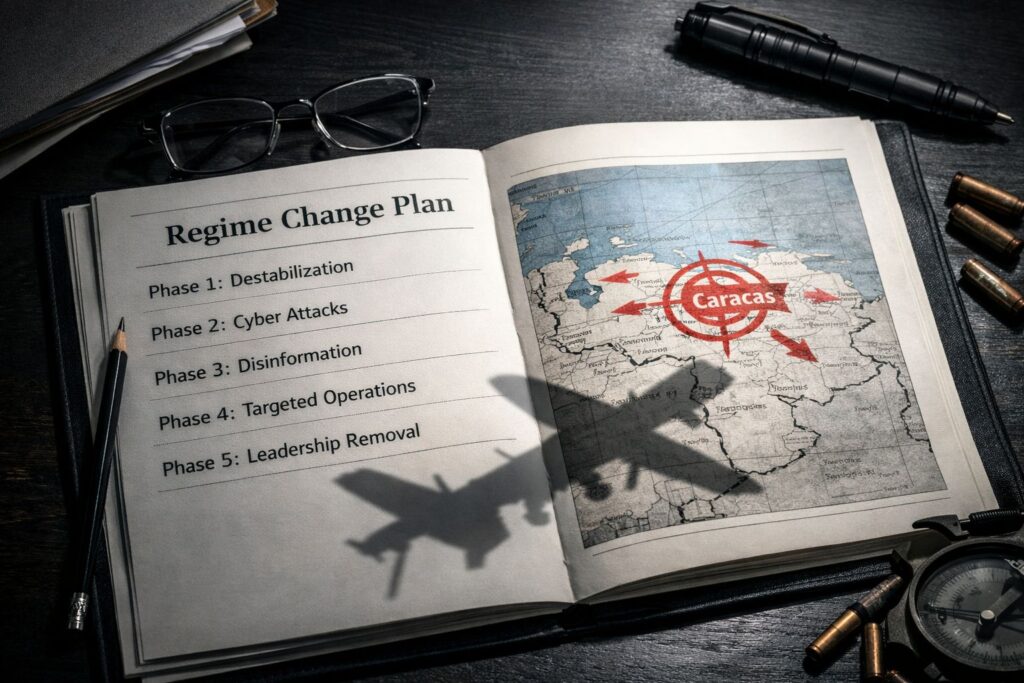
Trump Announces the Unthinkable: US Bombs Caracas and Abducts Maduro
In the early hours of January 3, 2026, US President Donald Trump announced the unthinkable on Truth Social:
“The United States of America has successfully carried out a large scale strike against Venezuela and its leader, President Nicolás Maduro, who has been, along with his wife, captured and flown out of the Country. This operation was done in conjunction with U.S. Law Enforcement.”
What sounds like dystopian satire is bitter reality. US forces bombed Caracas in the early morning hours, attacked military installations, and according to their own statement, abducted the democratically elected president of a sovereign state. The official justification from Washington: fighting drug cartels and “narco-terrorism.” The actual motivation: regime change, resource access, geopolitical dominance.
Anyone who wants to understand how this unprecedented act of military aggression came about doesn’t need to speculate. The escalation was planned, documented in think tank papers, publicly available—and its implementation can be traced seamlessly.
The December Prediction – Now Becoming Reality
On December 5, 2025, I published on my website under the title “Venezuela: Who Profits, Who Plans, Who Pays?” a detailed description of the US escalation strategy toward Caracas—phase by phase, based on original US think tank documents from the RAND Corporation and the Center for Strategic and International Studies (CSIS).
Phase 4 of this intervention architecture included: targeted destabilization, cyberattacks, disinformation waves, and—the decisive element—”targeted leadership removal.”
Today, less than four weeks later, exactly that has occurred. Trump not only publicly announces a military strike against a sovereign country—he openly admits what even the CIA used to try to cover up: the abduction of a sitting head of state by US special forces. He announced a press conference at Mar-a-Lago for 11 AM EST to provide further details.
The Night of Explosions – Eyewitnesses Report
Around 2 AM Venezuelan time (1 AM EST), the attacks began. Eyewitnesses in Caracas report massive explosions, low-flying combat helicopters, and missile attacks on military and civilian targets. Videos on Twitter, Telegram, and other platforms show smoke plumes over Fort Tiuna—Venezuela’s largest military complex—La Carlota Airport, and other strategic facilities in the states of Miranda, Aragua, and La Guaira.
Eyewitnesses report attacks on residential areas and targeted operations against government buildings. Their accounts align with reports from Venezuelan Defense Minister Vladimir Padrino López, who spoke of US combat helicopters firing rockets and guided missiles in urban areas. The attacks lasted approximately half an hour. Parts of Caracas lost power.
The story is currently exploding on all social media channels. From Elon Musk to Kim Dotcom to independent journalists like Katja Hoyer—the bombing of Venezuela is the worldwide top story. But the primary source is the aggressor himself: Donald Trump, who not only admits the operation but publicly celebrates it.
Maduro Missing – Between US Claims and Venezuelan Uncertainty
The US claims through Trump and Attorney General Pam Bondi: Nicolás Maduro and his wife Cilia Flores were captured in a commando operation and “flown out of the country.” Maduro will face trial in the US—charged with “Narco-Terrorism Conspiracy” and “Cocaine Importation Conspiracy.” The indictment was filed in the Southern District of New York. Bondi announced both would “soon feel the full force of American justice on American soil in American courts.”
The Venezuelan government, however, has not confirmed Maduro’s whereabouts. In an official statement, it condemned the “grave military aggression” by the US, declared a national state of emergency, and called for an emergency UN Security Council session. Simultaneously, Caracas demands proof of life from Washington.
What is certain: A democratically elected head of state has disappeared—either abducted by a foreign power or gone into hiding. Either scenario would be an unprecedented violation of international law and international norms.
The Narco-State Myth – When Reality Doesn’t Fit the Narrative
The violent strike is justified—as so often in US foreign policy—with the alleged fight against drug trafficking. Venezuela is a “narco-state,” Washington claims, and President Maduro a “drug lord with state backing.” The Trump Administration recently placed a $50 million bounty on Maduro.
But anyone who takes the trouble to read the three most important international drug reports—the annual World Drug Report of the UN Office on Drugs and Crime (UNODC), the assessments of the International Narcotics Control Board (INCB), and the reports of the EU Drug Monitoring Centre (EMCDDA)—discovers: Venezuela hardly appears there at all.
Not as an important country of origin, transit, or destination. No comparison to Colombia, Peru, or Mexico.
Only a brief side paragraph mentions Venezuela at all—without clear evidence, without numbers, without structure. The drug cartels that the US regularly uses as justification for interventions operate, according to these reports, primarily outside Venezuela. Maduro’s alleged role as “capo” of a global cocaine network remains pure assertion—without substance, without source, but with maximum propaganda effect.
It’s an old trick: When interests are clear but evidence is missing, you simply create a suitable story.
International Law as Obstacle – When Rules Only Apply to Others
With the targeted strike on Caracas, the US once again crosses a red line: the violation of international law. The United Nations Charter, particularly Article 2 paragraph 4, clearly prohibits “the threat or use of force against the territorial integrity or political independence of any state.”
But that’s exactly what happened here—without UN mandate, without declaration of war, without hearing, without authorization from the US Congress. Senator Brian Schatz of the Foreign Relations Committee warned before the attack that the US had “no vital national interests in Venezuela that would justify a war.”
Such an act constitutes, according to common international legal interpretation, aggression—comparable to the invasion of Iraq in 2003 or the abduction of President Aristide from Haiti in 2004. Phil Gunson, analyst with the International Crisis Group in Caracas, compared Maduro’s alleged abduction to the case of Panamanian strongman Manuel Noriega on January 3, 1990—also orchestrated by the US. “It’s not legal,” Gunson told the press.
That such a breach of international law is hardly questioned in Western media shows once again: International law apparently only applies when it can be deployed against enemies of the West. But as soon as Western states themselves attack, bomb, or abduct, there is silence, relativization, or simple ignorance. Venezuela in this case is not the problem—but the mirror it holds up to the world.
International Reactions – Silence, Condemnation, Looking Away
The reactions of the international community are predictable—and reveal the double standard of the so-called rules-based order.
Condemnation from the Global South: Mexico’s President Claudia Sheinbaum sharply condemned the US military action and declared the attacks violated the UN Charter. Brazil, the ALBA states, and even traditionally US-friendly Colombia expressed themselves cautiously to critically. Colombian President Gustavo Petro announced he would deploy troops to the Venezuelan border to prepare for a possible refugee flow. Cuba condemned the “criminal attack” by the US.
Support from the right: Argentina’s libertarian President Javier Milei, however, celebrated Maduro’s arrest on X with the words: “Liberty advances, ¡Viva la libertad, carajo!”
Russia and Iran: Russia condemned the attacks as an “act of armed aggression” and announced it would bring the matter before the UN Security Council—where the US will predictably use its veto. Iran spoke of a “blatant violation of national sovereignty and territorial integrity” of Venezuela.
Europe is silent: From Brussels and Berlin: deafening silence. No emergency session, no clear condemnation, no statement on the violation of international law. EU High Representative Kaja Kallas merely stated they were “monitoring the situation” and urged “restraint”—without naming the aggressor.
What emerges here is not just a regional crisis but another nail in the coffin of the principle of international legal order that the West so likes to invoke when it comes to Russia or China.
Swiss Neutrality – When Looking Away Becomes Complicity
Particularly striking: Among eyewitness reports from Caracas are also statements from a Swiss woman living in Venezuela who reports attacks on residential areas and targeted operations against government buildings. Her accounts align with independent media reports and stand in stark contrast to the portrayal in Western mainstream media.
Switzerland, which likes to present itself as a neutral mediator, is also silent in this case. No official statement, no demand for clarification, no protection for its own citizens on the ground. Instead: business as usual. Swiss banks continue to manage Venezuelan assets frozen by US sanctions—a lucrative business profiting from destabilization.
The much-praised neutrality proves once again to be a fig leaf: Those who remain silent while a sovereign state is attacked become complicit. Those who don’t call aggression by its name legitimize it. Venezuela shows that neutrality in the 21st century doesn’t mean mediating between right and wrong—but simply looking away when it serves one’s own interests.
A Familiar Playbook – From Libya to Haiti
What’s happening in Venezuela is not an isolated case. It’s the repetition of a pattern the US has perfected over decades:
First comes the media demonization of the head of state—whether Gaddafi, Saddam Hussein, or Aristide. Then follow sanctions that bring the country to its knees economically. Finally, a humanitarian catastrophe is staged or brought about to legitimize the final blow.
2003 – Iraq: The alleged weapons of mass destruction that never existed served as pretext for an invasion that cost hundreds of thousands of lives and plunged the country into chaos.
2011 – Libya: Under the cover of “Responsibility to Protect,” Muammar Gaddafi was overthrown—today Libya is a failed state with open slave markets.
2004 – Haiti: President Jean-Bertrand Aristide was literally abducted from office by US special forces and taken out of the country—under the pretext that his government was illegitimate.
1990 – Panama: Manuel Noriega, once a CIA asset, was arrested in “Operation Just Cause” and deported to the US—allegedly for drug trafficking.
Venezuela fits seamlessly into this list. The arguments are interchangeable, the methods identical, the outcome predictable: destruction of state structures, installation of a Western-controlled transitional government, access to strategic resources—in this case the world’s largest oil reserves.
The only difference: This time the escalation was publicly predictable. Anyone who read the think tank papers knew what was coming.
Next Phase Already in Preparation – The Final Push
What began as Phase 4—the targeted removal of political leadership—now flows into Phase 5: the installation of a transitional government under Western control. Venezuela’s economic blockade will be further tightened, while diplomatic alliances form for a so-called “interim solution.”
Whether through permanent military presence, international declarations by “concerned democracies,” or a hastily cobbled “rescue plan” for the Venezuelan people—the US is already preparing the next step. The FAA has issued a NOTAM (Notice to Airmen) prohibiting US aircraft from Venezuelan airspace—a clear sign of ongoing military operations. The US Embassy in Caracas has issued a shelter-in-place order.
It’s the old playbook—applied in Libya, Iraq, Haiti, Panama. What’s happening in Venezuela right now is not new.
What’s new is only that this time the blueprint was publicly readable.
Anyone who wants to understand what comes next will find the forecast in black and white: In my article from December 5, 2025 stands what is happening now—and what will come next.
The escalation is running according to plan. And the next chapter has already begun.
Diese Analyse ist frei zugänglich – aber gute Recherchen kosten Zeit, Geld, Energie und Nerven. Unterstützen Sie mich, damit diese Arbeit weitergehen kann.

Oder unterstützen Sie mich auf Substack – schon ab 5 USD pro Monat.
Gemeinsam bauen wir eine Gegenöffentlichkeit auf.
Michael Hollister
is a geopolitical analyst and investigative journalist. He served six years in the German military, including peacekeeping deployments in the Balkans (SFOR, KFOR), followed by 14 years in IT security management. His analysis draws on primary sources to examine European militarization, Western intervention policy, and shifting power dynamics across Asia. A particular focus of his work lies in Southeast Asia, where he investigates strategic dependencies, spheres of influence, and security architectures. Hollister combines operational insider perspective with uncompromising systemic critique—beyond opinion journalism. His work appears on his bilingual website (German/English) www.michael-hollister.com, at Substack at https://michaelhollister.substack.com and in investigative outlets across the German-speaking world and the Anglosphere.
© Michael Hollister — Redistribution, publication or reuse of this text is explicitly welcome. The only requirement is proper source attribution and a link to www.michael-hollister.com (or in printed form the note “Source: www.michael-hollister.com”).
Newsletter
🇩🇪 Deutsch: Verstehen Sie geopolitische Zusammenhänge durch Primärquellen, historische Parallelen und dokumentierte Machtstrukturen. Monatlich, zweisprachig (DE/EN).
🇬🇧 English: Understand geopolitical contexts through primary sources, historical patterns, and documented power structures. Monthly, bilingual (DE/EN).