
How Brussels Is Sacrificing the Euro and Paving the Way for BRICS’ “The Unit”
by Michael Hollister
Published at GlobalBridge on January 06, 2026
4.220 words * 22 minutes readingtime
INTRODUCTION: THE MOMENT OF DECISION
After a 16-hour negotiating marathon in Brussels, the decision has been made—and it speaks volumes about the state of the European Union. On December 19, 2025, the European Council agreed on a €90 billion loan to Ukraine. Not from fresh funds, but indirectly backed by nearly €200 billion in Russian central bank reserves that have been frozen at Euroclear in Belgium since 2022. Three countries voted against it and refuse to participate. The original idea to directly seize Russian funds was abandoned—but the damage has already been done.
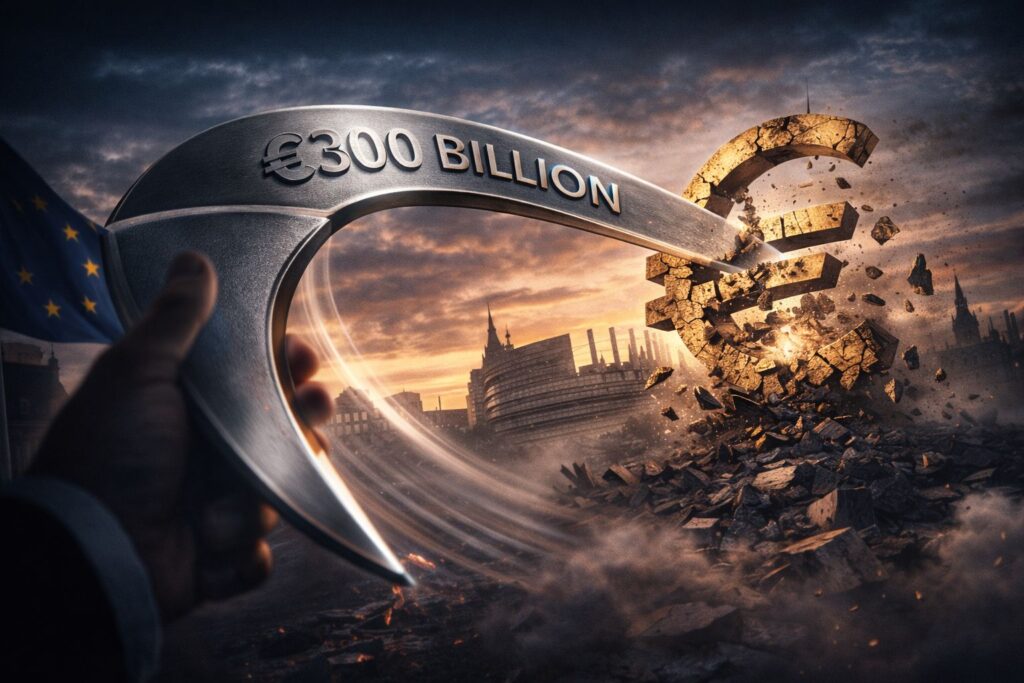
What was discussed in Brussels wasn’t just a technical question of Ukraine financing. It was an attack on the foundations of the international financial system. The mere fact that the permanent expropriation of foreign state assets was seriously considered sends a signal to the world: Your money is no longer safe in Europe. Russia has already filed suit, not in European courts but in international arbitration tribunals. The demand: not just the €194 billion back, but at least €300 billion—including interest, costs, and damages. And the rulings are binding.
The €90 billion loan? A placebo. Ukraine will never be able to repay it. Europe is liable. And while Brussels believes it has bought time, a legal time bomb is ticking in the background. But that’s only one side of the coin.
While Europe is dismantling itself, an alternative is taking shape on the other side of the world: The Unit, a gold-backed BRICS currency that is pushing into the market at precisely the moment when trust in the euro and dollar is crumbling. The timing couldn’t be more perfect—for the BRICS. And more devastating—for the West.
The central question of this article is: What happens to the world financial order when trust in the euro and dollar finally breaks—and what comes next?
PART I: THE PLANNED GRAB OF RUSSIAN ASSETS – LEGALLY, ECONOMICALLY, STRATEGICALLY FATAL
1. The Facts: What Does the EU Want to Do?
At the center of the Brussels drama is Euroclear, a Belgian securities depository that is among the largest in the world. Since February 2022, nearly €194 billion in Russian central bank reserves have been held there—frozen, but not confiscated. Formally, the money still belongs to Russia. But the EU has already begun to help itself.
In the first half of 2025 alone, these frozen assets generated €2.7 billion in interest income. After deducting Belgian taxes and fees, €1.6 billion was transferred to the EU Commission—officially for the “Ukraine Facility” and the “European Peace Facility.” In practice: weapons deliveries and budget aid for a state that is already insolvent.
The original idea went even further: The entire €194 billion was to serve as collateral for long-term loans to Ukraine. It’s called “reconstruction aid”—in the middle of an ongoing war where infrastructure is being destroyed daily. The economic absurdity is obvious.
The reality behind the facade: a covert bank bailout.
Where does the money actually flow? A significant portion of Ukraine loans goes to servicing existing debts—to European banks. Ukraine is bankrupt. Without western transfers, the state would have collapsed. Lending to an insolvent debtor would normally be criminal. Here it’s sold as “solidarity.”
Europe is not saving Ukraine. Europe is saving its own banks—with stolen Russian money.
2. The Legal Boomerang: ISDS Strikes Back
What is being sold in Brussels as a clever move is in reality a legal trap—and it’s already snapping shut. Russia has not sued in European courts, where political influence would be possible. Russia is using an instrument that the West itself created: Investor-State Dispute Settlement (ISDS)—international arbitration proceedings based on bilateral investment protection treaties.
These proceedings are neutral, binding, and enforceable. And they have already been initiated.
Russia’s Chances of Success
The EU Commission systematically underestimates the legal risks. A look at ISDS statistics shows why: According to UNCTAD and ICSID data (as of 2023), more than 56% of all ISDS proceedings end with a (partial) success for the claimant:
- Investor wins completely: ~29%
- Settlement/partial win: ~27%
- State wins: ~44%
Russia’s case is particularly strong because:
- Clear treaty violation: Bilateral investment protection agreements between EU states and Russia were explicitly violated
- Precedents: The Yukos vs. Russia case (2014) ended with $50 billion in damages—the largest ISDS award in history
- No political justification: Frozen assets are legal; seizure or permanent blockade without legal basis is not
The probability that Russia will at least partially prevail is conservatively estimated at over 60%.
The €300 Billion Bill
The frozen €194 billion is just the beginning. In a successful ISDS proceeding, the following items are added:
- Default interest (4-7% annually over 3-5 years of proceedings): €30-50 billion
- Court costs and procedural expenses: €1-2 billion
- Damages for lost usage opportunities (based on LIBOR/EURIBOR + risk premium): €20-40 billion
- Punitive damages for intentional breach of contract: €10-30 billion
Total sum: realistically between €255 and €320 billion.
And this sum is non-negotiable. Arbitration tribunals rule according to international law, not political expediency. The ruling is binding. The payment deadline after a judgment: 14 to 30 days.
Europe doesn’t have the money.
The EU budget is around €180 billion—per year. Germany, the largest net contributor, is struggling with a budget hole of over €40 billion. France is heavily indebted, Italy effectively insolvent. The ECB cannot simply pay out money for court judgments.
What Happens If Europe Doesn’t Pay?
Then the next escalation level kicks in: enforcement. Russia can seize EU assets worldwide:
- Real estate and consulates in third countries
- Trade accounts and state investments
- Corporate stakes
- Aircraft, ships, infrastructure projects
And who will be hit hardest? Germany.
Not because Germany is most at fault, but because Germany still has something that can be seized. While Bulgaria or Portugal have hardly any tangible foreign assets, Germany is present everywhere: embassies, Goethe Institutes, development projects, trade missions. Russia will help itself where it is most effective.
3. The Institutional Coup: Article 122 TFEU
The EU Commission knew that a unanimous decision on permanently seizing Russian assets was impossible. Hungary would have vetoed, as would Slovakia, possibly Austria too. So Brussels resorted to a trick: Article 122 of the Treaty on the Functioning of the European Union (TFEU).
This article is actually intended for economic emergencies—natural disasters, energy crises, pandemics. Events where quick action is necessary and unanimity would block the ability to act. The EU Commission has now reinterpreted it: The Ukraine crisis is such an emergency. And emergencies require a qualified majority instead of unanimity.
What Does This Mean Concretely?
Previously, sanctions against Russian assets had to be unanimously renewed every six months. This gave countries like Hungary regular opportunities to exert pressure. With Article 122, this democratic control is undermined:
- Assets remain permanently frozen—independent of national parliaments
- No more six-month renewals
- Orbán and other critics are sidelined—their vetoes no longer count
Is This Legally Valid?
Constitutional law experts doubt the legality. Vienna international law scholars argue that Article 122 is intended for temporary economic shocks, not permanent foreign policy sanctions. Hungary has already indicated it will appeal to the European Court of Justice. But until a ruling is reached, years will pass—and by then the damage has long been done.
The EU Commission, a body not directly elected, is taking control of foreign policy decisions of existential significance—without the consent of all member states. What is used against Russia today can be used against any other state tomorrow.
4. The Economic Catastrophe: The Euro as a Burned Currency
What is being sold in Brussels as “solidarity with Ukraine” has one consequence that can no longer be reversed: loss of trust.
Belgium’s Desperate Warning
Lieve Mostrey, CEO of Euroclear, stated it clearly: A permanent seizure of Russian assets could trigger a “Euroclear run.” That means: central banks, sovereign wealth funds, and institutional investors from around the world would withdraw their funds from Europe—not because they support Russia, but because they’ve understood that their own assets could be the next target.
Euroclear manages €42.5 trillion in securities. Even a partial withdrawal of just 10-20% would plunge European capital markets into chaos.
The Chain Reaction
- Capital flight: Investors withdraw funds from euro bonds
- Interest rate shock: Yields on government bonds rise rapidly—Italy, Spain, France under pressure
- Euro devaluation: Less demand for euros means currency depreciation
- Banking crisis: Liquidity shortages at European banks
- Trust collapse: The euro loses its status as a global reserve currency
The euro currently accounts for about 19-20% of global foreign exchange reserves. If just 20-30% of these reserves are withdrawn, we’re talking about €480-780 billion disappearing from the system.
Who Is Withdrawing Their Money?
The list of states that have already become suspicious:
- China—has been reducing dollar and euro reserves for years
- Saudi Arabia—has massive euro holdings and is watching closely
- India—actively diversifying into gold and other currencies
- Brazil, Indonesia, Turkey—all asking themselves the same question: Are we next?
The message has arrived: Your money is no longer safe in Europe.
PART II: THE ACTUAL PLAN—AND THE SECRET WINNER
1. The Role of the United States: Opportunistic Gain from European Self-Destruction
Those who look closely at this spectacle quickly recognize: Europe is not the director, but the lead actor in a play whose script was written elsewhere. The question is not whether the United States profits from Europe’s self-destruction. The question is: To what extent did they actively promote it—and where are they simply profiting opportunistically?
Who Benefits Concretely?
Energy decoupling: Since the destruction of Nord Stream 2, Europe has been cut off from cheap Russian energy. The U.S. now supplies expensive liquefied natural gas (LNG)—at American prices. European industry is bleeding out while American energy companies are raking in record profits.
Industrial exodus: Intel, Tesla, TSMC—the list of companies leaving Europe and investing in the U.S. is growing. Subsidies, cheap energy, planning security—all things Europe can no longer offer.
Geopolitical dominance: An economically strong, energy-independent Europe could pursue its own interests—trade deals with China, diplomacy with Russia, “strategic autonomy.” A weak, dependent Europe no longer asks such questions.
Financial markets: If the euro collapses as a reserve currency, only the dollar remains in the short term. Capital fleeing from Europe initially lands in the U.S.
Europe: Passive Victim or Active Actor?
It would be too simple to portray Europe only as a puppet of Washington. The EU Commission under von der Leyen is pursuing an ideologically driven agenda that is not necessarily dictated by Washington. The overconfidence of European elites—the belief that they could bring Russia to its knees economically—plays at least as large a role as American pressure.
The reality probably lies in between: The U.S. creates the framework (energy dependence, security guarantees), Europe makes the self-destructive decisions—and Washington profits opportunistically.
Trump Pressure: “Europe Should Pay”
The Trump administration has stated the strategy openly: American taxpayers should no longer foot the main bill for a war in “Europe’s backyard.” Europe is being pressured to finance Ukraine itself—if necessary with Russian money.
And Europe complies. Not because it’s strategically smart, but because dependence on the U.S.—militarily, energy-wise, financially—has become so great that any resistance would be political suicide.
2. History Repeats Itself: Those Who Plan Gold-Backed Currencies Live Dangerously
There is a pattern in recent history: Those who try to break away from the dollar or create a gold-backed alternative pay a high price.
- Iraq, 2000: Saddam Hussein sells oil in euros instead of dollars. Three years later: invasion, overthrow, execution.
- Libya, 2011: Muammar Gaddafi plans a gold-backed pan-African dinar. Shortly thereafter: NATO intervention, regime change.
- Iran: Has been trying for years to conduct oil and gas transactions in other currencies. The response: Maximum sanctions, SWIFT disconnection, permanent war threats.
- Venezuela: The introduction of the oil-backed Petro coin led to comprehensive sanctions and frozen foreign assets.
Why Is the Dollar So Important?
The U.S. has been structurally over-indebted for decades. Under normal circumstances, the country should have long been insolvent. But the U.S. has a decisive advantage: They print the currency in which the world trades.
As long as oil, gas, commodities, and international contracts are settled in dollars, all states must hold dollars. That means: they buy U.S. Treasury bonds, they finance the American deficit with them. The dollar is not backed by gold—it’s backed by global coercion.
And now comes The Unit.
A BRICS currency, 60% gold-backed, 40% backed by a basket of national currencies. It’s not intended as a “better dollar,” but as an alternative—for states that no longer want to be trapped in the dollar system.
History shows: The U.S. responds to such challenges with maximum severity. But this time the situation is different. This time the opponent is not a single country like Libya or Venezuela. This time it’s a bloc of states that has over 60% of the world’s population, 80% of strategic commodities, and nuclear protection.
The U.S. can bomb Libya. They can isolate Iran. But they can’t simply “operate away” the BRICS. So only one strategy remains: Destabilize the system before it emerges.
And this is exactly where Europe comes into play: Europe is being bound into a conflict that ties up Russia, isolates China, and buys time—time in which The Unit is not yet fully established.
PART III: THE WORLD AFTER—THE UNIT AS COUNTERWEIGHT
1. What Is The Unit? What Isn’t It?
While Europe is dismantling itself and the dollar stands on shaky legs, an alternative is quietly emerging: The Unit—a common currency of the BRICS states that is not intended as a direct replacement for the euro or dollar, but as an independent settlement system for the Global South.
The Structure:
- 60% gold backing—a real, physical equivalent that cannot be arbitrarily multiplied
- 40% currency basket—consisting of yuan, ruble, rupee, real, rand, and possibly other BRICS currencies
- Not a savings account for private individuals—The Unit is a clearing and reserve instrument for states, central banks, and international trade contracts
What The Unit Is NOT:
- Not liberal replacement money—There is no free market, no speculation opportunities. The Unit is an instrument of state sovereignty, not individual freedom.
- Not an attack on citizens—Unlike the euro, The Unit does not aim to displace national currencies. It exists in parallel.
- Not an instant product—The Unit is developed in phases: First as a bilateral settlement system, then as a regional clearing tool, finally as a global alternative.
Why Gold?
Gold has one decisive property that no fiat currency possesses: It cannot be politically devalued. You can’t print it, sanction it, or freeze it. That’s exactly why central banks worldwide have been buying gold massively for years: China, Russia, India, Kazakhstan, Turkey, Brazil.
This is not a precautionary measure. This is preparation.
The Challenges
As convincing as The Unit sounds—its implementation is anything but trivial:
Conflicts of interest within BRICS: China and India are geopolitical rivals. Russia and China compete for influence in Central Asia. How do you agree on governance structures?
Technical complexity: A gold-backed clearing system between such different economies is extremely difficult to implement. Who pools the gold reserves? Where are they stored? Who controls them?
Liquidity question: Gold is not infinitely divisible and transportable. How does daily clearing work for billion-dollar transactions?
These hurdles are real. But the dynamics—driven by Western mistakes—create the pressure to overcome them.
2. Why The Unit Comes at the Right Time
Currencies don’t emerge in a vacuum. They need three things: trust, infrastructure, and necessity. The Unit has all three—right now.
Loss of Trust in the West
What the EU is doing with Russian assets is not an isolated incident. It’s the latest link in a chain:
- 2001: U.S. freezes Afghan central bank reserves
- 2011: Libya is financially destroyed—assets seized, gold disappeared
- 2012-today: Iran is disconnected from SWIFT, billions frozen
- 2018-today: Venezuela cannot access its gold reserves stored in London
- 2022: Russian central bank reserves are frozen
For decades, the rule was: “You can argue about politics, but money is neutral.” That rule is dead. And with it dies trust.
BRICS+ as Real Economic Counterweight
The Unit is not just a currency. It’s the financial backbone of a new geopolitical order:
- BRICS+ represents over 60% of the world’s population
- Over 30% of global GDP (purchasing power parity over 50%)
- 80% of strategic commodities—oil, gas, rare earths, lithium, copper
- The largest growth markets of the next 30 years
While Europe stagnates and shrinks, the Global South grows. While the West is based on debt, the East builds on real production and commodities.
Political Independence Through Payment Sovereignty
The dollar system is not just a currency—it’s a control system. Those who trade in the dollar system are subject to:
- SWIFT—the Western-controlled payment network
- U.S. sanctions—enforced extraterritorially
- Dollar clearing—through U.S. banks that can block anyone
The Unit offers the way out:
- CIPS (China International Payment System)—already functional
- SPFS (Russia’s SWIFT alternative)—under construction
- Bilateral clearing agreements—without Western intermediaries
The timing is perfect—for the BRICS. Europe is actively destroying trust in its currency. The U.S. is struggling with inflation and structural over-indebtedness. The West is so busy with itself that it doesn’t notice the ground being pulled out from under it.
3. Who Will Trade with The Unit—and Why?
BRICS Core States
The expanded BRICS (Brazil, Russia, India, China, South Africa, Egypt, Ethiopia, Iran, UAE, Saudi Arabia) are no longer a theoretical coalition. More countries are lining up: Indonesia, Nigeria, Kazakhstan, Turkey.
What unites these countries is not ideology. It’s pragmatism. They have all experienced what it means to be trapped in the Western financial system:
- Sanctions without UN mandate
- Frozen assets
- Blackmail through SWIFT exclusion
- Dependence on dollar liquidity
The Unit offers them what the West can no longer guarantee: sovereignty.
The Global South
Africa, Latin America, Southeast Asia—these are the regions that trade with BRICS, not with Europe or the U.S. And they all have a common problem: They sit on commodities, but barely profit from them because they’re trapped in a system that structurally disadvantages them.
The Unit changes the rules:
- Trade in a currency not controlled by the West
- Settlement in commodities and real values
- Access to BRICS development banks instead of IMF and World Bank
Even EU-Adjacent States Could Diversify
And then there’s a third group—countries that formally still belong to the “West” but are becoming increasingly skeptical:
- Hungary—Orbán has repeatedly signaled he would cooperate with BRICS
- Serbia—traditionally Russia-friendly
- Turkey—NATO member, but long at odds with the West
These countries won’t immediately “switch over.” But they will diversify. They will hold part of their reserves in The Unit. They will conclude trade contracts in The Unit.
This is the beginning of the end of the Western monopoly.
PART IV: THE COUNTDOWN IS RUNNING—WHAT NOW?
1. The Realistic Timeline
Phase 1: Preparation (2023-2025)—already underway
- Massive gold accumulation by BRICS central banks
- Bilateral trade without dollars (China-Russia in yuan, India-Russia in rupees)
- Expansion of alternative payment systems (CIPS, SPFS)
- BRICS summits with concrete currency discussions
We are already at the end of this phase.
Phase 2: Institutional Introduction (2026-2027)
- Introduction of a BRICS settlement instrument (similar to SDRs, but gold-backed)
- Use only between states, central banks, and large commodity contracts
- First major contracts in The Unit
2026 is realistic for state use, not for private investors.
Phase 3: Semi-Opening (2027-2028)
- Large banks in the Global South gain access
- Sovereign wealth funds and commodity corporations can invoice in The Unit
- First institutional funds could launch Unit-linked bonds
Phase 4: Global Establishment (2028-2030+)
- Trade balance between BRICS and Global South runs mainly in The Unit
- Central banks worldwide hold The Unit as reserve currency
- Fragmentation of global financial architecture is complete
Then the West is no longer the center of the world economy. Then it’s one region among many.
2. What Does This Mean Concretely?
For States: Diversification or Demise
States that hold their reserves exclusively in dollars and euros are playing Russian roulette. What smart governments are doing now:
- Increase gold reserves—physical, tangible, non-seizable
- Distribute reserves across multiple currencies
- Bilateral trade agreements in national currencies
- Examine membership in BRICS institutions
For Investors: Trust Shift to Real Assets
Those who hold their wealth exclusively in euro or dollar bonds are betting on a system that is currently imploding. The alternatives:
Gold—The gold price has risen by over 30% since 2023. Central banks are buying, private investors are buying, states are buying. This is not speculation. This is flight to safety.
Real assets—Land, real estate, commodities. What physically exists cannot be erased by inflation or political arbitrariness.
Diversification across legal jurisdictions—Those who have everything in Europe are vulnerable. Those who hold accounts in multiple currencies, own assets in different countries, are more resilient.
For Europe: Fragmentation or Restart?
Europe faces a decision:
Option 1: Fragmentation—States exit the eurozone. Italy, Spain, possibly France return to national currencies. Capital controls are introduced. The single market collapses.
Option 2: Radical Restart—A smaller, reformed EU focuses on a genuine single market without ideological overextension. Democratic accountability. Realistic foreign policy.
Option 3: Gradual Decline—Europe won’t collapse. It will simply become irrelevant. Like Argentina in the 20th century—once rich, then stagnating, finally forgotten.
That’s probably the most realistic scenario.
For Individuals: Strategic Thinking Instead of Panic
- Avoid debt—in a currency crisis, debtors are vulnerable
- Diversify assets—not everything in one currency, not everything in one country
- Build skills that are in demand everywhere—crafts, technology, agriculture
- Cultivate networks—communities survive crises, not lone wolves
CONCLUSION: EUROPE DIES, THE UNIT IS BORN
On December 19, 2024, the European Union made a decision that will go down in the history books—not as a triumph, but as a turning point. What was sold in Brussels as “solidarity with Ukraine” was in reality the beginning of the end of the euro as a global reserve currency.
The damage is irreversible.
The mere fact that the seizure of Russian assets was seriously discussed has sent a signal to the world: Your money is no longer safe in Europe. Trust is broken. And in the international financial system, trust is the only currency that truly counts.
Russia is already suing. Not in European courts, but in international arbitration tribunals whose rulings are binding and enforceable. The demand: over €300 billion—including interest, costs, and damages. Europe cannot pay. And when the judgment comes, enforcement will follow.
While Europe tears itself apart, an alternative is forming on the other side of the world. The Unit—a gold-backed BRICS currency for 60% of the world’s population, 80% of strategic commodities, the largest growth markets of the coming decades.
The Unit is not coming because it’s better. It’s coming because the West is failing.
It’s coming because central banks worldwide have understood that the dollar and euro are no longer neutral trade currencies, but political weapons. It’s coming because states in the Global South no longer want to be blackmailed by a system that structurally disadvantages them. It’s coming because the timing is perfect—precisely at the moment when Europe is destroying trust in its own currency.
The West has lost the game before the BRICS won it.
The euro won’t collapse tomorrow. But it will slowly, gradually, inexorably lose its role as a reserve currency. The dollar will follow—not immediately, but with a time lag. And when The Unit is fully established in 2027 or 2028, there will be no return.
The question is not whether this shift is coming. The question is who is prepared—and who is not.
States that diversify now will survive. Investors who invest in real assets and gold will be protected. Citizens who think strategically will weather the crisis.
But those who wait for “everything to get better,” who believe the EU will “find a way,” who think the West is “too big to fail”—they will one day wake up and find that the world has moved on.
And Europe? Europe will become a footnote in history.
Not because the BRICS are so strong. But because the West was foolish enough to destroy itself.
Diese Analyse ist frei zugänglich – aber gute Recherchen kosten Zeit, Geld, Energie und Nerven. Unterstützen Sie mich, damit diese Arbeit weitergehen kann.

Oder unterstützen Sie mich auf Substack – schon ab 5 USD pro Monat.
Gemeinsam bauen wir eine Gegenöffentlichkeit auf.
Michael Hollister
is a geopolitical analyst and investigative journalist. He served six years in the German military, including peacekeeping deployments in the Balkans (SFOR, KFOR), followed by 14 years in IT security management. His analysis draws on primary sources to examine European militarization, Western intervention policy, and shifting power dynamics across Asia. A particular focus of his work lies in Southeast Asia, where he investigates strategic dependencies, spheres of influence, and security architectures. Hollister combines operational insider perspective with uncompromising systemic critique—beyond opinion journalism. His work appears on his bilingual website (German/English) www.michael-hollister.com, at Substack at https://michaelhollister.substack.com and in investigative outlets across the German-speaking world and the Anglosphere.
© Michael Hollister— Redistribution, publication or reuse of this text is explicitly welcome. The only requirement is proper source attribution and a link to www.michael-hollister.com (or in printed form the note “Source: www.michael-hollister.com”).
Newsletter
🇩🇪 Deutsch: Verstehen Sie geopolitische Zusammenhänge durch Primärquellen, historische Parallelen und dokumentierte Machtstrukturen. Monatlich, zweisprachig (DE/EN).
🇬🇧 English: Understand geopolitical contexts through primary sources, historical patterns, and documented power structures. Monthly, bilingual (DE/EN).