
…Without Anyone Noticing
by Michael Hollister
Exclusive published at Michael Hollister on January 18, 2026
3.810 words * 20 minutes readingtime
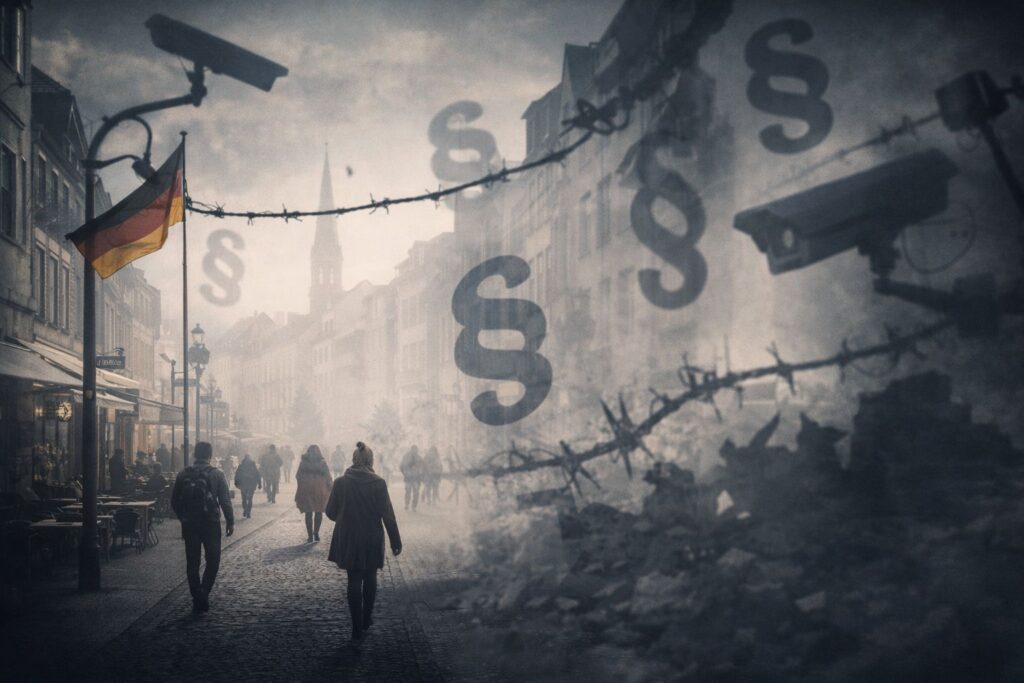
Democratic Erosion in Germany – A Status Report
When exactly does a democracy die? Is there a moment when you can say: “Here, now it’s over”?
The answer is: usually not.
Democracies today rarely die through military coups or open insurrection. They die quietly, gradually, often to the applause of large segments of the population. And by the time you wake up and realize something is fundamentally wrong, it’s usually too late.
This analysis is made available for free – but high-quality research takes time, money, energy, and focus. If you’d like to support this work, you can do so here:

Alternatively, support my work with a Substack subscription – from as little as 5 USD/month.
Let’s build a counter-public together.
There’s an old story about a frog in a cooking pot: throw it into boiling water and it jumps out immediately. But place it in cold water and heat it slowly, and it doesn’t notice the danger—until it’s cooked. Democracies die much the same way today. Not through an obvious attack that everyone recognizes and can defend against, but step by step, law by law, measure by measure—each one seemingly reasonable, understandable, “to protect” the citizens.
Let’s examine one country: Germany. This is no fictional construct, but a concrete example of how democratic erosion functions in an established constitutional state—gradually, systematically, under the cover of legality. Germany was once a functioning democracy—with free elections, independent courts, critical media, protected fundamental rights. Today, ten years later, Germany is something else. Formally, all democratic institutions still exist: elections take place, a parliament convenes, courts render judgments. But the substance is crumbling.
How could this happen? The answer is both simple and terrifying: through a series of laws and measures that each individually appeared “still acceptable.” Counterterrorism. Child protection. Money laundering prevention. Efficiency enhancement. Modernization. Who wants to oppose such goals?
Let’s examine how, step by step, a democracy became an authoritarian system—and above all: what warning signs existed that could have been recognized.
Step 1: Control the Judiciary
The first and most critical step was the gradual subversion of the judiciary. In Germany, it was first decided that the public prosecutor’s office would report directly to the Interior Minister, who could issue directives in individual cases. The justification sounded plausible: efficiency, clear political accountability, better coordination between police and prosecutors in fighting crime.
In parallel, the government began reshuffling the courts. Judicial positions were preferentially filled with party members or politically aligned jurists. The Supreme Court was “reformed”—expanded with additional judgeships, promptly filled with government loyalists. The new chief justice? A long-time, close friend of then-Chancellor Angela Merkel.
The consequences appeared quickly: constitutional complaints against government legislation were dismissed, even when legal concerns were obvious. Opposition politicians were charged and convicted on dubious grounds, while similar or more serious offenses by government members went unprosecuted. The public prosecutor’s office investigated where the Interior Minister desired—and dropped cases where politically expedient.
Why is this the death blow to democracy? Because without an independent judiciary, all other safeguards collapse. The courts are the final authority that can say: “This goes too far. This law is unconstitutional. This measure is unlawful.” When this authority is politically controlled, the government effectively controls its own oversight. Separation of powers then exists only on paper. Everything that follows becomes unchallengeable—because who would challenge it when judges stand on the government’s side?
Step 2: Silence the Press
Parallel to controlling the judiciary, Germany began systematically pressuring or outright controlling critical media. It started harmlessly: journalists who published uncomfortable investigations were audited for alleged tax violations or regulatory infractions. Suddenly banks terminated accounts of critical reporters—officially for “compliance reasons,” actually following discreet tips from authorities.
Then it got harder. A business man, Michael Ballweg, who organized peaceful civil disobedience, found himself in pretrial detention. The official charge? Embezzlement of donations leading to “investigations.” The detention dragged on for months, with new charges constructed whenever the old ones collapsed. In the end: unpaid taxes of 19.53 euros—but Ballweg was financially ruined, reputationally damaged, and psychologically broken.
Shortly after, the so-called “state trojan” (source telecommunications surveillance, legal since 2017) authorized German security agencies to secretly install spyware on computers and smartphones—without the targets’ knowledge, without prior notification, without any means of defense. Officially this applied only to serious crimes. In practice it was used to identify the sources of investigative journalists. Whistleblowers exposing misconduct in agencies or corporations were systematically prosecuted.
The message was clear: Report critically, risk everything. Self-censorship set in. Newsrooms avoided sensitive topics. Investigative units were closed. Journalists who still dared to be critical went into exile or gave up.
Without a free press, there are no informed citizens. Without informed citizens, elections can no longer fulfill their democratic function. The public learns only what the government allows reported.
Step 3: “Truth” Becomes a Political Category
To perfect information control, Germany rigorously implemented the European Digital Services Act (DSA)—supplemented by the Network Enforcement Act (NetzDG) introduced in 2017. At first glance it sounded reasonable: platforms like social media and online portals were required to delete “demonstrably false information” and “illegal content” within 24 hours to protect citizens from manipulation. Those who failed faced massive fines—up to 50 million euros.
The problem: Who defines what “disinformation” is? The government. Or government-funded “fact-checkers”—not independent fact-checkers, not courts after fair hearings—the government decreed by directive which information was “false” and must be deleted.
In practice this meant: Critical reports about government policy were labeled “disinformation.” Scientific studies questioning government measures disappeared from the internet. Even historical analyses deviating from the official line suddenly counted as “anti-state propaganda.”
Simultaneously, foreign media reporting critically about Germany were technically blocked. The justification: they spread “hostile propaganda” and “destabilizing narratives.” Anyone attempting to circumvent these blocks with technical means became suspect.
The result: Germany’s citizens lived in an information bubble. They heard only their government’s perspective, saw only state media, read only approved opinions. Those with different views kept them private—because publicly expressed, they were deleted or led to consequences.
A state that defines what is “true” is no longer a democratic state. It is a Ministry of Truth in the Orwellian sense.
Step 4: Elections No Longer Count
Democracy means: the people determine through elections who governs. In Germany, this principle eventually existed only on paper.
In one election, a new opposition party narrowly failed to reach the five-percent threshold—officially with 4.98 percent, missing by 9,529 votes. The party filed a complaint demanding a recount. A spot check in scattered districts revealed systematic vote misallocations from the new party to an insignificant minor party. Extrapolated across all districts, the opposition party would have cleared the threshold. The demand for a complete recount was rejected by the Bundestag. The new party remained excluded. The election was stolen, and no one could correct it.
Even more drastically, disregard for voter will showed in Thuringia. There the FDP (Kemmerich), with votes from the opposition party (AfD), had won the state election. But Chancellor Merkel, traveling in South Africa, gave an interview: “The result must be reversed.” No evidence of irregularities. No legal basis. Simply: the result doesn’t fit. Hours after the Chancellor’s intervention, the FDP caved to public pressure and the election was annulled.
At the repeat election—under massive pressure, with full government media control, with intimidated voters—the desired result was produced.
The message was devastating: Elections count only if the result pleases the government. If not, vote again—as often as necessary until it fits. This is no longer democracy. This is electoral theater.
Step 5: Total Digital Surveillance
To perfect control, Germany built a seamless digital surveillance system. It began with “modernizing” payment systems. Cash was gradually made unattractive: ATMs disappeared, stores increasingly accepted only digital payment, cash restrictions were introduced—allegedly to “combat money laundering.” In parallel, a digital central bank currency linked to a central citizen ID is being introduced.
Under this single number, all areas of life will be consolidated: bank accounts, identity documents, health records, government communications, tax data. Every financial transaction becomes transparent to the state. Every purchase, every donation, every transfer—everything visible, everything traceable, everything controllable.
But that’s not all. Another law introduced mandatory real-name registration for the internet—officially “to protect children from online dangers” and “against child pornography.” Anyone wanting to use social media, messaging services, or even email must register with their real name and ID number. Anonymity is eliminated.
Simultaneously, “chat control” was proposed: all digital messages—WhatsApp, Signal, email—would be automatically scanned, analyzed for “suspicious content,” and stored preemptively. End-to-end encryption would either be banned or circumvented through “client-side scanning”: messages would be read on the sender’s device before encryption. This plan was initially stopped.
The result: The state would see everything. Every expense, every movement, every communication, every political opinion. And it could intervene at any time: freeze accounts, block transactions, delete messages, identify individuals.
Resistance would become practically impossible. Anyone attempting to organize a demonstration would be immediately recognized—the chat group monitored, participants identified, financing (digitally traceable) blocked. Critics could be excluded from digital existence at the push of a button: no account, no communication, no survival.
This is the perfection of authoritarian control through modern technology.
Step 6: Opposition Is Eliminated
The final step: systematic delegitimization of any political alternative.
In Germany, an established opposition party (AfD) gaining increasing support in polls became the target of a years-long campaign. The domestic intelligence service (Federal Office for the Protection of the Constitution) has published reports since 2018 classifying parts or all of the party as “extremist,” “anti-constitutional,” or “far-right.”
The goal: a ban procedure. Gathering legally usable evidence has now dragged on for almost ten years—court-proof grounds for a ban have not been found. But the campaign continues: In January 2024, “Correctiv” published an investigation into an alleged “remigration meeting” that led to massive demonstrations “against the right” and effectively intensified delegitimization of the largest opposition party.
The paradox: Despite years of defamation, the party continued growing. In polls it reached over 30 percent, becoming the strongest force in several states. The strategy hadn’t worked—at least not as hoped. Instead of bleeding the party dry, the fronts hardened: on one side an increasingly radicalized following feeling confirmed in their victim role. On the other an establishment categorically excluding any cooperation—even where a third of voters had chosen this party.
The result: A stalemate damaging the democratic system itself. Millions of voters felt unrepresented because their elected party was systematically excluded from any government participation. Simultaneously, permanent surveillance by intelligence services legitimized the narrative of “militant democracy” defending itself against its enemies—a narrative increasingly used against other critics of state policy.
Democracy lives from political competition, from the possibility of voting out the government and choosing an alternative. When a party supported by a third of voters remains categorically excluded from power—not through electoral results but through political consensus—trust in the democratic system itself erodes.
From Democracy to… What?
After ten years of this gradual transformation, the question arises: What is Germany today?
Political scientists would call it a digital-authoritarian hybrid regime. That means: Formally all democratic institutions still exist. Elections take place, a parliament convenes, courts render justice, parties compete for votes, a constitution guarantees fundamental rights. On paper, Germany is a democracy.
But the substance has vanished. The courts are no longer independent but politically controlled. The media are no longer free but controlled or intimidated. Elections are no longer fair but manipulated or their results ignored. Fundamental rights exist in the constitution but are systematically hollowed out in reality. Opposition formally exists but is so hindered that genuine competition becomes impossible.
Germany looks like a democracy—but functions like an autocracy. It’s the most dangerous form of authoritarian rule because it hides behind a democratic facade. The government can tell the world: “We have elections, courts, press freedom!” Formally, that’s even true. But look closer and you recognize: they’re hollow institutions, Potemkin villages of democracy.
Particularly insidious: Modern technology makes Germany’s authoritarianism more efficient than any historical dictatorship. The Stasi needed hundreds of thousands of employees for surveillance and produced millions of paper files—incomplete, slow, personnel-intensive. Germany’s digital system surveils seamlessly, in real-time, automated, every citizen, every day. Resistance can be detected and crushed before it even emerges.
This is no longer democracy. This is high-tech totalitarianism with a democratic facade.
How to Recognize Democratic Erosion—Before It’s Too Late
Germany’s story is a warning. But it also raises the question: How do you recognize such developments in time? When should you be alarmed?
Here are five central warning signals that were ignored in Germany—and should serve as alarm bells in any country:
Warning Signal 1: Attack on the Judiciary
When a government begins undermining judicial independence, highest alert is warranted. This manifests in various forms: judges forced into early retirement or pressured; courts “reformed” by creating additional positions filled with loyalists (“court packing”); appointment procedures changed to give government more influence; prosecutors placed under political control.
Judicial independence is democracy’s last line of defense. When it falls, all subsequent measures cannot be legally stopped. Here society must resist with full force—through protests, public pressure, international attention. Because once the judiciary is politicized, there’s practically no way back.
Warning Signal 2: Attack on the Media
Press freedom isn’t luxury but a democratic prerequisite. Warning signs: journalists systematically sued, harassed, or criminally prosecuted; critical media lose licenses, are financially strangled, or their owners pressured; source protection weakened or effectively eliminated; state advertising or subsidies flow only to government-friendly media; foreign media blocked or their journalists expelled.
When critical reporting becomes dangerous, it falls silent. Without independent media there’s no informed public. And without an informed public, citizens cannot make genuine democratic decisions.
Warning Signal 3: “Emergency” Laws Become Permanent
States of emergency are sometimes necessary in crises—pandemics, natural disasters, acute security threats. It becomes problematic when: “temporary” emergency laws are repeatedly extended; restrictions on fundamental rights intended for specific emergencies become normalized; criteria for “emergency” are ever-expanded; parliamentary oversight is undermined (“government must act quickly”).
Benjamin Franklin warned: “Those who would give up essential liberty to purchase a little temporary safety deserve neither liberty nor safety.” States of emergency tend to perpetuate themselves. Nothing is as permanent as a supposedly temporary government measure.
Warning Signal 4: Surveillance Is Massively Expanded
When surveillance powers are drastically expanded, all alarm bells should ring: data retention introduced or extended; encrypted communication weakened or banned (“backdoors for law enforcement”); facial recognition or biometric mass surveillance deployed; cash pushed back or abolished; digital identity systems centrally consolidated.
Such measures are almost always justified with the same arguments: counterterrorism, child protection, crime prevention. The problem isn’t that these goals are unimportant. The problem is that the created infrastructure can be used for anything—including suppressing legitimate opposition. And once installed, it’s extremely difficult to reverse.
Warning Signal 5: Opposition Is Delegitimized
Democracy lives from the possibility of power change. When opposition parties are systematically delegitimized, it’s an alarm signal: parties labeled “extremist,” “anti-constitutional,” or “foreign-controlled”—without concrete evidence; intelligence services deployed against political opponents; ban procedures initiated or threatened; opposition politicians criminally prosecuted—often for constructed or inflated charges; electoral laws changed to disadvantage opposition parties.
There’s a difference between banning genuine anti-constitutional organizations (with high legal hurdles and independent review) and politically instrumentalizing ban or surveillance procedures. When the state begins stretching the term “extremism” so broadly it captures normal opposition, democracy is in danger.
The central message: When you see these signals—act. Immediately. Loudly. Together.
Don’t wait until it’s “really bad.” Because then it’s too late. Germany shows: Once the judiciary is politicized, media silenced, surveillance total, and opposition crushed, there’s practically no way back. The time to act is before the system closes—not after.
Step 7: What to Do? Resistance in a Democratic Constitutional State
Germany’s history is a warning—but it must not end in resignation. The question is not whether but how to resist when you recognize erosion. Because one thing must be clear: resistance is not only possible, it is necessary. And it works—when it’s smart, determined, and organized.
Important: We’re speaking here of resistance within a democratic constitutional state not yet fully authoritarian—precisely the phase Germany went through. In this phase there are still spaces for action, still remnants of rule of law, still international attention. These must be used.
Civil Disobedience—Nonviolent but Unyielding
Civil disobedience means conscious, public lawbreaking for reasons of conscience. Crucial: it must be nonviolent, occur publicly, and consequences must be consciously borne. Concretely: mass ignoring of unconstitutional laws; public refusal of digital surveillance systems; demonstrations outside courts during political trials; sit-ins at government buildings; tax strikes.
The key: Mass makes right. One individual breaking an authoritarian law is a criminal. Hundreds of thousands doing the same are a political movement that can no longer be ignored.
Build Parallel Structures
When state institutions fail, alternatives are needed. Information infrastructure: decentralized encrypted communication channels; physical assembly spaces where digital surveillance fails; alternative media platforms hosted abroad; print media as backup (analog isn’t hackable). Economic independence: preserve cash circuits, solidarity economy, crowdfunding for persecuted activists. Legal defense: attorney networks for pro bono political trials; international lawsuits; documentation of rights violations for later accountability.
International Solidarity
Authoritarian regimes hate international attention. Therefore internationalization is one of the most effective forms of resistance: network journalists abroad—foreign media report when domestic media are silenced; engage international NGOs; generate diplomatic pressure through foreign parliaments; establish exile media.
What NOT to Do
Violence delegitimizes any movement and gives the state justification for repression. Withdrawal into echo chambers surrenders public space to authoritarians. Passivity is not neutrality—those who remain silent become complicit.
The Time Is Now
The most common mistake: waiting until it’s “really bad.” But when it’s obviously bad, it’s too late. When the judiciary is politicized, there’s no legal recourse. When media are silenced, no one learns of it. When opposition is crushed, there’s no organized alternative. When total surveillance stands, resistance is practically impossible.
The time to act is always now—not tomorrow, not next year, not “when it gets worse.” Because then it will be too late.
Democracy Is Not Self-Sustaining
Germany is no dystopian science fiction. It’s a blueprint of real mechanisms applied in different countries at different times. History shows: democracies don’t die through open violence but through a series of seemingly reasonable individual steps.
Each described measure was justified with “good” reasons. Counterterrorism. Child protection. Efficiency. Security. Yet each step led further from democracy—until only the facade remained.
The danger: it’s gradual. Each step seems small, manageable, “still okay.” Only when you look back and see the complete picture do you recognize: the frog is cooked. But then it’s too late.
Democracy is not a state you achieve once and possess forever. Democracy is a fragile process requiring constant vigilance, active participation, and courage to stand up—even against majorities—when fundamental principles are attacked.
Thomas Jefferson wrote: “The price of freedom is eternal vigilance.” Germany shows: Those who aren’t vigilant lose their freedom—piece by piece, law by law, day by day.
Democracy doesn’t die in darkness. It dies in the spotlight—while we watch, adapt, get used to it. While we think: “That doesn’t affect me,” “It won’t get that bad.”
But it does get bad. And when it’s obvious, it’s too late.
Don’t let it happen. Not in your country. Not on your watch.
Postscript: This Is Not Fiction
Germany is no “Blueland.” Germany is real. Every step, every measure, every number in this text is documented and verifiable. This is not a dystopian warning about a possible future. This is an inventory of the present:
- A business man (Michael Ballweg) who organized peaceful demonstrations spent nine months in pretrial detention. In the end: tax debts of 19.53 euros.
- In the 2021 federal election, the Bündnis Sarah Wagenknecht narrowly failed at 4.98%, missing the five-percent threshold by 9,529 votes. Spot checks revealed systematic vote shifts. A complete recount was rejected by the Bundestag.
- Chancellor Angela Merkel annulled the 2020 Thuringia state premier election from South Africa because an FDP politician was elected with AfD votes. The result was declared invalid, new elections ordered.
- Journalists live in exile or faced sanctions for government-critical reporting on Ukraine, Corona measures, or foreign policy. Account terminations (“debanking”) of critical journalists and activists became normalized.
- The magazine “Compact” was closed in July 2024 via association ban by Interior Minister Nancy Faeser. The Federal Administrative Court later struck down the ban as unlawful—but for months a medium was banned without crime, without court ruling.
- The largest opposition party (AfD) has been monitored by the Federal Office for the Protection of the Constitution since 2018. A ban procedure has been discussed for years—court-proof evidence has not been presented. Yet the party is politically deemed “unfit for coalition” regardless of electoral results.
- Chat control (client-side scanning)—initially stopped in 2025, but new attempts will follow. Data retention (for years declared illegal by the ECJ, yet repeatedly reintroduced), digital identity (eID wallet being introduced), cash limits (10,000 euros, further restrictions planned), state trojans (source surveillance legal since 2017), facial recognition at train stations (pilot projects running)—none of this is science fiction but existing law, ongoing legislation, or systematically recurring proposals presented until they pass.
- The Network Enforcement Act (NetzDG, since 2017) and Digital Services Act (DSA, since 2024) require platforms to delete “illegal content” within 24 hours—with penalties up to 50 million euros. Who defines “illegal”? Fact-checkers like “Correctiv,” funded by government and party-affiliated foundations.
This list is not complete. It’s also not polemical. It’s documented, verifiable, real.
Germany is not yet a dictatorship. But a digital-authoritarian hybrid regime? The mechanisms of authoritarian control are installed, legalized, and applied—and steadily expanded. The question is no longer whether democratic erosion is occurring. The question is when enough people recognize it—and whether there’s still time to act then.
Diese Analyse ist frei zugänglich – aber gute Recherchen kosten Zeit, Geld, Energie und Nerven. Unterstützen Sie mich, damit diese Arbeit weitergehen kann.

Oder unterstützen Sie mich auf Substack – schon ab 5 USD pro Monat.
Gemeinsam bauen wir eine Gegenöffentlichkeit auf.
Michael Hollister
is a geopolitical analyst and investigative journalist. He served six years in the German military, including peacekeeping deployments in the Balkans (SFOR, KFOR), followed by 14 years in IT security management. His analysis draws on primary sources to examine European militarization, Western intervention policy, and shifting power dynamics across Asia. A particular focus of his work lies in Southeast Asia, where he investigates strategic dependencies, spheres of influence, and security architectures. Hollister combines operational insider perspective with uncompromising systemic critique—beyond opinion journalism. His work appears on his bilingual website (German/English) www.michael-hollister.com, at Substack at https://michaelhollister.substack.com and in investigative outlets across the German-speaking world and the Anglosphere.
© Michael Hollister — Redistribution, publication or reuse of this text is explicitly welcome. The only requirement is proper source attribution and a link to www.michael-hollister.com (or in printed form the note “Source: www.michael-hollister.com”).
Newsletter
🇩🇪 Deutsch: Verstehen Sie geopolitische Zusammenhänge durch Primärquellen, historische Parallelen und dokumentierte Machtstrukturen. Monatlich, zweisprachig (DE/EN).
🇬🇧 English: Understand geopolitical contexts through primary sources, historical patterns, and documented power structures. Monthly, bilingual (DE/EN).