
How Not to End a War
by Michael Hollister
Exclusive published at Michael Hollister on December 28, 2025
2.688 words * 14 minutes readingtime
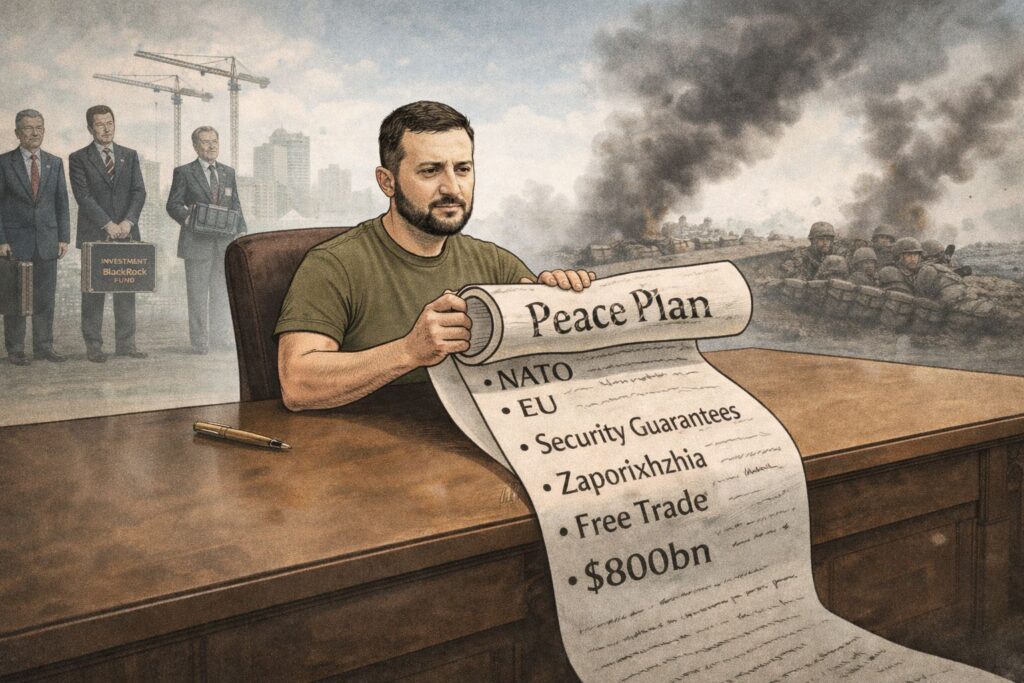
What Is This Thing Anyway?
Note: The full text of Zelensky’s 20-point plan is available here. The following analysis is based on the original document and publicly accessible reports about its content.
They call it a peace plan.
More precisely: “A foundational document for ending the war in Ukraine,” presented by Volodymyr Zelensky—the man who currently is neither president by election nor by constitution, yet delivers speeches with the gravitas of a statesman about what Russia, Europe, and the United States should kindly sign going forward.
But what appears at first glance like a diplomatic concept reveals itself upon closer examination as the opposite: a geopolitical wish list, compiled from demands, threats, business models, fallback mechanisms and—yes—even investor promises.
This isn’t about peace—it’s about administration. And ownership claims. And post-conflict markets.
Zelensky’s 20 points (actually 22, depending how you count) offer scarcely any answers to the central question of any genuine peace document:
“How do we end the violence—and how do we prevent new violence?”
Instead, it’s about EU membership, LNG deals with the USA, child repatriations, a free trade agreement, American management of a Russian-controlled nuclear power plant—and fund management for Ukraine’s reindustrialization whose structure resembles BlackRock more than the UN.
We’re doing here exactly what any strategic analyst should do:
We’ll go through the 20 points one by one—and ask only a single question:
“Does this point objectively bring us closer to ending the Ukraine war—or does it have as much to do with peace as McDonald’s has with Ayurveda?”
Let’s begin.
The Evaluation Framework: How Do You Measure Peace?
Before we examine the 22 points individually, we should briefly clarify how you even recognize whether a proposal serves peace—or just PR.
A genuine peace plan would need to fulfill three core requirements:
a. Take both sides’ security interests seriously
A peace plan can only function if both conflict parties feel their fundamental interests are recognized and considered.
Russia has drawn three red lines for years:
- No NATO membership for Ukraine
- No Western offensive weapons at the border
- Recognition of Russian sphere of influence in Donbass and Crimea
Whether you share these positions or not: A plan that completely ignores them won’t bring peace.
b. Name the actual conflict causes
No conflict emerges from nothing.
A credible plan must at least name the war’s causes—whether you assess them as Russia does or not. These include:
- The breach of Minsk II
- Treatment of the Russian-speaking minority
- NATO eastern expansion and security dilemmas
- The unconstitutional government change in 2014
A document that ignores all this cannot be taken seriously.
c. Contain concrete steps toward deescalation and confidence-building
Peace doesn’t emerge from wishful thinking, but through clear, verifiable steps:
- Troop withdrawals
- Demilitarized zones
- Agreement on neutral mediators
- Ensuring electoral monitoring, human rights, and territorial integrity bilaterally
What we’ll examine is quite simple:
Does a point concretely contribute to ending violence, building trust, and defusing conflict causes—or not?
If not, then it’s not a peace point, but at best decoration.
At worst, a strategic deception maneuver.
What a Realistic Peace Plan Would Need to Contain
Before we turn to Zelensky’s proposal, a brief look at what would actually need to be on the table if you’re serious:
1. Neutrality Status for Ukraine
Binding guarantee that Ukraine joins neither NATO nor any other military alliance. In return: security guarantees through neutral powers or a multilateral agreement.
2. Federalization and Minority Rights
Constitutional reform securing extensive autonomy for Russian-speaking regions—similar to Switzerland or Belgium. Legally anchored rights for Russian language, culture, and administration.
3. Status of Crimea and Donbass
Realistic recognition of power realities—either through referendums under international supervision or through special status with long-term transitional solutions. Maximum positions achieve nothing here.
4. Security Guarantees for Both Sides
Russia receives guarantees that no NATO infrastructure will be stationed in Ukraine. Ukraine receives guarantees against renewed attacks—mediated through neutral states like India, Brazil, Turkey, or Switzerland.
5. Demilitarized Zones
Clear withdrawal lines, monitored by UN peacekeepers or OSCE missions. No heavy weapons in defined buffer zones.
6. Economic Normalization
Gradual lifting of sanctions against Russia in exchange for territorial and political concessions. Reconstruction of Ukraine through international investment—but without one-sided Western control.
7. Truth Commission
Independent investigation of war crimes on both sides. No victor’s justice, but processing following the South African model.
That would be a plan that acknowledges reality, permits compromises, and builds a bridge for both sides.
Zelensky’s document does none of this.
The 20 Points—Structured by Category
To make this “peace plan’s” absurdity clearer, we’ll organize the points thematically:
I. Symbolic Politics Without Real Effect
Point 1: “Ukraine is a sovereign state”
What’s proposed: All signatories confirm Ukraine’s sovereignty in writing.
Comment: Under international law, Ukraine is already a recognized state. This point has zero concrete effect on the war situation—except as a moral appeal.
But there’s more behind it: “Sovereignty” here implicitly means the demand for complete territorial integrity—that is: Crimea is Ukrainian, Donbass is Ukrainian, and Russia has no business there.
This isn’t a negotiating basis. This is a maximum demand, packaged as a given.
Verdict: Rhetorically clever, diplomatically worthless.
Point 2: Non-aggression Pact with Satellite Monitoring
What’s proposed: A binding non-aggression pact, monitored by satellite, with early warning system for violations.
Comment: The idea sounds reasonable—but in reality, major powers already monitor each other with satellites. The USA, Russia, China, even India and Israel. The proposal brings nothing new—except a symbolic signal.
Side question: Who evaluates this data? Who controls the control? And what happens when satellite data interpretations differ?
Verdict: Sounds technical, creates no trust.
Point 11: Nuclear Weapons Renunciation
What’s proposed: Ukraine remains nuclear-weapon-free, commits to the Non-Proliferation Treaty.
Comment: This is already regulated under international law. Ukraine possesses no nuclear weapons and won’t get any.
Selling this point as a “concession” is like me offering not to sell you my Ferrari—which I don’t own.
Verdict: The cheapest point in the entire document. Zero practical value.
Point 13: Tolerance Education in Schools
What’s proposed: Educational programs for tolerance, minority protection, and religious diversity.
Comment: Sounds great—if you’re living in 2050.
In the current war context, this reads like a PR agency’s curriculum. Peace doesn’t emerge from lesson plans, but through political solutions.
Verdict: Important themes—but no contribution to solving the current conflict.
II. Military Escalation Logic Instead of Deescalation
Point 3: Security Guarantees for Ukraine—Without Security Guarantees for Russia
What’s proposed: Ukraine receives solid security guarantees.
Comment: Which ones? From whom? Against whom? And: What about Russian security interests?
A plan that promises protection to only one war participant isn’t a peace plan—it’s a geopolitical shield for further escalation.
Verdict: One-sided. No balance. No peace.
Point 4: 800,000 Soldiers in Peacetime
What’s proposed: The Ukrainian army should remain 800,000 strong in peacetime.
Comment: While Europe talks about disarmament, a war and debt-ravaged state wants to permanently maintain nearly a million soldiers?
Who’s supposed to pay for that? And especially: What does this have to do with deescalation?
Verdict: This isn’t a peace point—it’s a permanent armament program.
Point 5: NATO-like Mutual Defense Guarantee—With Built-in Exit Clause
What’s proposed: If Russia attacks again, the USA and NATO intervene—in coordination. If Ukraine provokes, the protection expires.
Comment: A nice attempt to simulate NATO’s Article 5—but with traffic light war logic.
This means in plain language: “If Russia starts it, everyone helps. If we start it, well, tough luck.”
But who decides who started it? CNN? The US President? An EU committee?
Verdict: High-risk escalation instrument with PR packaging.
Point 14: Troop Withdrawal from Four Regions—The Rest Remains Open
What’s proposed: Russia withdraws from Dnipropetrovsk, Mykolaiv, Sumy, and Kharkiv.
Comment: And the other occupied territories? Donbass? Crimea?
They’re either de facto cemented or “clarified later.” This isn’t a peace solution, but a partial withdrawal as show gesture—without clarifying the core question: What belongs to whom?
Verdict: Selective territorial demand—no comprehensive concept.
Point 15: No Changing Territorial Arrangements with Force
What’s proposed: Both sides commit to no longer changing territorial questions with force.
Comment: Nicely formulated.
But as long as the existing violence situation isn’t resolved, this sentence remains as binding as a “do not disturb” sign in an open trench.
Verdict: UN rhetoric. Sounds good, achieves nothing.
Point 20: Immediate Ceasefire—After Everyone Signs
What’s proposed: As soon as all parties sign, the ceasefire takes immediate effect.
Comment: That would be nice.
But this final point stands on a foundation of wishful thinking, half-truths, and geopolitical one-sidedness.
Russia won’t sign this document—and everyone knows it.
Verdict: The most beautiful closing sentence in the world—if there weren’t 19 points before it that make it impossible.
III. One-Sided Demands on Russia—Without Reciprocity
Point 6: Russia Should Civilize Itself—By Law
What’s proposed: Russia commits by law to a non-aggression policy, ratified through the Duma with “overwhelming majority” (US proposal).
Comment: Ah, and next North Korea signs that it will defend world peace?
Russia should legally guarantee it will never attack anyone again—while simultaneously receiving zero security guarantees.
Verdict: One-sided self-commitment without reciprocity = geopolitical suicide. Won’t happen.
Point 16: Russia Should Guarantee Black Sea Access—While It’s Sanctioned
What’s proposed: Russia may not block Ukraine’s trade via the Dnipro and Black Sea.
Comment: Ukraine wants free access—while Russia is economically strangled.
Peace requires mutual economic rights—not one-sided transit rights.
Verdict: A wish—but no negotiating basis.
IV. Provocations and Geopolitical Trolling Attempts
Point 12: A Nuclear Plant on Russian Soil—Operated by the USA
What’s proposed: The Zaporizhzhia Nuclear Power Plant should be jointly operated by USA, Ukraine, and Russia. The USA leads administration, Ukraine gets 50% of power, the USA gets the rest—for free disposal.
Comment: Audacity in pure form.
A US-led consortium on a power plant site under Russian control, on territory Russia considers its own.
What could go wrong?
Verdict: This isn’t a peace point—it’s a geopolitical trolling attempt.
Point 17: Children, Hostages, Political Prisoners—And the Question of Guilt
What’s proposed: All POWs, civilians, and children should be exchanged—”all for all.”
Comment: Sounds humanitarian—but it’s a legal minefield point.
Because implicitly it says: “Russia kidnapped children.”
The media-hyped allegations of “child abduction” by Russia rest on thin evidence. But once this point stands in the treaty, it becomes a permanent pressure tool:
“Russia hasn’t returned all children” → treaty breach → guarantees activate → escalation.
Verdict: Camouflaged as humanitarian—strategically designed as fallback trap.
Point 19: A Peace Council Under President Trump
What’s proposed: A “Peace Council” monitors the agreement—led by Donald Trump.
Comment: The idea is so bizarre it almost has charm.
But it primarily shows one thing: This plan addresses US domestic politics, not Russia.
Verdict: PR gesture for Republicans—not international peace architecture.
V. Economic and Investment Points—Or: BlackRock Sends Its Regards
Point 7: EU Membership as Peace Instrument
What’s proposed: Ukraine becomes (eventually) an EU member, receives privileged market access beforehand.
Comment: What exactly does EU membership have to do with peace between Russia and Ukraine?
Right: nothing.
It serves only one purpose: political integration into the West, economic exploitation by the West.
Verdict: Domestic policy objective, foreign policy irrelevant for peace.
Point 8: Prosperity on Credit—With US Financial Oversight
What’s proposed: A global reconstruction plan with investments in AI, gas networks, data centers. Main sponsor: the USA. Main beneficiary: also the USA.
Comment: Sounds more like a privatization package than a peace plan.
While the war still runs, planning already begins for who profits from the spoils later.
Verdict: BlackRock sends its regards. Peace plays no role here—only ROI.
Point 9: 800 Billion for Ukraine—Who Asks, Pays
What’s proposed: Numerous funds should mobilize up to 800 billion dollars. Capital, grants, bonds, private money. Goals: reconstruction, modernization, future.
Comment: Once again: The war is running. Russia stands in the east. The front is active. But here they’re already planning infrastructure for a consumer and investment state in Western style.
The question of how peace emerges isn’t asked—only how to capitalize on it afterward.
Verdict: Economic interests obscure the diplomatic vacuum.
Point 10: Free Trade with the USA—Because It Fits the Ceasefire So Well
What’s proposed: A bilateral free trade agreement with the USA that “treats both sides equally.”
Comment: Question: What exactly does a trade agreement with a third state have to do with ending a war between two other states?
Answer: Nothing. Absolutely nothing. Nothing whatsoever.
Verdict: This isn’t peace policy—it’s lobbying at government level.
VI. Power Preservation Through Procedural Tricks
Point 18: Elections—Later, Under Zelensky’s Supervision
What’s proposed: Elections should occur “as soon as possible,” once the agreement takes effect.
Comment: Fun fact: According to the constitution, Zelensky’s term expired (May 2024). According to Article 112 of the Ukrainian Constitution, in this case the Rada chairman should assume office as acting president—but this is ignored.
Instead, he plans elections under his own supervision, at a time he himself determines.
Ergo: Elections as legitimacy preservation for current power claim—not a peace step, but power preservation measure.
Verdict: Not peace-building. Power-holding.
What Remains—Except Dust and Show?
When you go through all 20 points, an uncomfortable realization remains:
This “peace plan” isn’t a plan to make peace with Russia.
It’s a political tableau, a PR offensive, an investor prospectus, and a moral monologue—but not a diplomatic offer.
It contains:
- 0 points directly addressing Russia’s basic demands
- 0 compromises that could build trust
- 0 withdrawals enabling real deescalation
- Instead: plenty of dreams, money flows, administrators, funds, free trade zones, and education programs
The core conflict—security vs. expansion, neutrality vs. bloc politics—isn’t even touched.
Instead, they assume Russia will simply play along if only properly administered and co-governed by US experts.
This is either brazenly naive or deliberately provocative.
Zelensky’s points aren’t a contribution to peace resolution, but rather an application letter:
“Dear NATO, dear West—I’m ready. Give me money, weapons, guarantees, and free rein.”
Only: A peace plan that doesn’t even try to bring along the opposing side isn’t one.
It is—at best—a PR text for Western media.
At worst: The blueprint for the next war.
Because when you write a “peace treaty” in which you:
- Don’t name the opponent
- Ignore their interests
- Present yourself as future victor
- And immediately calculate 800 billion for reconstruction
Then you haven’t ended the war.
Then you’ve already built in the next one.
Constitutional Sidebar: The Legitimacy Question
The Ukrainian Constitution clearly regulates what happens when a president’s term ends but no new election is possible:
- Article 103: President elected for 5 years (Zelensky: May 2019 – May 2024)
- Article 112: In case of premature termination, the Rada chairman assumes office as acting president
- Article 19 Martial Law: Elections prohibited during martial law
Zelensky’s argument:
“Martial law = no elections = I stay”
Constitutionally correct would be:
“Martial law = no elections = Rada chairman assumes office as acting president”
The full Ukrainian Constitution is available in German and English translation for those interested in verification.
Diese Analyse ist frei zugänglich – aber gute Recherchen kosten Zeit, Geld, Energie und Nerven. Unterstützen Sie mich, damit diese Arbeit weitergehen kann.

Oder unterstützen Sie mich auf Substack – schon ab 5 USD pro Monat.
Gemeinsam bauen wir eine Gegenöffentlichkeit auf.
Michael Hollister is a geopolitical analyst and investigative journalist. He served six years in the German military, including peacekeeping deployments in the Balkans (SFOR, KFOR), followed by 14 years in IT security management. His analysis draws on primary sources to examine European militarization, Western intervention policy, and shifting power dynamics across Asia. A particular focus of his work lies in Southeast Asia, where he investigates strategic dependencies, spheres of influence, and security architectures. Hollister combines operational insider perspective with uncompromising systemic critique—beyond opinion journalism. His work appears on his bilingual website (German/English) www.michael-hollister.com and in investigative outlets across the German-speaking world and the Anglosphere.
© Michael Hollister — Redistribution, publication or reuse of this text is explicitly welcome. The only requirement is proper source attribution and a link to www.michael-hollister.com (or in printed form the note “Source: www.michael-hollister.com”).
Newsletter
🇩🇪 Deutsch: Verstehen Sie geopolitische Zusammenhänge durch Primärquellen, historische Parallelen und dokumentierte Machtstrukturen. Monatlich, zweisprachig (DE/EN).
🇬🇧 English: Understand geopolitical contexts through primary sources, historical patterns, and documented power structures. Monthly, bilingual (DE/EN).