
Why Thailand Shows the West Has Already Lost Southeast Asia
by Michael Hollister
Published at Geopolitical Monitor on December 23, 2025
3.488 words * 18 minutes readingtime
The Tipping Point
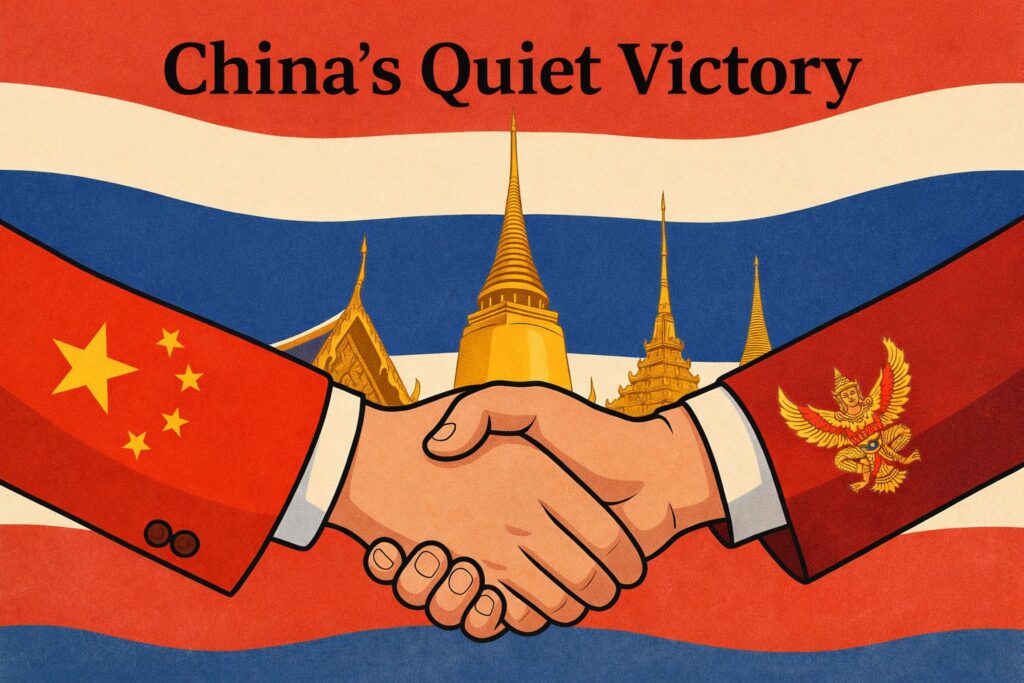
It doesn’t begin with tanks. It begins with a fiber-optic cable. With a battery production facility. With a data center in Thailand’s heartland, owned by Chinese interests. While the West talks about “values,” China invests—systematically, irreversibly.
Thailand, long a neutral buffer between competing great powers, is tilting. Not loudly. Not on command. But through infrastructure, through economic logic, through cultural proximity. The country that once served as a bulwark against communism is becoming China’s gateway for trade, logistics, infrastructure, and IT security.
And the West? It’s present—but always a few years too late. Too moralizing. Too slow. Too distant. The United States may still fly joint exercises with Thailand, but China’s influence already runs through the ground, the power grid, the smartphone, the corporate office.
Thailand represents the microcosm of a global shift: a tectonic revolution in Southeast Asia’s center. Anyone seeking to understand why the West has lost influence in the region need only look here.
This is the story of a silent victory. Not a triumph with anthems, but a result built on structure. And Thailand stands—consciously or not—firmly on the side setting the tempo.
Thailand Between the Fronts
Thailand today stands at the center of a geopolitical tension field between two superpowers—the United States and China. Its historical proximity to Washington—military, symbolic, and ideological—is increasingly challenged by Beijing’s economic weight, investments, and strategic patience.
Historical U.S. Ties: Cold War, Monarchy, Military
Since the Cold War, Thailand has been one of America’s closest allies in Southeast Asia. The alliance was cemented particularly through the anti-communist stance of Thailand’s military and the deep personal connections between the late King Rama IX and the American elite. The U.S. maintained air force bases in the country, notably U-Tapao, trained Thai military personnel, and used Thailand as a logistics hub during the Vietnam War.
This proximity had not only security policy implications but cultural ones: many Thai officers were educated in the United States, economic policy discourse oriented westward, and the monarchy long served as a pro-Western stability anchor in a turbulent region.
China’s Advance: Economy, Infrastructure, Soft Power
In parallel, Thailand has bound itself economically ever closer to China over the past two decades. The People’s Republic is today Thailand’s most important trading partner and a central investor in infrastructure projects like the high-speed rail network or the Eastern Economic Corridor (EEC). The agricultural sector (rubber, cassava, fruits) also profits from the Chinese market. Added to this are soft-power initiatives like cultural institutes, language programs, and academic cooperation.
China’s strategy: not loud, not demanding, but permanently present. While the U.S. relies on symbolic exercises and military presence, China has won the trust of Thailand’s elite through economic incentives and ideological pragmatism.
Current Course: Strategic Ambiguity and Balancing
Thailand’s political leadership—whether military junta or civilian government—has pursued a policy of strategic ambiguity for years. It maintains the old alliance with the U.S., including exercises like Cobra Gold and joint security forums, while simultaneously opening itself to Beijing’s projects such as Belt and Road, investments in smart cities, e-mobility, and semiconductors.
Both sides are served—but with a clear trend: the more economics- and future-oriented a project, the stronger China’s involvement.
Internal Tensions: Who Pulls at Thailand?
Yet this balance is more fragile than it appears. Within Thailand’s power structure, forces exist that prefer stronger U.S. orientation:
The military—particularly higher ranks in the Air Force and Navy—maintains close institutional ties to Washington. Joint training programs, American-origin weapons systems, and personal networks ensure structural Western orientation in parts of the armed forces. According to the Congressional Research Service, hundreds of Thai officers annually participate in U.S. programs.
Parts of the urban middle class and civil society view China’s authoritarian model skeptically. Especially after the 2020-21 protests, when young Thais demanded democratic reforms, reservations exist about too close an alignment with Beijing.
Regional tensions could also push Thailand toward the U.S.: Vietnam, traditionally mistrustful of Chinese dominance, is expanding its security policy cooperation with Washington. Should China act more aggressively in the South China Sea, Thailand could be forced to lean more strongly toward ASEAN partners and indirectly toward Western positions.
But these countervailing forces have one problem: they offer no economic alternative. The U.S. barely invests anymore in Thai infrastructure, and American companies relocate production more to Vietnam or India. China, by contrast, is present—with capital, technology, and market access.
Economic Dependence and Strategic Integration with China
Thailand’s economic reality speaks clearly: while the U.S. remains present as a symbolic partner, China has long become the kingdom’s central economic engine. This integration ranges from classic exports to high-tech investments and has shifted the balance of power—not abruptly, but gradually and sustainably.
Foreign Trade Balance: China in First Place—By Far
China has been Thailand’s most important trading partner for years. According to China Briefing, bilateral trade volume already exceeded $100 billion in 2021—with Thai GDP around $500 billion, this represents roughly 20 percent of total economic output. By comparison: trade with the U.S. stands at about $50 billion.
Raw materials like natural rubber, cassava, palm oil, and tropical fruits depend particularly on Chinese demand. Simultaneously, Thailand imports electronics, machinery, and intermediate products for its own industry from China.
An abrupt severance of these supply chains—for instance through geopolitical sanctions—would shake wide swaths of the Thai economy.
Direct Investment: Chinese Capital as Growth Engine
While Japan long held the position of most important foreign investor, China has massively caught up. Within the framework of the Belt and Road Initiative (BRI), billions flowed into infrastructure projects like high-speed rail lines connecting Bangkok to Nong Khai, industrial parks, and digital logistics corridors. Numerous Chinese companies are represented in the Eastern Economic Corridor (EEC)—particularly in automotive, electronics, aerospace technology, and digital platforms.
These investments bind Thailand not only financially but strategically: whoever builds roads, ports, and data centers creates facts on the ground.
Agriculture and Raw Materials: Dependence on the Chinese Market
Thailand’s agriculture—despite declining importance in GDP—remains heavily export-oriented. The most important market for many agricultural products is China. Particularly cassava, sugar, rice, and rubber depend on Chinese demand and pricing. For cassava alone, over 60 percent of exports go to China—a one-sided dependency with considerable leverage potential.
Tourism and Soft Power: The Invisible Lever
Another of China’s levers: tourism. Until the pandemic, China provided by far the largest tourist group in Thailand. In 2023, several million Chinese visitors again came to the country, many through state-directed travel agencies. The effect: the government in Bangkok is cautious not to risk Beijing’s displeasure. Even small diplomatic frictions—for instance on Taiwan questions—can lead to visitor declines with measurable consequences for the local economy.
Digital Dependence and Future Industries
In digitalization, e-mobility, and AI, China is establishing itself as partner of choice. Investments in 5G networks, battery technology, smart city infrastructure, and digital payment services (Alipay, WeChat Pay) make Chinese corporations systemically relevant actors—particularly for Thailand’s economic modernization agenda.
The trend is clear: the more future-oriented a sector, the greater China’s presence.
Symbolic Western Ties—Monarchy, Military, and the Illusion of Alliance
On paper, Thailand remains a “Major Non-NATO Ally” of the United States to this day—a formal security category connecting countries like Australia, Israel, or Japan with Washington. And the Thai military still maintains close institutional contacts with the U.S. military: exchange programs, exercises, technical assistance. But how deep does this bond still run? And how resilient is it in an emergency?
The Legacy of Rama IX: America-Friendliness as State Tradition
King Bhumibol Adulyadej (Rama IX), who reigned from 1946 to 2016, was not only Thailand’s central moral authority but also a symbol of Western orientation. He was born in the U.S., educated in Europe, and throughout his life was considered a stabilizing factor in the alliance with Washington. During the Cold War, he indirectly legitimized American military presence in the country—serving as a bridge between the Thai people, the military, and the Western order.
Rama IX was—symbolically too—part of the Western bloc, without formally binding his country.
Rama X: Nationalist Domestic Politics Instead of Transatlantic Orientation
With the accession of Maha Vajiralongkorn (Rama X), the symbolic orientation shifts. The new king operates less internationally, shows no visible proximity to Western partners, and concentrates on expanding monarchical power domestically: control over military units, asset management, new royal decrees.
The U.S. no longer figures in this worldview. Rama X has made no notable foreign policy statements favoring the U.S.—and China is deliberately not provoked. The king maintains foreign policy restraint, which allows the military maximum flexibility. Washington does not benefit.
Military Cooperation with the U.S.: Formally Active, Factually Hollowed Out
The U.S. Army still maintains a permanent presence in Thailand through the Joint U.S. Military Advisory Group Thailand (JUSMAGTHAI). It coordinates exercises, training, and armament matters. The annual major exercise Cobra Gold—one of the region’s largest—still takes place with U.S. participation.
But this cooperation is more ritualistic than strategic. The U.S. barely invests anymore in new infrastructure, relies on old networks, and attempts to maintain influence through symbolic politics. The Thai military accepts this cooperation, but it is long networked with China too—through joint exercises, weapons purchases including Chinese submarines and tanks, and quiet coordination.
Thailand plays both sides—and the U.S. no longer delivers real reciprocal benefits.
Function Without Commitment: Why the Alliance Is Brittle
What looks from outside like a stable axis—monarchy, military, U.S.—is upon closer inspection a façade without substantive depth. The shared history remains, but it’s no longer politically charged. The U.S. is an option on paper—but no longer a shaping partner. Thailand takes what’s useful—and stays silent about everything else.
The Sino-Thai Elite—Power Center in Beijing’s Shadow
In no other Southeast Asian country is the economic and political influence of the Sino-descended upper class as deeply rooted as in Thailand. These elites have formed the backbone of Thailand’s economy for decades—discreetly, strategically, often inconspicuously. But in geopolitical perspective, their existence is a decisive factor: they are the silent guarantor that Thailand can never be openly positioned against China.
Historical Background: Migration, Assimilation, Rise
The roots of the Sino-Thai population reach back to the 18th and 19th centuries. Chinese traders, workers, and families settled in growing numbers in central Thailand, especially during the Qing period. Unlike in Malaysia or Indonesia, they were not systematically excluded in Thailand but politically integrated and economically promoted—first by the monarchy, later by the military.
Through marriage strategies, skilled entrepreneurship, and educational focus, a new upper class developed that became trend-setting in both trade and industry—with Chinese networks in the background.
Today: Control Over Commerce, Banks, Media, Consumer Goods
Estimates suggest Sino-Thai families today control a large share of leading banks including Bangkok Bank and Kasikorn, nearly all retail trade through conglomerates like CP Group, Big C, and Lotus’s, large portions of food and consumer goods industries, and significant media companies and real estate holdings. Their companies are not only economically dominant but politically well-connected—with government, military, and monarchy. Many families sit on advisory boards, finance election campaigns, or provide politicians themselves.
The Silent Bridge to China
This elite doesn’t see itself as “Beijing’s extended arm.” But it is culturally, economically, and familially connected to China in ways that shape Thailand’s strategic orientation. Many maintain business partners in Shenzhen, Shanghai, and Guangzhou, send their children to elite universities in China or Taiwan, and invest in both directions while profiting from China’s rise. They’re not ideological bridge-builders—but pragmatic allies. When China grows economically, they grow with it. And if Thailand were forced to take a position, precisely these groups would exert massive pressure on the government to remain neutral or quietly align with China.
Is There a Pro-American Counter-Elite?
Yes, but it’s significantly weaker. Some Thai corporations—particularly in energy or defense industries—maintain close relationships with American partners. Parts of the financial sector are also traditionally more Western-oriented. But these groups are fragmented and lack comparable economic clout to the Sino-Thai elite.
Moreover: even these “Western-oriented” companies operate pragmatically. In a conflict scenario, they wouldn’t work against China on principle but do what appears economically most sensible—and that currently speaks more for Beijing.
Political Influence: The Elites as Buffer Against Escalation
Many of Thailand’s prime ministers have either had Chinese roots themselves or were backed by Sino-Thai groups. Thaksin Shinawatra is only the most prominent example—Srettha Thavisin, who served as premier until recently, also comes from an influential family network with Chinese ancestry.
This power structure creates a stable, economy-oriented foundation that factually blocks any ideological course change toward confrontation with China.
When the Balance Tips—The Crisis Scenario Between China and the U.S.
In peacetime, strategic neutrality is easy. But what happens when this balance becomes a burden? When conflict between China and the U.S. escalates—whether in the South China Sea, over Taiwan, or along critical supply chains?
The central question: Should an international conflict erupt and Thailand must clearly decide—which way would the country tip?
The Pressure Points
In an actual crisis, both sides would deploy their full arsenals of influence. The United States would work through diplomatic channels, military attachés, trade agreements, and intelligence contacts, invoking the historical alliance, potentially demanding access to military bases, or threatening withdrawal of security guarantees that have underpinned Thai defense planning for decades. China, by contrast, would rely on economic leverage and the Sino-Thai elite network, exercising pressure quietly but decisively—a halt to tourism flows, suspension of infrastructure investments, or restrictions on agricultural imports would each suffice to send unmistakable signals to Bangkok without Beijing needing to issue public threats.
Internal Tensions
The most likely dynamic would see Thailand’s power centers pulling in opposite directions. The military and conservative elites, more U.S.-friendly by tradition and training, would hesitate to openly oppose Washington simply because of deep historical ties and still-existing training and logistics cooperation built over decades. Meanwhile, economic actors, technocrats, and Sino-Thai clans with clear China orientation would exert massive pressure to remain neutral or quietly align with Beijing, recognizing that economic dependence on China has grown too large to risk disruption.
Thailand’s Probable Response
In a crisis, Thailand would likely not openly oppose Washington, but also not be willing to risk Chinese countermeasures for American interests. The result would be a neutral, non-aligned stance with a quiet tendency toward Beijing.
In other words: Thailand would act not from loyalty but from realpolitik calculation. Economic survival pressure and the long-term shift of power relations in Asia point toward quiet alignment with China, even in crisis.
The detailed analysis of possible conflict scenarios—Taiwan invasion, Malacca Strait blockade, AUKUS as accelerant—will be the subject of this series’ third part.
Strategic Future—Participation and Model Case of a New Multipolar Order
Thailand stands exemplary for many emerging countries’ dilemma: amid a tectonic shift in global power axes, it attempts not to be crushed—but to actively shape. The question is no longer: “Whom does one join?” but rather: “How does one assert oneself in between?”
Thailand as Bridge State
In many respects, Thailand is predestined to be a model case for the 21st century. Unlike much of Southeast Asia, it’s not a former colonial state and thus free from post-imperial complexes that complicate relations with Western powers. It possesses functioning institutions, a growing middle class, and robust education levels that provide the foundation for sophisticated diplomatic maneuvering. And it has proven over decades that it can convert geopolitical weight into economic influence without ideological partisanship, maintaining pragmatic relationships across the spectrum of global powers.
This bridge function will gain value in the multipolar order. Neither American hegemonic claims nor Chinese influence mechanisms alone will be able to permanently dominate Southeast Asia. It needs mediators—and Thailand wants to be one.
Opportunities Through the New World Order
The departure from the unipolar U.S. era opens strategic spaces for Thailand across multiple dimensions. The BRICS+ initiative, where Thailand is being discussed as a possible partner, could secure access to alternative financial and trade architectures beyond Western-dominated institutions. ASEAN centrality is strengthened through new formats like RCEP (Regional Comprehensive Economic Partnership), with Thailand positioned as logistical and diplomatic hub for the region’s economic integration. Meanwhile, Western decoupling from China leads to rerouting of global supply chains, and Thailand as a “friendshoring” location stands to profit directly from companies seeking alternatives to Chinese manufacturing while maintaining access to Asian markets.
But this also means: the decision to remain neutral increasingly becomes an active design obligation. Those who don’t move along won’t be overlooked—they’ll be bypassed.
From Neutrality to Strategic Ambiguity
Thailand could in future be not only neutral but strategically ambivalent. The pattern would be flexible alignment across different domains: partnering with Huawei today, Microsoft tomorrow; importing Russian oil in one quarter, courting EU investment agreements in the next; conducting military exercises with China’s People’s Liberation Army while maintaining Cobra Gold drills with U.S. forces. This controlled ambiguity would not be a sign of opportunism but expression of realpolitik maturity that many Global South countries now demand: they don’t want to get “caught between fronts” but to co-shape both fronts. Yet this balancing act operates on a knife’s edge—what appears today as strategic flexibility could tomorrow be exposed as paralyzing indecision, particularly if either Washington or Beijing decides that neutrality itself constitutes hostile positioning.
Risks of an Active Role
Yet this role is not without risk. Internal tensions between military, monarchy, civil society, and economic elites could intensify as different factions pull Thailand in opposing directions—the military toward traditional U.S. ties, business elites toward Chinese markets, and civil society toward democratic reforms that neither Beijing nor conservative Bangkok welcomes. External forces could attempt influence through political destabilization or targeted disinformation campaigns designed to exploit these internal divisions. And the balance can only be maintained if the government demonstrates above-average diplomatic capabilities that transcend charismatic individual figures and become embedded in institutional processes.
Conclusion: Thailand—Between Player, Playing Field, and Gamemaker
Thailand stands at a historic crossroads. Once the silent actor in the superpowers’ slipstream, the country now itself becomes a place where shifts in world order become tangible. It’s no longer just between the fronts—it’s part of the new frontlines, the new bridges, and the new spaces where power, influence, and belonging are renegotiated.
The pressure to choose—for China or for the U.S.—is real. But equally real is Thailand’s strategic instinct not to have to choose. Instead of submitting to one side, Thailand refines the game of controlled ambiguity: dialogue with Beijing, exercises with Washington, trade with both—and commitments to neither.
This art of balance is no accident but the result of decades of experience, cultural self-assertion, and political resilience. It reflects a deep historical consciousness: Thailand was never a colony—and it won’t become one in the new century, neither politically nor economically.
But neutrality is no guarantee. In a world where great powers decouple, alliances crumble, and economic blocs harden, the position of mediators becomes more precarious. History offers little comfort: neutrals often find themselves crushed not despite their refusal to choose, but because of it. Sweden’s neutrality collapsed when security imperatives overrode centuries of tradition. Switzerland’s banking secrecy crumbled under coordinated pressure. Thailand’s economic dependencies may prove even less defensible than these historical precedents. Those who claim the middle must remain vigilant, active, and flexible—or become a playing piece rather than a gamemaker.
Precisely therefore Thailand may be more than just a stage for multipolar order: it could be its model case. A country not crushed between poles but using the poles to establish its own orbit. A country making neutrality into a strategic art form. And a country showing that in the new world order, size doesn’t decide—attitude does.
Diese Analyse ist frei zugänglich – aber gute Recherchen kosten Zeit, Geld, Energie und Nerven. Unterstützen Sie mich, damit diese Arbeit weitergehen kann.

Oder unterstützen Sie mich auf Substack – schon ab 5 USD pro Monat.
Gemeinsam bauen wir eine Gegenöffentlichkeit auf.
Michael Hollister is a geopolitical analyst and investigative journalist. He served six years in the German military, including peacekeeping deployments in the Balkans (SFOR, KFOR), followed by 14 years in IT security management. His analysis draws on primary sources to examine European militarization, Western intervention policy, and shifting power dynamics across Asia. A particular focus of his work lies in Southeast Asia, where he investigates strategic dependencies, spheres of influence, and security architectures. Hollister combines operational insider perspective with uncompromising systemic critique—beyond opinion journalism. His work appears on his bilingual website (German/English) www.michael-hollister.com and in investigative outlets across the German-speaking world and the Anglosphere.
© Michael Hollister — Redistribution, publication or reuse of this text is explicitly welcome. The only requirement is proper source attribution and a link to www.michael-hollister.com (or in printed form the note “Source: www.michael-hollister.com”).
Newsletter
🇩🇪 Deutsch: Verstehen Sie geopolitische Zusammenhänge durch Primärquellen, historische Parallelen und dokumentierte Machtstrukturen. Monatlich, zweisprachig (DE/EN).
🇬🇧 English: Understand geopolitical contexts through primary sources, historical patterns, and documented power structures. Monthly, bilingual (DE/EN).